Example: dental hygienist
The Multivariate Gaussian Distribution
Recall that the density function of a univariate normal (or Gaussian) distribution is given by p(x;µ,σ2) = 1 √ 2πσ exp − 1 2σ2 (x−µ)2 . Here, the argument of the exponential function, − 1 2σ2(x−µ) 2, is a quadratic function of the variable x. Furthermore, the parabola points downwards, as the coefficient of the quadratic term ...
Tags:
Information
Domain:
Source:
Link to this page:
Documents from same domain
Part IV Generative Learning algorithms
cs229.stanford.eduCS229Lecturenotes Andrew Ng Part IV Generative Learning algorithms So far, we’ve mainly been talking about learning algorithms that model p(y|x;θ), the conditional distribution of y …
Data Fusion for Predicting Breast Cancer Survival
cs229.stanford.eduData Fusion for Predicting Breast Cancer Survival Linbailu Jiang, Yufei Zhang, Siyi Peng Mentor: Irene Kaplow December 11, 2015 1 Introduction 1.1 Background
Automated Bitcoin Trading via Machine Learning …
cs229.stanford.eduAutomated Bitcoin Trading via Machine Learning Algorithms Isaac Madan Department of Computer Science Stanford University Stanford, CA 94305 imadan@stanford.edu
Prediction of consumer credit risk - Machine learning
cs229.stanford.eduCS229 Prediction of consumer credit risk Marie-Laure Charpignon mcharpig@stanford.edu Enguerrand Horel ehorel@stanford.edu Flora Tixier ftixier@stanford.edu
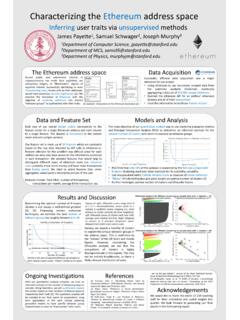
Inferring user traits via unsupervised methods
cs229.stanford.edufeature vector for a single Ethereum address and each column to a single feature. The dataset is normalized to the sample ... "Ethereum: A secure decentralised generalised transaction ledger." Ethereum Project Yellow Paper 151 (2014). [3] Kodinariya, Trupti M., and Prashant R. Makwana. "Review on determining number of Cluster in K-Means
X-Ray Photoelectron Spectroscopy Enhanced by …
cs229.stanford.eduX-Ray photoelectron spectroscopy (XPS) is a technique for identifying individual elements in a mixture/compound. Samples are irradiated by X …
More on Multivariate Gaussians - CS229: Machine …
cs229.stanford.eduMore on Multivariate Gaussians Chuong B. Do November 21, 2008 Up to this point in class, you have seen multivariate Gaussians arise in a number of appli-

Stock Trading with Recurrent Reinforcement …
cs229.stanford.eduStock Trading with Recurrent Reinforcement Learning (RRL) CS229 Application Project Gabriel Molina, SUID 5055783
James Payette,1 Samuel Schwager, and Joseph …
cs229.stanford.eduJames Payette,1 Samuel Schwager,2 and Joseph Murphy3 1Department of Computer Science, Stanford University, Stanford, CA 94305, USA 2Department of Mathematical and Computational Science, Stanford University 3Department of …

Sales Prediction with Time Series Modeling - …
cs229.stanford.eduSales Prediction with Time Series Modeling Gautam Shine, Sanjib Basak I. Introduction Predicting sales-related time series quantities like number of transactions, page views, and revenues is ... P.A. Fishwick, Time series forecasting using neural networks vs Box-Jenkins methodology, Simulation, Vol. 57 (1991) pp. 303-310.
Related documents
Lecture: Probability Distributions
www.ssc.wisc.eduThe distribution function has the same interpretation for discrete and continuous random variables. The CDF is also sometimes called the distribution function (DF). x Requirements for CDFs (1) Fx()≥0 everywhere the distribution is defined (2) Fx() non-decreasing everywhere the distribution is defined. (3) Fx()→1 as x →∞ 1
The Truncated Normal Distribution
people.sc.fsu.eduNote that the standard deviation of any distribution, represented by std(ˆ()), is simply the square root of the variance, so for the standard normal distribution, we also have that std(˚(0;1;)) = 1. 1.3 The Cumulative Distribution Function Recall that any probability density function ˆ(x) can be used to evaluate the probability that a random
Lecture 4: Random Variables and Distributions
www.gs.washington.edu•This implies that until data is collected, any function (statistic) of the observations (mean, sd, etc.) is also a random variable •Thus, any statistic, because it is a random variable, has a probability distribution - referred to as a sampling distribution •Let’s focus on the sampling distribution of the mean,! X

DISCRIMINANT FUNCTION ANALYSIS (DA)
userwww.sfsu.eduNormal distribution: It is assumed that the data (for the variables) represent a sample from a multivariate normal distribution. You can examine whether or not ... discriminant function coefficients will not reliably assess the relative importance of the predictor variables.

Lecture 15: Order Statistics - Duke University
www2.stat.duke.eduBeta Distribution The Beta distribution is a continuous distribution de ned on the range (0;1) where the density is given by f(x) = 1 B(r;s) xr 1(1 x)s 1 where B(r;s) is called the Beta function and it is a normalizing constant which ensures the density integrates to 1. 1 = Z 1 0 f(x)dx 1 = Z 1 0 1 B(r;s) xr 1(1 x)s 1dx 1 = 1 B(r;s) Z 1 0 xr 1 ...

Inverse Gamma Distribution
www.johndcook.comthe inverse gamma distribution prevents having to repeatedly apply the transformation theorem in applications. Here we derive the distribution of the inverse gamma, calculate its moments, and show that it is a conjugate prior for an exponential likelihood function. 1 Parameterizations There are at least a couple common parameterizations of the ...