Transcription of UNISONIC TECHNOLOGIES CO., LTD
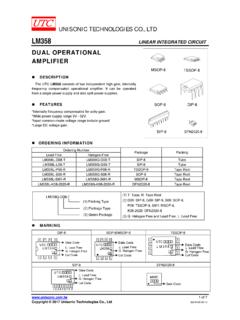
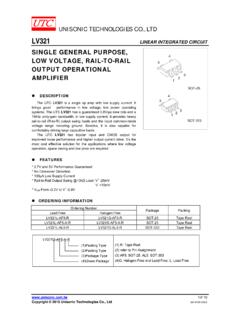
1 UNISONIC TECHNOLOGIES CO., LTD lm386 LINEAR INTEGRATED CIRCUIT 1 of 7 Copyright 2015 UNISONIC TECHNOLOGIES Co., Ltd. LOW voltage AUDIO POWER AMPLIFIER DESCRIPTION The UTC lm386 is a power amplifier, designed for use in low voltage consumer applications. The gain is internally set to 20 to keep external part count low, but the addition of an external resistor and capacitor between pin 1 and pin 8 will increase the gain to any value up from 20 to 200 dB. The inputs are ground referenced while the output automatically biases to one-half the supply voltage . The quiescent power drain is only 24 milliwatts when operating from a 6 volt supply, making the lm386 ideal for battery operation.
2 FEATURES *Battery Operation *Minimum External Parts *Wide Supply voltage Range: 4V~12V *Low Quiescent Current Drain:4mA * voltage Gains: 20~200dB *Ground Referenced Input *Self-Centering Output Quiescent voltage *Low Distortion: (Av=20, VS=6V, RL=8 , PO=125mW, f=1kHz) ORDERING INFORMATION Ordering Number Lead Free Halogen Free Package Packing LM386L-D08-T LM386G-D08-T DIP-8 Tube - LM386G-S08-R SOP-8 Tape Reel - LM386G-P08-R TSSOP-8 Tape
3 Reel MARKING DIP-8 SOP-8 TSSOP-8 UTCLM38623415678 Date CodeL: Lead FreeG: Halogen FreeLot Code lm386 LINEAR INTEGRATED CIRCUIT UNISONIC TECHNOLOGIES CO., LTD 2 of 7 PIN CONFIGURATION BLOCK DIAGRAM 12345678 GAINGAIN-INPUT+ lm386 LINEAR INTEGRATED CIRCUIT UNISONIC TECHNOLOGIES CO.
4 , LTD 3 of 7 ABSOLUTE MAXIMUM RATINGS PARAMETER SYMBOL RATINGS UNIT Supply voltage VCC 15 V Input voltage VIN ~ + V DIP-8 1250 SOP-8 600
5 Power Dissipation TSSOP-8 PD 600 mW Operating Temperature TOPR -25 ~ +85 C Junction Temperature TJ +125 C Storage Temperature TSTG -40 ~ +150 C Note:1. Absolute maximum ratings are stress ratings only and functional device operation is not implied. The device could be damaged beyond Absolute maximum ratings. ELECTRICAL CHARACTERISTICS (TA=25 C, unless otherwise specified.) PARAMETER SYMBOL TEST CONDITIONS MIN TYP MAX UNITO perating Supply voltage VS 4 12V Quiescent Current IQ VS=6V, VIN=0 4 8 mAVS=6V, RL=8 , THD=10% 250 325 Output Power POUT VS=9V, RL=8 , THD=10% 500 700 mWVoltage Gain GV VS=6V.
6 F=1kHz 10 F from pin 1 to pin 8 26 46 dBdBBandwidth BW VS=6V , Pin1 and pin 8 open 300 kHzTotal Harmonic Distortion THD POUT=125mW, VS=6V, f=1kHz RL=8 pin1 and pin 8 open % Rejection Ratio RR VS=6V, f=1kHz, CBYPASS=10 F pin1and pin 8 open, Referred to output 50 dBInput Resistance RIN 50 k Input Bias Current IBIAS VS=6V Pin2 and pin 3 open 250 nA lm386 LINEAR INTEGRATED CIRCUIT UNISONIC TECHNOLOGIES CO., LTD 4 of 7 APPLICATION NOTES GAIN CONTROL To make the lm386 a more versatile amplifier, two pins(1and 8) are provided for gain control.
7 With pins 1 and 8 open the k resistor sets the gain at 20 (26dB), If a capacitor is put from pin 1 to 8, bypassing the k resistor, the gain will go up to 200(46dB). If a resistor is placed in series with the capacitor, the gain can be set to any value from 20 to 200. Gain control can also be done by capacitively coupling a resistor (or FET) from pin 1 to ground. Additional external components can be placed in parallel with the internal feedback resistors to tailor the gain and frequency response for individual applications. For example we can compensate poor speaker bass response by frequency shaping the feedback path.
8 This is done with a series RC from pin 1 to 5 (paralleling the internal 15 k resistor). For 6 dB effective bass boost: R=15 k , the lowest value for good stable operation is R=10 k , if pin 8 is open, If pins 1 and 8 are bypassed then R as low as 2 k can be used. This restriction is because the amplifier is only compensated for closed-loop gains greater than 9. INPUT BIASING The schematic shows that both inputs are biased to ground with a 50 k resistor. The base current of the input transistors is about 250nA, so the inputs are at about when left open. If the dc source resistance driving the lm386 is higher than 250 k it will contribute very little additional offset (about at the input, 50mW at the output).
9 If the dc source resistance is less than 10 k , then shorting the unused input to ground will keep the offset low (about at the input, 50 mV at the output). For dc source resistances between these values we can eliminate excess offset by putting a resistor from the unused input to ground, equal in value to the dc source resistance. Of course all offset problems are eliminated if the input is capacitively coupled. When using the lm386 with higher gains (bypassing the k resistor between pins 1 and 8) it is necessary to bypass the unused input, preventing degradation of gain and possible instabilities. This is done with a F capacitor or a short to ground depending on the dc source resistance on the driven input.
10 lm386 LINEAR INTEGRATED CIRCUIT UNISONIC TECHNOLOGIES CO., LTD 5 of 7 TYPICAL APPLICATIONS CIRCUIT +-VsFROM DETECTOR1234567810K 250 F+ FAM Radio Power Amplifier +10 F10 F+CcVOL10K F+8 SPEAKERFERRITEBEAD47 Notes: 1: Twist Supply lead and supply ground very tightly. 2: Twist speaker lead and ground very tightly. 3: Ferrite bead in Ferroxcube K5-001-001/3B with 3 turns of wire. 4: R1C1 band limits input signals. 5: All components must be spaced very closely to IC. 47LM386 LINEAR INTEGRATED CIRCUIT UNISONIC TECHNOLOGIES CO.