Transcription of What Is Permanent and Total Disability?
1 Cat. No. 12059 RInstructions forSchedule 3 (Form 1040A)Credit for the Elderly or the Disabled for Form 1040A FilersDepartment of the TreasuryInternal Revenue Service2001 Purpose of ScheduleUse Schedule 3 to figure the credit for the elderly or InformationSee Pub. 524 for more details about the Can Take the CreditThe credit is based on your filing status, age, and income. Ifyou are married filing a joint return, it is also based on yourspouse s age and income. You may be able to take thiscredit if either of the following applies. You were age 65 or older at the end of 2001 or You were under age 65 at the end of 2001 and you meetall three of the You were permanently and totally disabled on thedate you retired. If you retired before 1977, you must havebeen permanently and totally disabled on January 1, 1976, orJanuary 1, You received taxable disability income for On January 1, 2001, you had not reached mandatoryretirement age (the age when your employer s retirementprogram would have required you to retire).
2 For the definition of Permanent and Total disability , seeWhat Is Permanent and Total disability ? on page , see the instructions for Part Persons Filing Separate ReturnsIf your filing status is married filing separately and youlived with your spouse at any time during 2001, you cannottake the LimitsSee the chart the IRS To Figure Your Credit?If you can take the credit and you want us to figure it foryou, check the box in Part I of Schedule 3 for your filingstatus and age. Fill in Part II and lines 11 and 13 of Part IIIif they apply to you. Then, enter CFE next to line 28 onForm 1040A and attach Schedule 3 to your Limits for the Credit for the Elderly or the DisabledIF you are ..Single, head of household, orqualifying widow(er)Married filing a joint return andonly one spouse is eligible for thecreditMarried filing a joint return andboth spouses are eligible for thecreditMarried filing a separate return andyou lived apart from your spousefor all of 2001 The amount onForm 1040A, line 20, is.
3 $17,500 or more$20,000 or more$25,000 or more$12,500 or moreTHEN you generally cannot take the credit if:Or you received ..$5,000 or more of nontaxable socialsecurity or other nontaxable pensions$5,000 or more of nontaxable socialsecurity or other nontaxable pensions$7,500 or more of nontaxable socialsecurity or other nontaxable pensions$3,750 or more of nontaxable socialsecurity or other nontaxable pensionsPage 2 What Is Permanent and Total Disability? A person is permanently and totally disabled if both 1and 2 below He or she cannot engage in any substantial gainfulactivity because of a physical or mental condition and2. A physician determines that the condition has lasted orcan be expected to last continuously for at least a year orcan lead to 1 and 2 below show situations in which theindividuals are considered engaged in a substantial gainfulactivity.
4 Example 3 shows a person who might not beconsidered engaged in a substantial gainful activity. In eachexample, the person was under age 65 at the end of the 1. Sue retired on disability as a sales clerk. Shenow works as a full-time babysitter at the minimum she does different work, Sue babysits on ordinaryterms for the minimum wage. She cannot take the creditbecause she is engaged in a substantial gainful 2. Mary, the president of XYZ Corporation, retiredon disability because of her terminal illness. On her doctor sadvice, she works part time as a manager and is paid morethan the minimum wage. Her employer sets her days andhours. Although Mary s illness is terminal and she workspart time, the work is done at her employer s is considered engaged in a substantial gainful activityand cannot take the 3.
5 John, who retired on disability , took a job witha former employer on a trial basis. The purpose of the jobwas to see if John could do the work. The trial period lastedfor some time during which John was paid at a rate equal tothe minimum wage. But because of John s disability , he wasgiven only light duties of a nonproductive, make-worknature. Unless the activity is both substantial and gainful,John is not engaged in a substantial gainful activity. Theactivity was gainful because John was paid at a rate at orabove the minimum wage. However, the activity was notsubstantial because the duties were of a nonproductive,make-work nature. More facts are needed to determine ifJohn is able to engage in a substantial gainful IncomeGenerally, disability income is the Total amount you werepaid under your employer s accident and health plan orpension plan that is included in your income as wages orpayments instead of wages for the time you were absentfrom work because of Permanent and Total , any payment you received from a plan that doesnot provide for disability retirement is not disability figuring the credit, disability income does not includeany amount you received from your employer s pension planafter you have reached mandatory retirement more details on disability income, see Pub.
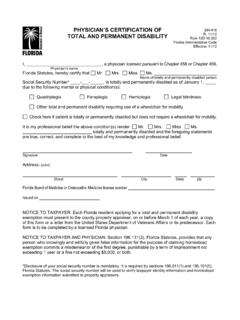
6 IIStatement of Permanent and TotalDisabilityIf you checked box 2, 4, 5, 6, or 9 in Part I and you did notfile a physician s statement for 1983 or an earlier year, oryou filed or got a statement for tax years after 1983 andyour physician signed on line A of the statement, you musthave your physician complete a statement certifying that: You were permanently and totally disabled on the dateyou retired or If you retired before 1977, you were permanently andtotally disabled on January 1, 1976, or January 1, do not have to file this statement with your Form1040A. But you must keep it for your records. You mayuse the physician s statement on page 4 for this physician should show on the statement if thedisability has lasted or can be expected to last continuouslyfor at least a year, or if there is no reasonable probabilitythat the disabled condition will ever improve.
7 If you file ajoint return and you checked box 5 in Part I, you and yourspouse must each get a you filed a physician s statement for 1983 or an earlieryear, or you filed or got a statement for tax years after 1983and your physician signed on line B of the statement, youdo not have to get another statement for 2001. But you mustcheck the box on line 2 in Part II to certify all three of thefollowing:1. You filed or got a physician s statement in an You were permanently and totally disabled You were unable to engage in any substantial gainfulactivity during 2001 because of your physical or you checked box 4, 5, or 6 in Part I, enter in the spaceabove the box on line 2 in Part II the first name(s) of thespouse(s) for whom the box is the Department of Veterans Affairs (VA) certifies thatyou are permanently and totally disabled, you can use VAForm 21-0172 instead of the physician s statement.
8 VAForm 21-0172 must be signed by a person authorized by theVA to do so. You can get this form from your local VAregional 3 Part IIIF igure Your CreditLine 11If you checked box 2, 4, 5, 6, or 9 in Part I, use thefollowing chart to complete line you checked ..The Total of $5,000 plus thedisability income you reported onForm 1040A for the spouse whowas under age Total amount of disabilityincome you reported on Total amount of disabilityincome you reported on Form1040A for both you and 6 Box 2, 4, or 9 Box 5 THEN enter on line 11 ..Example 1. Bill, age 63, retired on Permanent and totaldisability in 2001. He received $4,000 of taxable disabilityincome that he reported on Form 1040A, line 7. He filed ajoint return with his wife who was age 67 in 2001.
9 On line11, Bill enters $9,000 ($5,000 plus the $4,000 of disabilityincome he reported on Form 1040A).Example 2. John checked box 2 in Part I and enters $5,000on line 10. He received $3,000 of taxable disability income,which he enters on line 11. John also enters $3,000 on line12 (the smaller of line 10 or line 11). The largest amount hecan use to figure the credit is $3, 13a Through 18 The amount on which you figure your credit may be reducedif you received certain types of nontaxable pensions andannuities. The amount may also be reduced if your adjustedgross income is over a certain amount, depending on whichbox you checked in Part 13a. Enter any social security benefits (beforededuction of Medicare premiums) you (and your spouse iffiling a joint return) received for 2001 that are not , enter any tier 1 railroad retirement benefits treated associal security that are not any of your social security or equivalent railroadretirement benefits are taxable, the amount to enter on thisline is generally the difference between the amounts enteredon Form 1040A, line 14a and line If your social security or equivalent railroad retirementbenefits are reduced because of workers compensationbenefits, treat the workers compensation benefits as socialsecurity benefits when completing Schedule 3, line 13b.
10 Enter the Total of the following types of incomethat you (and your spouse if filing a joint return) receivedfor 2001. Veterans pensions (but not military disability pensions). Any other pension, annuity, or disability benefit that isexcluded from income under any provision of Federal lawother than the Internal Revenue Code. Do not includeamounts that are treated as a return of your cost of a pensionor not include on line 13b any pension, annuity, orsimilar allowance for personal injuries or sickness resultingfrom active service in the armed forces of any country, or inthe National Oceanic and Atmospheric Administration or thePublic Health Service. Also, do not include a disabilityannuity payable under section 808 of the Foreign ServiceAct of 20 Use the worksheet below to figure the credit you may take ifeither 1 or 2 below The amount on line 20 is more than the amount onForm 1040A, line 26, or2.