Transcription of William Stallings Computer Organization Dr. …
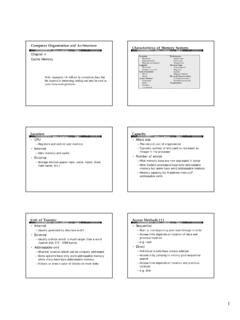
1 + William Stallings Computer Organization and Architecture10thEdition 2016 Pearson Education, Inc., Hoboken, NJ. All rights byDr. George Lazik+ Chapter 4 Cache Memory 2016 Pearson Education, Inc., Hoboken, NJ. All rights Key Characteristics of Computer Memory SystemsLocation Internal ( processor registers, cache, main memory) External ( optical disks, magnetic disks, tapes) Capacity Number of words Number of bytes Unit of Transfer Word Block Access Method Sequential Direct Random Associative Performance Access time Cycle time Transfer rate Physical Type Semiconductor Magnetic Optical Magneto-optical Physical Characteristics Volatile/nonvolatile Erasable/nonerasable Organization Memory modules 2016 Pearson Education, Inc.
2 , Hoboken, NJ. All rights reserved.+Characteristics of Memory Systems Location Refers to whether memory is internal and external to the Computer Internal memory is often equated with main memory Processor requires its own local memory, in the form of registers Cache is another form of internal memory External memory consists of peripheral storage devices that are accessible to the processor via I/O controllers Capacity Memory is typically expressed in terms of bytes Unit of transfer For internal memory the unit of transfer is equal to the number of electrical lines into and out of the memory module 2016 Pearson Education, Inc.
3 , Hoboken, NJ. All rights of Accessing Units of DataSequential accessMemory is organized into units of data called recordsAccess must be made in a specific linear sequenceAccess time is variableDirect accessInvolves a shared read-write mechanismIndividual blocks or records have a unique address based on physical locationAccess time is variableRandom accessEach addressable location in memory has a unique, physically wired-in addressing mechanismThe time to access a given location is independent of the sequence of prior accesses and is constantAny location can be selected at random and directly addressed and accessedMain memory and some cache systems are random accessAssociativeA word is retrieved based on a portion of its contents rather than its addressEach location has its own addressing mechanism and retrieval time is constant independent of location or prior access patternsCache memories may employ associative access 2016
4 Pearson Education, Inc., Hoboken, NJ. All rights and Performance:The two most important characteristics of memoryThree performance parameters are used:Three performance parameters are used:Access time (latency) For random-access memory it is the time it takes to perform a read or write operation For non-random-access memory it is the time it takes to position the read-write mechanism at the desired locationMemory cycle time Access time plus any additional time required before second access can commence Additional time may be required for transients to die out on signal lines or to regenerate data if they are read destructively Concerned with the system bus.
5 Not the processorTransfer rate The rate at which data can be transferred into or out of a memory unit For random-access memory it is equal to 1/(cycle time) 2016 Pearson Education, Inc., Hoboken, NJ. All rights reserved.+Memory The most common forms are: Semiconductor memory Magnetic surface memory Optical Magneto-optical Several physical characteristics of data storage are important: Volatile memory Information decays naturally or is lost when electrical power is switched off Nonvolatile memory Once recorded, information remains without deterioration until deliberately changed No electrical power is needed to retain information Magnetic-surface memories Are nonvolatile Semiconductor memory May be either volatile or nonvolatile Nonerasable memory Cannot be altered, except by destroying the storage unit Semiconductor memory of this type is known as read-only memory (ROM)
6 For random-access memory the Organization is a key design issue Organization refers to the physical arrangement of bits to form words 2016 Pearson Education, Inc., Hoboken, NJ. All rights reserved.+Memory Hierarchy Design constraints on a Computer s memory can be summed up by three questions: How much, how fast, how expensive There is a trade-off among capacity, access time, and cost Faster access time, greater cost per bit Greater capacity, smaller cost per bit Greater capacity, slower access time The way out of the memory dilemma is not to rely on a single memory component or technology, but to employ a memory hierarchy 2016 Pearson Education, Inc.
7 , Hoboken, NJ. All rights The Memory HierarchyInboardmemoryOutboardstorageOff -linestorageMainmemoryMagnetic diskCD-ROMCD-RWDVD-RWDVD-RAMBlu-RayMagne tic tapeCacheReg-isters 2016 Pearson Education, Inc., Hoboken, NJ. All rights + T2T21 Fraction of accesses involving only Level 1 (Hit ratio)Average access timeFigure Performance of a Simple Two-Level Memory 2016 Pearson Education, Inc., Hoboken, NJ. All rights reserved.+Memory The use of three levels exploits the fact that semiconductor memory comes in a variety of types which differ in speed and cost Data are stored more permanently on external mass storage devices External.
8 Nonvolatile memory is also referred to as secondary memory or auxiliary memory Disk cache A portion of main memory can be used as a buffer to hold data temporarily that is to be read out to disk A few large transfers of data can be used instead of many small transfers of data Data can be retrieved rapidly from the software cache rather than slowly from the disk 2016 Pearson Education, Inc., Hoboken, NJ. All rights TransferFastFastestFastLessfastSlowSlowB lock TransferCacheMain MemoryFigure Cache and Main Memory(a) Single cache(b) Three-level cache organizationCPUL evel 1(L1) cacheLevel 2(L2) cacheLevel 3(L3) cacheMainMemory 2016 Pearson Education, Inc.
9 , Hoboken, NJ. All rights 132n 1 WordLengthBlock Length(K Words)Block 0(K words)Block M 1 LineNumberTagBlock(b) Main memory(a) CacheFigure Cache/Main-Memory Structure 2016 Pearson Education, Inc., Hoboken, NJ. All rights addressRA from CPUIs blockcontaining RAin cache?Fetch RA wordand deliverto CPUDONEA ccess mainmemory for blockcontaining RAAllocate cacheline for mainmemory blockDeliver RA wordto CPULoad mainmemory blockinto cache lineFigure Cache Read OperationSTARTNoYes 2016 Pearson Education, Inc., Hoboken, NJ.
10 All rights Typical Cache OrganizationControlSystem Bus 2016 Pearson Education, Inc., Hoboken, NJ. All rights Elements of Cache Design Cache Addresses Logical Physical Cache Size Mapping Function Direct Associative Set Associative Replacement Algorithm Least recently used (LRU) First in first out (FIFO) Least frequently used (LFU) Random Write Policy Write through Write back Line Size Number of caches Single or two level Unified or split 2016 Pearson Education, Inc., Hoboken, NJ.