Transcription of Your TSP Account
1 your TSP AccountA Guide for Beneficiary ParticipantsiTable of ContentsThriftLine Service Center .. iiThe Thrift Savings Plan .. 1 TSP Benefits .. 1 Investing in the TSP .. 2 The Individual Funds .. 2 The L Funds .. 3 Fund Risks .. 4 Choosing your Own investment Mix .. 5 Comparison of the TSP Funds .. 6 The Mutual Fund Window .. 7 Reallocations and Fund Transfers .. 7 Administrative Expenses for TSP Funds .. 7 Taking Money Out of your Account .. 8 Distribution Options .. 8 Taxes on Distributions .. 9 IRS Required Minimum Distributions (RMDs).
2 9 Death Benefits .. 10 Inter-plan Rollovers .. 11 Other Information about the TSP .. 12 TSP Website (tsp .gov) ..12 Court Orders and Legal Processes ..12 TSP Administration ..12 Glossary of Terms .. 13iiThriftLine Service CenterPhone: 1-877-968-3778 (United States, toll-free) +1-404-233-4400 (Outside the United States, not toll-free) 7 a .m . 9 p .m . eastern time, Monday through FridayFax: 1-276-926-8948 Mail: ThriftLine Service Center C/O Broadridge Processing PO Box 1600 Newark, NJ 07101-16001 The Thrift Savings Plan The Thrift Savings Plan (TSP) is a retirement savings plan similar to 401(k) plans offered to private sector employees.
3 This booklet provides you with an overview of TSP features and rules that apply to beneficiary participant accounts . When a TSP participant dies, the TSP Account is distributed according to the participant s designation of beneficiaries on file with the TSP . If there is no designation of beneficiaries on file for a TSP Account , then distribution follows the statutory order of precedence (see page 10) .If you are a spouse beneficiary of a deceased civilian or uniformed services TSP participant s Account , and your share of the balance in the TSP Account is $200 or more, we will establish a beneficiary participant Account in your name.
4 (Although non-spouse beneficiaries also have accounts set up for them, those accounts are temporary . The information in this booklet applies only to spouse beneficiaries .)Note: If your share of the balance in the TSP participant s Account is less than $200, your share will be paid directly to you . You will not be able to remain in the TSP .At the time your Account is established, we will send you a confirmation notice that confirms the Account balance and explains how to access the Account . This notice tells you how your Account is initially invested and what you can expect from the TSP.
5 Be sure to read it carefully and let us know immediately if any of your personal information is incorrect . TSP BenefitsAs the owner of a TSP beneficiary participant Account , you ll enjoy many benefits including the following: a diversified choice of investment options, including individual funds; professionally designed lifecycle funds, which mix the individual funds with an eye toward specific target dates; and an option for investing in mutual funds tax-deferred earnings on traditional money tax-free earnings on Roth money if qualified (see Qualified Earnings in the glossary on page 14) low administrative and investment expenses the ability to roll your beneficiary participant Account over to an existing civilian or uniformed services TSP Account if you have one a variety of distribution optionsYou will not be able to make contributions to, borrow from, or roll money over to your beneficiary participant Account .
6 2 Investing in the TSPWhen your beneficiary participant Account is first established, the money in it will be invested just as it was in your spouse s Account except for any money he or she had invested in the mutual fund window . Money from the mutual fund window will be reinvested in TSP funds according to your spouse s investment election on file . (See Mutual Fund Window below and on page 7 .) You can change how the money is invested by making a reallocation or fund transfer (see page 7) .We offer you three approaches to investing your money: Individual Funds You make your own decisions about your investment mix by choosing from any or all of the individual TSP investment funds (G, F, C, S, and I Funds).
7 The L Funds Each of the ten Lifecycle Funds (L Funds) is a diversified mix of the five individual funds . They were designed by investment professionals to let you invest your entire portfolio in a single L Fund and get the best expected return for the amount of expected risk that is appropriate for you . Mutual Fund Window If you meet certain conditions and pay the necessary fees, you can invest in mutual funds available in our mutual fund window . Once you ve made the election to invest in the mutual fund window, you independently select which mutual funds you want to invest in with that money.
8 You cannot take distributions directly from money invested in the mutual fund window . You must first transfer it to a TSP fund . No more than 25% of your total Account balance may be invested in the mutual fund window, and your initial investment in it must be at least $10,000 .These investment options are designed so you can choose either the L Fund that is appropriate for you, or a combination of the TSP funds and mutual funds that will support your personal investment strategy . You may invest in any fund or combination of funds . Because the L Funds are already made up of the five individual funds, you will duplicate your investments if you invest simultaneously in an L Fund and individual TSP funds.
9 The Individual Funds The TSP has five individual investment funds:The Government Securities investment Fund (G Fund) The G Fund is invested in short-term U .S . Treasury securities . It gives you the opportunity to earn rates of interest similar to those of long-term government securities with no risk of loss of principal . Payment of principal and interest is guaranteed by the U .S . government . The interest rate paid by the G Fund securities is calculated monthly, based on the market yields of all U .S . Treasury securities with more than 4 years to maturity; the interest rate changes monthly.
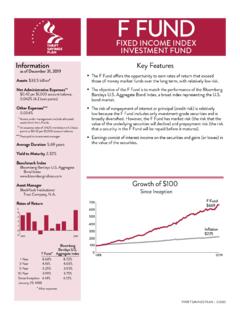
10 The Fixed Income Index investment Fund (F Fund) The F Fund tracks the Bloomberg U .S . Aggregate Bond Index . This is a broad index representing the U .S . government, mortgage-backed, corporate, and foreign government (issued in the U .S .) sectors of the U .S . bond market . This fund offers you the opportunity to earn rates of return that exceed money market fund rates over the long term (particularly during periods of declining interest rates) .3 The Common Stock Index investment Fund (C Fund) The C Fund tracks the Standard & Poor s 500 (S&P 500) Stock Index.