
Dynamic Light Scattering Training
Dynamic Light Scattering and Brownian Motion › Dynamic light scattering is a non-invasive technique for measuring the size of particles and molecules in suspension › Brownian motion is the random movement of particles due to collisions caused by bombardment by the solvent molecules that surround them
Download Dynamic Light Scattering Training

Information
Domain:
Source:
Link to this page:
Documents from same domain
Standard practices for Fmoc-based solid-phase …
www.chem.uci.eduStandard practices for Fmoc-based solid-phase peptide synthesis in the Nowick laboratory (Version 1.6.1) Adam G. Kreutzer and Patrick J. Salveson

An Introduction to Fluorescence Spectroscopy
www.chem.uci.eduAn Introduction to Fluorescence Spectroscopy 3 Table of Contents ... molecular extinction coefficient of the compound; in other words, the corrected
CHAPTER 10: COORDINATION CHEMISTRY II: BONDING
www.chem.uci.edu10.8 Co(II) is d 7. In tetrahedral complexes, it is generally high spin and has 3 unpaired electrons; in In tetrahedral complexes, it is generally high spin and has 3 unpaired electrons; in octahedral complexes, it is also typically high spin and also has 3 unpaired electrons; in square
Introduction to Kinetics and Equilibrium
www.chem.uci.eduIntroduction to Kinetics and Equilibrium Kinetics and equilibrium are two of the most ... At iitill tii lPClA system initially containing only PCl 5 at t ti f 0 100t a concentration of 0.100 M has a Q c = 0, which is less than 0.030. What are the equilibrium concentrations

Introductionto FourierTransform InfraredSpectrometry ...
www.chem.uci.eduof material present. With modern software algorithms, infrared is an excellent tool for quantitative analysis. Older Technology. The original infrared instruments were of the . dispersive. type. These instruments separated the individual frequencies of energy emitted from the infrared source. This was accomplished by the use of a prism or grating.
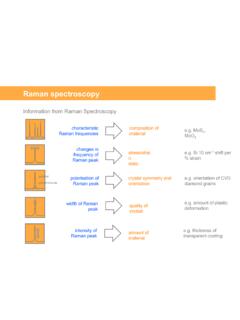
Raman spectroscopy
www.chem.uci.eduFrom the Renishaw Raman software the user can select: • a fixed grating measurement with a spectrum 'window' of 400 cm-1 to 1000 cm (configuration dependent) • a unique 'extended scanning' facility allowing the user to choose any Raman shift range up to about 10000 cm-1 (configuration dependent). Essential for extended range
A Second Application of Symmetry
www.chem.uci.eduWe can use character tables to determine the symmetry of all 18 motions and then assign them to translation, rotation, or vibration. We can also tell which vibrations are IR or Raman active. Procedure: 1. Assign x,y,z coordinates to each atom. 2. Determine how each axis transforms for every class of symmetry operation in the group.
Coordination Chemistry II: Ligand Field Theory Continued
www.chem.uci.eduCoordination Chemistry II: Ligand Field Theory Continued Chapter 10 Wednesday, November 25, 2015. Adding Metal Electrons e g e g * a1g a1g * t1u t1u * t2g Metal ions typically have some valence electrons that can be accommodated in the metal d …
Zinc-EDTA Titration
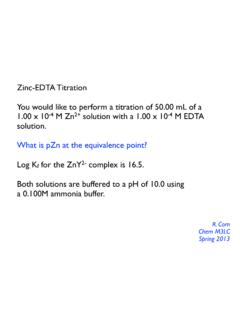
www.chem.uci.eduZinc-EDTA Titration You would like to perform a titration of 50.00 mL of a 1.00 x 10⁻⁴ M Zn2+ solution with a 1.00 x 10⁻⁴ M EDTA solution. What is pZn at the equivalence point? Log K f for the ZnY2-complex is 16.5. Both solutions are buffered to a pH of 10.0 using

A Guide to Recording Fluorescence Quantum Yields
www.chem.uci.eduJobin Yvon Ltd. 2 Dalston Gardens, Stanmore, Middlesex HA7 1BQ UK Tel: 020 8204 8142 Fax: 020 8204 6142 Email: jy@jyhoriba.co.uk www.jyhoriba.co.uk
Related documents

Lecture 34 Rayleigh Scattering, Mie Scattering
engineering.purdue.eduThe scattering cross section is the e ective area of a scatterer such that the total scattered power is proportional to the incident power density times the scattering cross section. As such it is de ned as s= P s 1 2 jE i 2 = 8ˇa2 3 " s " " s+ 2 2 ( a)4 (34.1.21) In other words, P s= hS inci s

The Compton Effect-- Compton Scattering and Gamma Ray ...
www.phys.utk.eduCompton scattering involves the scattering of photons by charged particles where both energy and momentum are transferred to the charged particle while the photon moves off with a reduced energy and a change of momentum. Generally, the charged particle is an

Rayleigh Mie Light Scattering - University of Florida
plaza.ufl.edumost spherical particle scattering systems, including Rayleigh scattering. However, Rayleigh scattering theory is generally preferred if applicable, due to the complexity of the Mie scattering formulation. The criteria for Rayleigh scattering is that <<1 and m <<1, where is ˜the dimensionless size parameter given by the expression

Compton Scattering - High Energy Physics
pages.hep.wisc.eduThe Compton effect is the elastic scattering of photons from electrons. As a reaction, the process is: γ +e −→ γ +e . Since this is a two body elastic scattering process, the angle of the scat-tered photon is completely correlated with the energy of the scattered photon by energy and momentum conservation. This relation is usually ...

Lecture 7: Propagation, Dispersion and Scattering
topex.ucsd.eduRayleigh scattering ¥ Rayleigh scattering is molecular scattering and occurs when the diameter of the molecules and particles are many times smaller than the wavelength of the incident EMR ¥ Primarily caused by air particles i.e. O2 and N2 molecules ¥ All scattering is accomplished through absorption and re-emission of radiation by atoms or molecules in the manner …

Lecture 4 Scattering theory - University of Arizona
atlas.physics.arizona.edu3 Scattering cross section The differential cross-sectionfor scattering is defined as the number of particles scattered into an element of solid angle dΩin the direction (θ,φ)per unit time : The total cross-section corresponds to scatterings through any scattering angle: [dimensions of an area] (1.2) (1.1) Ω Ω σϑφ d dN J 1 d d ( , ) sc inc = Most scattering experiments are carried out ...
Introduction to Scattering Theory - Michigan State University
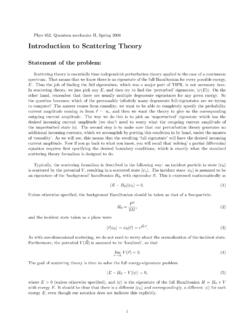
web.pa.msu.eduIntroduction to Scattering Theory Statement of the problem: Scattering theory is essentially time-independent perturbation theory applied to the case of a continuous spectrum. That means that we know there is an eigenstate of the full Hamiltonian for every possible energy, E.

Chapter 2 Rutherford Scattering - University of Southampton
www.personal.soton.ac.ukat which point the α-particle would reverse direction, i.e. the scattering angle θwould equal π. On the other hand, if the line of incidence of the α-particle is a distance b, from the nucleus ( bis called the “impact parameter”), then the scattering angle will be smaller. 2.1 Relation between scattering angle and an impact parameter

Lecture 20 Scattering theory - University of Cambridge
www.tcm.phy.cam.ac.ukScattering theory Scattering theory is important as it underpins one of the most ubiquitous tools in physics. Almost everything we know about nuclear and atomic physics has been discovered by scattering experiments, e.g. Rutherford’s discovery of the nucleus, the discovery of sub-atomic particles (such as quarks), etc.