
General Linear Models (GLM) - Statistical Software
2 Specify the General Linear Models (GLM) procedure options • Find and open the General Linear Models (GLM) procedure using the menus or the Procedure Navigator. • The settings for this example are listed below and are stored in the Example 1 settings template. To load this template, click Open Example Template in the Help Center or File menu.
Download General Linear Models (GLM) - Statistical Software

Information
Domain:
Source:
Link to this page:
Documents from same domain
Mixed Models - Repeated Measures - Statistical …
ncss-wpengine.netdna-ssl.comMixed Models – Repeated Measures Introduction ... analysis, and the amount of data available for the analysis. When more than one fixed factor may influence the
Repeated Measures Analysis - NCSS
ncss-wpengine.netdna-ssl.comThis section provides the technical details of the repeated measures designs that can be analyzed by PASS. Earlier ... Repeated Measures Analysis ...
Chapter 469 Decomposition Forecasting - NCSS
ncss-wpengine.netdna-ssl.comChapter 469 Decomposition Forecasting Introduction Classical time series decomposition separates a time series into five components: mean, long-range trend, seasonality, cycle, and randomness. The decomposition model is Value = (Mean) x (Trend) x (Seasonality) x (Cycle) x (Random).
Chapter 575 Probit Analysis - Statistical Software
ncss-wpengine.netdna-ssl.comChapter 575 Probit Analysis Introduction Probit Analysis is a method of analyzing the relationship between a stimulus (dose) and the quantal (all or nothing) response. Quantitative responses are almost always preferred, but in many situations they are not practical. In these cases, it is only possible to determine if a certain response (such as ...
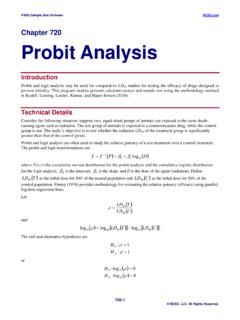
Chapter 720 Probit Analysis - Statistical Software
ncss-wpengine.netdna-ssl.comChapter 720 Probit Analysis. Introduction . Probit and logit analysis may be used for comparative LD. 50. studies for testing the efficacy of drugs designed to prevent lethality. This program module presents calculates power and sample size using the methodology outlined
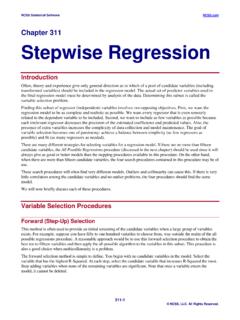
Chapter 311 Stepwise Regression - Statistical Software
ncss-wpengine.netdna-ssl.comNCSS Statistical Software NCSS.com © NCSS, LLC. All Rights Reserved.
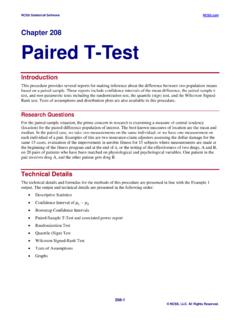
Chapter 208 Paired T-Test - NCSS
ncss-wpengine.netdna-ssl.comNCSS Statistical Software NCSS.com Paired T-Test 208-6 © NCSS, LLC. All Rights Reserved. Tests Alpha Alpha is the significance leve l used in the hypothesis tests.
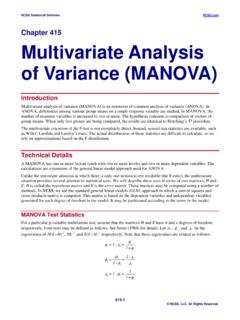
Multivariate Analysis of Variance (MANOVA)
ncss-wpengine.netdna-ssl.comNCSS Statistical Software NCSS.com Multivariate Analysis of Variance (MANOVA) 415-4 © NCSS, LLC. All Rights Reserved. Assumptions and Limitations
Chapter 194 Normality Tests - NCSS
ncss-wpengine.netdna-ssl.comNCSS Statistical Software NCSS.com © NCSS, LLC. All Rights Reserved.
Distribution Weibull Fitting - NCSS
ncss-wpengine.netdna-ssl.comDistribution (Weibull) Fitting Introduction This procedure estimates the parameters of the exponential, extreme value, logistic, log-logistic, lognormal, normal, and Weibull probability distributions by maximum likelihood. It can fit complete, right censored, left censored, interval censored (readou t), and grouped data values.
Related documents
Linear Mixed-Effects Regression - University of Minnesota
users.stat.umn.eduRandom effects are random variables in the population Typically assume that random effects are zero-mean Gaussian Typically want to estimate the variance parameter(s) Models with fixed and random effects are calledmixed-effects models. Nathaniel E. Helwig (U of Minnesota) Linear Mixed-Effects Regression Updated 04-Jan-2017 : Slide 9

Linear Predictive Coding (LPC)- Introduction
web.ece.ucsb.edurepresents the effects of the glottal pulse shape, the vocal tract IR, and radiation at the lips • the system is excited by an impulse train for voiced speech, or a random noise sequence for unvoiced speech • this ‘all-pole’ model is a natural representation for non-nasal voiced speech—but it also works reasonably

CHAPTER 1: THE OP AMP - Analog Devices
www.analog.comcommon linear design building blocks. In section 1 the basic operation of the op amp will be discussed. We will concentrate on the op amp from the black box point of view. There are a good many texts that describe the internal workings of an op …
Lecture 9: Linear Regression - University of Washington
www.gs.washington.eduFixed -vs- Random Effects Models •In ANOVA and Regression analyses our independent variables can be treated as Fixed or Random •Fixed Effects: variables whose levels are either sampled exhaustively or are the only ones considered relevant to the experimenter •Random Effects: variables whose levels are randomly sampled
Title stata.com regress — Linear regression
www.stata.comregress performs ordinary least-squares linear regression. regress can also perform weighted estimation, compute robust and cluster–robust standard errors, and adjust results for complex survey ... estimating treatment effects, and providing answers to public policy questions. For a mathematically rigorous treatment, seePeracchi(2001, chap. 6
An introduction to hierarchical linear modeling - TQMP
www.tqmp.orgmixed level-, mixed linear-, mixed effects-, random effects-, random coefficient (regression)-, and (complex) covariance components-modeling (Raudenbush & Bryk, 2002). These labels all describe the same advanced regression technique that is HLM. HLM simultaneously investigates relationships within and between hierarchical levels of grouped data,
Using the Margins Command to Estimate and Interpret ...
www3.nd.edu• Marginal effects are popular in some disciplines (e.g. Economics) because they often provide a good approximation to the amount of change in Y that will be produced by a 1-unit change in X k. With binary dependent variables, they offer some of the same advantages that the Linear Probability Model (LPM) does –they give you a single number that