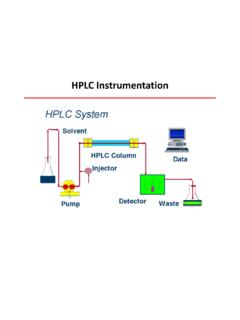
High Performance Liquid Chromatography (HPLC)
Gradient Elution in RP-HPLC Nonpolar stationary phase. To elute solutes, must increase the eluent strength by adding organic solvent (mixed with water). Solvent plays a key role in separation!!!! Make the solutes more soluble in mobile phase than in stationary phase!!! Solution to the general elution problem.
Download High Performance Liquid Chromatography (HPLC)

Information
Domain:
Source:
Link to this page:
Documents from same domain

Standard Operating Procedure: Pumps
www2.chemistry.msu.eduStandard Operating Procedure: Pumps Last Updated: ... operation of ports and evacuation procedures are covered in the glove box SOP document. As a general
Radiation Detection & Measurement Dept. of …
www2.chemistry.msu.eduRadiation Detection & Measurement Dept. of Chemistry --- Michigan State Univ. National Superconducting Cyclotron Lab DJMorrissey Spring/2oo9

Chemistry 151 - Michigan State University
www2.chemistry.msu.eduChemistry 151 • Professor James H. Geiger • Office: Chemistry Building, Room 9 ... Chemistry, the Central Science, 10th edition, Prentice-Hall, 2005. ISBN: 0-13-109686-9. ... Registering for Mastering Chemistry, What You Need: A valid email address

Chapter 3 Stoichiometry - Michigan State University
www2.chemistry.msu.eduChapter 3! Stoichiometry: Calculations with Chemical Formulas and Equations. Stoichiometry Anatomy of a Chemical Equation CH 4 (g) + 2O 2 (g) CO 2 (g) + 2 H 2 O (g) Stoichiometry Anatomy of a Chemical Equation Reactants appear on the left side of the equation. CH 4 (g) + …

Bond Dissociation Energies of Organic Molecules
www2.chemistry.msu.eduBond Dissociation Energies of Organic Molecules STEPHEN J. BLANKSBY*,† AND G. BARNEY ELLISON*,‡ Department of Chemistry, University of Wollongong, NSW, 2522, Australia, and Department of Chemistry &

Chapter 1 Structure and Bonding - Chemistry
www2.chemistry.msu.eduThe atomic mass (atomic weight) of an element is weighted average mass in atomic mass units (amu) of an element’s naturally occurring isotopes. Carbon: Atomic Number and Atomic Mass 12C 6 AC Z 13C 6 (98.9 12.000) (1.1 13.000) 12.011 100 × +× =

Chapter 9: Atomic Absorption Spectrometry
www2.chemistry.msu.eduChapter 9: Atomic Absorption Spectrometry. Read: pp. 230 – 249 Problems: 9-1,3,5,6,8. Figure 9-13a. A(λ)= ε(λ)bC = log P. o /P

Chapter 24 Chemistry of Coordination Compounds
www2.chemistry.msu.edu6 3+ • Co3+ electron configuration: • 4s23d4----" 4s03d6 • Need six orbitals for six ligands so: !Hybridize 1 4s, 3 4p and 2 3d to give: !Sp3d2 orbitals. The 6 …
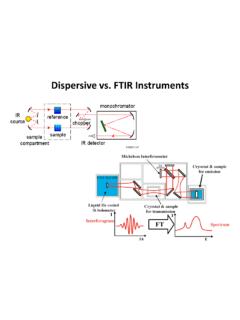
Dispersive vs. FTIR Instruments - Chemistry
www2.chemistry.msu.eduA spectroscopic technique used to observe vibrational, rotational, and other low-frequency [modes in a system. 1] It relies on inelastic scattering, or Raman scattering, of monochromatic light, usually from a laser in the visible, near infrared, or near ultraviolet range.

Principles of FTIR Spectroscopy - Chemistry
www2.chemistry.msu.eduPrinciples of Diffuse Reflectance Method K is the absorption coefficient, and S is the scattering coefficient. In practice, the comparative reflectance r∞ with respect to a standard powder such as KBr or KCl, of which K is near zero (0) in the actual measurement range Spectrum of solid caffeine Measurement of chemicals adhering to a surface ...
Related documents
HPLC Troubleshooting Guide
hplc.euproblems observed in reversed-phase HPLC (RP-HPLC) separations. Four major problem areas are covered: peak shape, retention time changes, ghost peaks and problems related to column backpressure. In addition, a section on column care is included – procedures that will help you get maximum lifetimes from your columns.

HPLC Troubleshooting Cover
ccc.chem.pitt.eduHPLC Troubleshooting Uwe D. Neue, Waters Corporation 1. Column Life-Time 2. Variable Retention Times 3. Drifting Retention Times 4. Column-to-Column and Batch-to-Batch Reproducibility 5. Sample Preparation Problems 6. Sources of Peak Tailing 7. Normal-Phase Chromatography 8. System Volume, Dead Volume, Dwell Volume 9. Transfer of Gradient ...

A Guide to Validation in HPLC - PARAS'S PHARMACY WORLD
parasshah.weebly.comphase. For absorbance detectors, longer path lengths in the flow cell enhances sensitivity though often to the detriment of post column dispersion. ... For an HPLC system this would involve the reproducibility of a number of replicate injections (ie 6) of an analytical solution.

GOOD LABORATORY PRACTICE for HPLC
www.ispybio.comWhen separating mixtures containing acids and/or bases by reversed phase HPLC, it is necessary to control the pH of the mobile phase using an appropriate buffer in order to achieve reproducible results. Example Chromatographic separation where resolution goes from an unacceptable 1.4
Tips and Tricks for HPLC and UHPLC
assets.thermofisher.com•Solvent compatibility • Try to use pre-mixed solvents • Add 5-10% of organic eluent to the aqueous eluent • Add 5-10% aqueous eluent to the organic eluent • Avoids local crystallization in the pump (with buffers) • Eluents with salt buffers • Change eluents with salt buffers regularly • Filtrate buffers • Use water with 18,2M Ohm AND <5ppb TOC

Tips for practical HPLC analysis
www.shimadzu.eu.comHPLC-type acetonitrile has the lowest absorbance (particularly for short wavelengths). Using an organic solvent with lower absorbance as the mobile phase results in less noise in UV detection, and so HPLC-type acetonitrile is suitable for high-sensitivity analysis in the UV short-wavelength range. Also, using HPLC-type acetonitrile