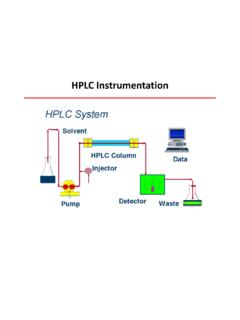
Transcription of HPLC Troubleshooting Cover
1 HPLCT roubleshootingGuide 1 hplc Troubleshooting Uwe D. Neue, Waters Corporation 1. Column Life-Time 2. Variable Retention Times 3. Drifting Retention Times 4. Column-to-Column and Batch-to-Batch Reproducibility 5. Sample Preparation Problems 6. Sources of Peak Tailing 7. Normal-Phase Chromatography 8. System Volume, Dead Volume, Dwell Volume 9. Transfer of Gradient Methods 10. Clogged System 11. Column Plate-Count 12. Column Backpressure 13. Peak Area Fluctuations 14. Ghost Peaks 15. Dependence of Retention Times on pH 16.
2 Column Equilibration 17. Column Conditioning 18. Complex Sample Matrices 19. Hydrophobic Collapse 20. Baseline Noise 21. Narrow-bore Columns 22. Sample Solvent 23. Gradient Scaling 24. Column Storage 25. Paired-Ion Chromatography 26. Hydrolytic Stability of Reversed-Phase Packings 27. Optimal Flow Rates 28. Carbon Load 29. pH Control 30. Mobile Phase Composition 31. Column Contamination 32. Method Verification 33. Double Peaks in Sugar Separations 34. Method Control 35. Mobile Phase pH 36. Signal-to-Noise Improvements 37. Overload 38. Column Durability 39. Fast Analysis and Column Backpressure 40.
3 Column Backflushing 41. Selectivity Shift 42. New Method 43. Negative Peaks 44. Tricky, Tedious, Time Consuming 45. Fast Separations 46. Buffers for LC/MS 47. Alkaline Buffers for RPLC 48. Post-Column Derivatization 49. Gradient Dwell Volume 50. Buffer Capacity 51. Flow Rate Changes and Quantitation 52. Analysis of polar compounds Click on sections below to go directly to that section of the Troubleshooting Guide 2 31. Column Life-Time Q.: My column lasted only for about 100 injections. After that time, the peaks became distorted and the plate-counts were very low.
4 What s wrong? A.: 100 injections is indeed a short life-time. Under normal circumstances, one can expect a column to be in service much longer. In order to determine what is wrong, we need to establish first, if short column life is the rule for your application or not. There are two fundamental cases: 1. previously columns used for the same assay lasted much longer. 2. all columns used for this application die after about the same amount of use. In the first case, one would explore if the assay has remained truly constant. Has the sample composition changed?
5 Strongly adsorbed contaminants in your sample can destroy column performance. Are the seals in the fluid path of your instrument in a good condition? Shedding seals can clog column filters and the top layers of the packing and thus effect the distribution of the sample. If one can be reasonably assured that there are no changes in the chromatographic conditions, one can safely assume that the cause of the problem is a mechanical weakness of the packed bed. This can be induced by rough handling of the column in your lab (did you drop it?) or during shipment, or it could be a manufacturing defect.
6 Such a defect can not be detected by standard column QC and could show up only after some use of the column. In this case, column manufacturers will replace your column free of charge. Q.: That is nice of these manufacturers, but this is not my problem. My columns always last only a short time. Sometimes it s 100 injections, sometimes 200. I could live with 200 injections, but only 100 is not good enough. This really is getting expensive. What can I do? A.: I agree with you 100%. What we need to do together is to find the cause of your problem and then see, what we can do about it.
7 The most likely cause of your problem is adsorption of sample constituents on the top of the column. They may either precipitate because of a low solubility in the mobile phase or they may be strongly adsorbed. As you inject more and more samples, these contaminants build up on the top of the column and prevent the sample to properly adsorb and distribute. This results in a distortion of the peak profile. Often this problem is accompanied by an increase in back pressure. Q.: OK, that could be it. How do I get around this problem? A.
8 : There are several ways to prevent this from happening. One is to clean up the sample with a suitable sample preparation technique. Solid phase extraction using a SPE cartridge with a similar chemistry as the separation column works well for this problem. Another and more powerful approach is to use a guard column. The precolumn serves as a sacrificial column top that is replaced when the problem occurs. For best performance, you should use a guard column that contains exactly the same packing as the analytical column and is packed with the same high performance packing technique as the analytical column.
9 If you use precolumns made with a different brand of packing, you will not get the optimal performance both in separation capability and in protection of your analytical column. Also, do not use a larger particle size. Larger particles or badly packed precolumns can result in a deterioration of the separation due to band- broadening in the precolumn. Q.: To use a guard column sounds ok. Do you have any other solutions? A.: Well, not really. There are a few other possibilities, but they all have their drawbacks. I am not an advocate of column "washing" with solvents that are supposed to dissolve the contaminants on the top of the column.
10 In many cases, this process simply does not work. For example, if the contaminants are proteins that have precipitated on the column top, by the time you try to wash them off they have aged a lot by denaturation and maybe even cross-linking that it may be impossible to solubilize them again. Furthermore, every washing will also remove hydrolyzed bonded phase, which otherwise remains in a local equilibrium at the site where the hydrolysis occurred. Consequently, a repetitive washing can actually result in an accelerated aging of the column.