
HPLC Troubleshooting Cover
HPLC Troubleshooting Uwe D. Neue, Waters Corporation 1. Column Life-Time 2. Variable Retention Times 3. Drifting Retention Times 4. Column-to-Column and Batch-to-Batch Reproducibility 5. Sample Preparation Problems 6. Sources of Peak Tailing 7. Normal-Phase Chromatography 8. System Volume, Dead Volume, Dwell Volume 9. Transfer of Gradient ...
Download HPLC Troubleshooting Cover

Information
Domain:
Source:
Link to this page:
Documents from same domain

Basics of LC/MS (5988-2045EN) - University of …
ccc.chem.pitt.eduContents Why Liquid Chromatography/Mass Spectrometry? 4 Instrumentation 6 Ion Sources 6 Electrospray ionization 7 Atmospheric pressure chemical ionization 8
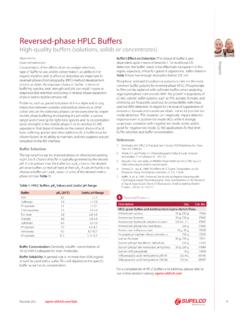
Reversed-phase HPLC Bu ers
ccc.chem.pitt.edu9 Reversed-phase HPLC Bu!ers High-quality bu!ers (solutions, solids or concentrates) Shyam Verma shyam.verma@sial.com Consideration of …
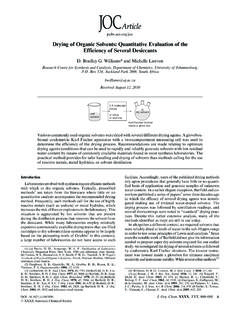
Drying of Organic Solvents: Quantitative …
ccc.chem.pitt.eduDOI: 10.1021/jo101589h J. Org. Chem. XXXX, XXX, 000–000 A rXXXX American Chemical Society pubs.acs.org/joc Drying of Organic Solvents: Quantitative Evaluation of the ...

NMR Chemical Shifts of Trace Impurities: Common …
ccc.chem.pitt.eduNMR Chemical Shifts of Common Laboratory Solvents as Trace Impurities Hugo E. Gottlieb,* Vadim Kotlyar, and Abraham Nudelman* Department of Chemistry, Bar …
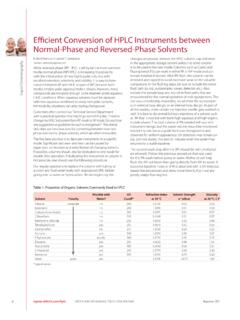
E cient Conversion of HPLC Instruments between Normal ...
ccc.chem.pitt.edu6 Liquid Chromatography sigma-aldrich.com/hplc ORDER: 800-247-6628 (US ONLY) / 814-359-3441 Reporter 28.5 E!cient Conversion of HPLC Instruments between

Incompatibilities of concentrated nitric acid: Never mix ...
ccc.chem.pitt.eduGroup 11: Olefins (cont.) Propylene tetramer (dodecene) 1-Tetradecene 1-Tridecene Turpentine 1-Undecene Group 12: Petroleum Oils Asphalt Gasolines Casingead Automotive Aviation Jet Fuels JP-1 (kerosene) JP-3 JP-4 JP-5 (kerosene, heavy) Kerosene Mineral spirits Naphtha (non aromatic) Naphtha Solvent Stoddard solvent VM&P Oils Absorption oil

1. The Wittig Reaction - CCC/UPCMLD
ccc.chem.pitt.eduFeb 12, 2007 · ratios that depend on the level of stabilization (charge delocalization) of the ylide. The Wittig reaction must involve a mechanism other than the betaine pathway. A synchronous ... An interplay of 1,2- and 1,3-steric interactions decides which diastereomeric oxaphosphetane will be favored. It is important to recall,
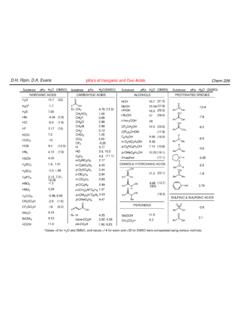
D.H. Ripin, D.A. Evans pKa's of Inorganic and Oxo-Acids ...
ccc.chem.pitt.eduD.H. Ripin, D.A. Evans 19-20 9 13 11 24.5 H2 ~36 *Values <0 for H2O and DMSO, and values >14 for water and >35 for DMSO were extrapolated using various methods. HCCH Substrate SubstrateSubstrate pKa H2O (DMSO) Substrate AMIDES HYDROCARBONS pKa H2OH(DMSO) pKa pKa2O (DMSO) H2O (DMSO) CH4 CH2=CHCH3 PhH CH2=CH2 PhCH3 …
Related documents
HPLC Troubleshooting Guide
hplc.euproblems observed in reversed-phase HPLC (RP-HPLC) separations. Four major problem areas are covered: peak shape, retention time changes, ghost peaks and problems related to column backpressure. In addition, a section on column care is included – procedures that will help you get maximum lifetimes from your columns.

A Guide to Validation in HPLC - PARAS'S PHARMACY WORLD
parasshah.weebly.comphase. For absorbance detectors, longer path lengths in the flow cell enhances sensitivity though often to the detriment of post column dispersion. ... For an HPLC system this would involve the reproducibility of a number of replicate injections (ie 6) of an analytical solution.

GOOD LABORATORY PRACTICE for HPLC
www.ispybio.comWhen separating mixtures containing acids and/or bases by reversed phase HPLC, it is necessary to control the pH of the mobile phase using an appropriate buffer in order to achieve reproducible results. Example Chromatographic separation where resolution goes from an unacceptable 1.4
Tips and Tricks for HPLC and UHPLC
assets.thermofisher.com•Solvent compatibility • Try to use pre-mixed solvents • Add 5-10% of organic eluent to the aqueous eluent • Add 5-10% aqueous eluent to the organic eluent • Avoids local crystallization in the pump (with buffers) • Eluents with salt buffers • Change eluents with salt buffers regularly • Filtrate buffers • Use water with 18,2M Ohm AND <5ppb TOC

Tips for practical HPLC analysis
www.shimadzu.eu.comHPLC-type acetonitrile has the lowest absorbance (particularly for short wavelengths). Using an organic solvent with lower absorbance as the mobile phase results in less noise in UV detection, and so HPLC-type acetonitrile is suitable for high-sensitivity analysis in the UV short-wavelength range. Also, using HPLC-type acetonitrile
High Performance Liquid Chromatography (HPLC)
www2.chemistry.msu.eduGradient Elution in RP-HPLC Nonpolar stationary phase. To elute solutes, must increase the eluent strength by adding organic solvent (mixed with water). Solvent plays a key role in separation!!!! Make the solutes more soluble in mobile phase than in stationary phase!!! Solution to the general elution problem.