
Lecture 7 Static Structural Analysis
•Thermal expansion coefficient is required if a temperature load is applied. ... Example: a Frictionless Support applied to the face of the block shown would indicate that the Z degree of freedom is no longer free (all other DOF are free). ... –Adjustment (length)
Download Lecture 7 Static Structural Analysis

Information
Domain:
Source:
Link to this page:
Documents from same domain
1 Finite Element Analysis Methods - Rice University
www.clear.rice.edu1 Finite Element Analysis Methods ... it is often referred to as finite element analysis (FEA). FEA is the most common tool for stress and structural ...

Lecture 1 Introduction to ANSYS Workbench - Rice …
www.clear.rice.eduThis training course covers the basics of using ANSYS Mechanical in performing structural and thermal analyses. It is intended for all new or occasional ANSYS Mechanical users, regardless

Types of Control: Open loop, feedback, feedforward
www.clear.rice.eduFeedback Control “Understand Your Technical World” ... • or better, why do you need a control system at all? • consider ovens, A/C units, airplanes, manufacturing, pumping stations, etc ... Design of dynamics through feedback Allows the dynamics (behavior) of the system to be modified ...

Lecture 9 Thermal Analysis - Rice University
www.clear.rice.eduthermal resistance. q TCC T target T contact The amount of heat flow across a contact interface is defined by the contact heat flux expression ^q” shown here: • T contact is the temperature of the contact surface and • T target is the temperature of the target surface. … Thermal ontact
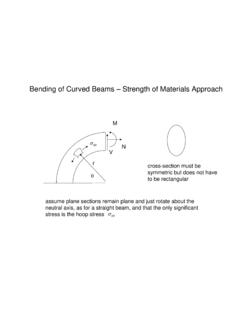
curved beam strength - Rice University
www.clear.rice.edukr σθθ=− − + = r r ... iar r m ari y r i r iar m yri ari ayri ar r m yrai r

Introduction to ANSYS Mechanical
www.clear.rice.edu– The “2D” switch must be set on the Project page prior to importing geometry. •Each node in a 2D element has two translational degrees of freedom (UX and UY) for structural or one temperature DOF for thermal. •2D solids are used to represent three types of 3D geometry, “Axisymmetric”, “Plane stress” and “Plane strain”.

8 Flat Plate Analysis - Rice University
www.clear.rice.eduThen, the plots are pretty, but wrong. If the edges of the plate are simply sitting on top of to walls, then the wall could not pull down on the corner. ... reaction forces appear, then move the split line away from the corner and repeat the process. It may be a slow procedure, but it can lead you to the correct lift off regions. ...

12 Buckling Analysis - Rice University
www.clear.rice.eduthose terms even though finite element analysis lets you conduct buckling studies in 1D, 2D, and 3D. For a material, stiffness refers to either its elastic modulus, E, or to its shear modulus, G = E / (2 + 2 v) where v is Poisson’s ratio.
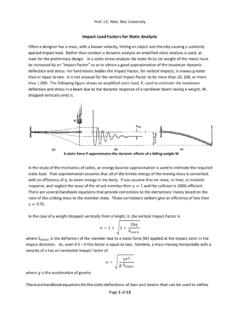
Impact Load Factors - Rice University
www.clear.rice.eduMaximum horizontal stress (143 MPa) is at the center plane top and bottom Of course, since the static model is linear there is no need to re-run the model (unless you want pretty plots). The static maximum fiber stress (SX) of 26.0 MPa could be multiplied by the 5.48 vertical Impact Factor to find the dynamic maximum SX stress of 143 MPa.

Space Truss and Space Frame Analysis - Rice University
www.clear.rice.eduspace frame is a combination of individual beam‐column elements that resists loadings by a combination of bending, axial member forces, and transverse (shear) forces, and axial torsion. Therefore, it is a more efficient
Related documents
MCP4728 - 12-Bit, Quad Digital-to-Analog Converter with ...
ww1.microchip.comAug 04, 2010 · • Extended Temperature Range: -40°C to +125°C Applications • Set Point or Offset Adjustment • Sensor Calibration • Closed-Loop Servo Control • Low Power Portable Instrumentation • PC Peripherals • Programmable Voltage and Current Source • Industrial Process Control • Instrumentation • Bias Voltage Adjustment for Power ...

2.7 V to 5.5 V, Serial-Input, Voltage-Output, 16-Bit DACs ...
www.analog.comadjustment over the full specified temperature range of −40°C to +85°C. Offering unbuffered outputs, the AD5541/AD5542 achieve a 1 µs settling time with low power consumption and low offset errors. Providing a low noise performance of 11.8 nV/√Hz and low glitch, the AD5541/AD5542 is suitable for deployment across multiple end systems.
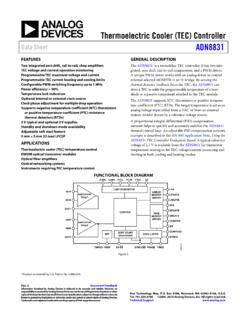
Thermoelectric Cooler (TEC) Controller Data Sheet ADN8831
www.analog.comTemperature lock indication diode or a passive component attached to the TEC module. Optional internal or external clock source . Clock phase adjustment for multiple drop operation . Supports negative temperature coefficient (NTC) thermistors or positive temperature coefficient (PTC) resistance thermal detectors (RTDs)

HVAC HEATING PRODUCTS
www.literature.mestek.comoutside temperature or unheated spaces. Calculate door as all glass. 3. Select heat-transfer coefficients from the table below (or the ASHRAE Handbook) and compute the heat-transmission loss for each area in BTU/HR by multiplying each area by the heat-transfer coefficient and the temperature difference. 4.

SLIDE BUSH
www.nipponbearing.comClearance-adjustment is achieved by creating a slit on the SMA/SWA type housing. Less clearance between block and shaft results in higher positioning accuracy by tightening the adjustment screw. RBW Type The housing is made of ABS resin for light-weight and low-cost. Inside is an inch sized bush of a resin retainer type with seals. SMP Type

Prepared by PCI Committee on Precast Sandwich Wall Panels
www.pci.orgC = coefficient of thermal expansion C u = factored compressive force C w = stud group adjustment factor d p = distance from compression fiber to centroid of pre-stressed reinforcement D = dead load e = eccentricity of panel section at midheight, due to out of plumbness, thermal bow, and load effects, relative to ultimate design load (for P-D ...
DC Parameters: Input Offset Voltage (V - TI.com
www.ti.comFigure 14. Block Diagram of Channel One of the TLC4502.....20 Figure 15. Typical Null Configuration of an Amplifier.....21 Figure 16. VIO Adjustment With (a) Potentiometer and (b) Low Temperature Coefficient