
Lecture 7 Static Structural Analysis
Basics of Linear Static Analysis For a linear static structural analysis, the global displacement vector {x} is solved for in the matrix equation below: Assumptions made for linear static structural analysis are: •[K] , which is the global stiffness matrix, is constant – Linear elastic material behavior is assumed
Download Lecture 7 Static Structural Analysis

Information
Domain:
Source:
Link to this page:
Documents from same domain
1 Finite Element Analysis Methods - Rice University
www.clear.rice.edu1 Finite Element Analysis Methods ... it is often referred to as finite element analysis (FEA). FEA is the most common tool for stress and structural ...

Lecture 1 Introduction to ANSYS Workbench - Rice …
www.clear.rice.eduThis training course covers the basics of using ANSYS Mechanical in performing structural and thermal analyses. It is intended for all new or occasional ANSYS Mechanical users, regardless

Types of Control: Open loop, feedback, feedforward
www.clear.rice.eduFeedback Control “Understand Your Technical World” ... • or better, why do you need a control system at all? • consider ovens, A/C units, airplanes, manufacturing, pumping stations, etc ... Design of dynamics through feedback Allows the dynamics (behavior) of the system to be modified ...

Lecture 9 Thermal Analysis - Rice University
www.clear.rice.eduthermal resistance. q TCC T target T contact The amount of heat flow across a contact interface is defined by the contact heat flux expression ^q” shown here: • T contact is the temperature of the contact surface and • T target is the temperature of the target surface. … Thermal ontact
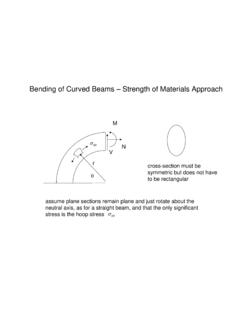
curved beam strength - Rice University
www.clear.rice.edukr σθθ=− − + = r r ... iar r m ari y r i r iar m yri ari ayri ar r m yrai r

Introduction to ANSYS Mechanical
www.clear.rice.edu– The “2D” switch must be set on the Project page prior to importing geometry. •Each node in a 2D element has two translational degrees of freedom (UX and UY) for structural or one temperature DOF for thermal. •2D solids are used to represent three types of 3D geometry, “Axisymmetric”, “Plane stress” and “Plane strain”.

8 Flat Plate Analysis - Rice University
www.clear.rice.eduThen, the plots are pretty, but wrong. If the edges of the plate are simply sitting on top of to walls, then the wall could not pull down on the corner. ... reaction forces appear, then move the split line away from the corner and repeat the process. It may be a slow procedure, but it can lead you to the correct lift off regions. ...

12 Buckling Analysis - Rice University
www.clear.rice.eduthose terms even though finite element analysis lets you conduct buckling studies in 1D, 2D, and 3D. For a material, stiffness refers to either its elastic modulus, E, or to its shear modulus, G = E / (2 + 2 v) where v is Poisson’s ratio.
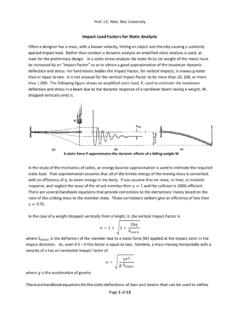
Impact Load Factors - Rice University
www.clear.rice.eduMaximum horizontal stress (143 MPa) is at the center plane top and bottom Of course, since the static model is linear there is no need to re-run the model (unless you want pretty plots). The static maximum fiber stress (SX) of 26.0 MPa could be multiplied by the 5.48 vertical Impact Factor to find the dynamic maximum SX stress of 143 MPa.

Space Truss and Space Frame Analysis - Rice University
www.clear.rice.eduspace frame is a combination of individual beam‐column elements that resists loadings by a combination of bending, axial member forces, and transverse (shear) forces, and axial torsion. Therefore, it is a more efficient
Related documents
Chapter 5. Force and Motion - Physics & Astronomy
physics.gsu.edu- static friction – prevent the motion of the object direction – opposite the direction in which the object would move fs rrrr. Major Forces: 1. Weight – gravitational force ... D. Friction, acting opposite the direction of motion E. A, B, and D but not C. Two rubber bands stretched the standard distance cause an object to accelerate at

UP1 OV Traveling Around a Banked Curve (f)
plaza.obu.eduThis means the static friction force points up the incline. Ex. Find the minimum speed a car traveling along a banked curve (whose path is the shape of a circle) can have in order to make the curve without sliding down the incline.

Basic Seismology: Some Theory and Observations
earthquake.usgs.govmedium in static equilibrium. Forces (stress) and deformation (strain) at a point in a general elastic solid are related by a (81-component) fourth-order constitutive tensor. If the physical properties of the medium are direction-independent (isotropic), a good first-order approximation for the earth, the number of independent elastic

STATIC, STAGNATION, AND DYNAMIC PRESSURE
me304.cankaya.edu.trThe static pressure corresponds to a point A is read from the wall static pressure tap. The stagnation pressure is measured directly at A by the total head tube. Two probes are combined as in pitot-static tube.The inner tube is used to measure the stagnation pressure at point B while the static pressure at C is measured by the small holes in the outer tube.

Challenge Problem Solutions: Static Equilibrium
ocw.aprende.orgwith a coefficient of static friction µ. s. In this problem you will try to find the minimum coefficient of friction between the ladder and the floor so that the person and ladder do not slip. Problem 3 Solution: We shall apply the two conditions for static equilibrium on the ladder, ! ! ! ! 1 + + !!! =! ! ! !! = !,1 +! + """ =
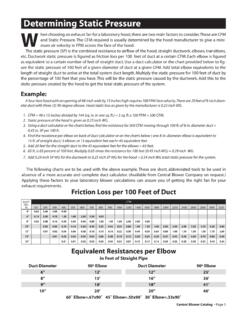
Determining Static Pressure - Central Blower
www.centralblower.comThe static pressure (SP) is the combined resistance to airflow of the hood, straight ductwork, elbows, tran si tions, etc. Ductwork static pressure is figured as friction loss per 100 feet of duct at a certain CFM. Each elbow is figured as equivalent to a certain number of feet of straight duct.