
Phase Locked Loop Circuits
minimize the required phase offset or error, the PLL loop gain, KD KO, should be maximized, since KD KDKO V1 1 0 0 ω ω φ − = = Thus, a high loop gain is beneficial for reducing phase errors. 4. PLL dynamic response: To see how the PLL works, suppose that we introduce a phase step at the input at t = t1. φin =ω1t +φ0 +φ1u(t −t1)
Download Phase Locked Loop Circuits

Information
Domain:
Source:
Link to this page:
Documents from same domain

Transistor Technologies for High Efficiency and Linearity
web.ece.ucsb.eduDifferential Topology • Double the available voltage swing • Even-order harmonic suppression • Double the frequency of current injection into substrate –Reduce the potential for LO-pulling • The tail current source is removed from the standard differential pair (this is a “quasi-differential” structure) –DC current set by the biasing of input devices

ADS Tutorial Stability and Gain Circles ECE145A/218A
web.ece.ucsb.eduequations. The syntax is: gp_circle(S, gain, # points on circle) where S is the S-parameter matrix. Let’s illustrate. In the example below, a table is used to display frequency, maximum stable gain (MSG), the stability factor, k, and the magnitude of delta. The gain circles are at MSG (MaxGain1 in this case), and 1 and 2 dB below MSG.
Audio Amplifier Circuit - UC Santa Barbara
web.ece.ucsb.eduWeek #1: Audio amplifier Week #2: Microphone circuit The audio amplifier project is more difficult and time-consuming than the microphone pre-amp, so part of week #2 may be used to finish the audio amp. All breadboarding and testing can and should be done in lab. Soldering and hardwiring can and should be done outside lab.

Harmonic Balance Simulation on ADS
web.ece.ucsb.eduHarmonic Balance Simulation on ADS General Description of Harmonic Balance in Agilent ADS 1 Harmonic balance is a frequency-domain analysis technique for simulating nonlinear circuits and systems. It is well-suited for simulating analog RF and microwave circuits, ... function is driven to a given small value), then the resulting voltage ...
Quality factor, Q
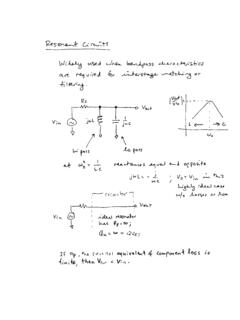
web.ece.ucsb.eduWhen a resonant circuit is connected to the outside world, its total losses (let’s call them RP or GP) are combined with the source and load resistances, RS and RL. For example, Here is a parallel resonant circuit (C,L and RP)connected to the outside. The total Q of this circuit is called the loaded Q or QL and is given by

Latches, the D Flip-Flop & Counter Design
web.ece.ucsb.eduFebruary 6, 2012 ECE 152A - Digital Design Principles 2 Reading Assignment Brown and Vranesic 7Flip-Flops, Registers, Counters and a Simple Processor 7.1 Basic Latch 7.2 Gated SR Latch 7.2.1 Gated SR Latch with NAND Gates 7.3 Gated D …

Flip-Flops and Sequential Circuit Design
web.ece.ucsb.edu11 Latches and Flip-Flops 11.5 S-R Flip-Flop 11.6 J-K Flip-Flop 11.7 T Flip-Flop 11.8 Flip-Flops with Additional Inputs 11.9 Summary 12 Registers and Counters 12.5 Counter Design Using S-R and J-K Flip-Flops 12.6 Derivation of Flip-Flop Input Equations – Summary

BASICS OF THE SPECTRUM ANALYZER - UC Santa Barbara
web.ece.ucsb.eduFourier ⋅ π → − + + Now instead of a bank of narrow filters, we shall have one narrow filter centered at a fixed frequency, say fI, and we shall scan the signal spectrum across this filter by multiplying x(t) by a sinusoid of varying frequency f0. See Figure 1. …

Mealy and Moore Machines
web.ece.ucsb.eduFebruary 22, 2012 ECE 152A - Digital Design Principles 5 Finite State Machines Two types (or models) of sequential circuits (or finite state machines) Mealy machine Output is function of present state and present input Moore machine Output is function of present state only Analysis first, then proceed to the design of
Number Representation and Computer Arithmetic
web.ece.ucsb.eduOne way to encode decimal digits using binary signals is to encode each of the digits 0-9 by means of its 4-bit binary representation. The resulting binary-coded decimal (BCD) representation is shown below:
Related documents

Stability, Gain Margins, Phase Margins - Mercer University
faculty.mercer.edufor the SISO open-loop model SYS (continuous or discrete). The gain margin Gm is defined as 1/G where G is the gain at the -180 phase crossing. The gain margin in dB is derived by Gm_dB = 20*log10(Gm) The phase margin Pm is in degrees. The loop gain at Wcg can increase or decrease by this many dBs before losing stability.

Stability of Closed-loop Control Systems - Jingwei Zhu
jingweizhu.weebly.comgain just below the ultimate, the loop oscillates with decaying amplitude, while at a gain just above the ultimate gain, the amplitude of oscillations increases with time. At the point of marginal stability, the amplitude of oscillation remains constant with time (Figure 3).

MT-033: Voltage Feedback Op Amp Gain and Bandwidth
www.analog.comOPEN-LOOP GAIN . Unlike the ideal op amp, a practical op amp has a finite gain. The open-loop dc gain (usually referred to as AVOL) is the gain of the amplifier without the feedback loop being closed, hence the name “open-loop.” For a precision op amp this gain can be vary high, on the order of 160 dB
Loop Stability Analysis - University of Delaware
www.eecis.udel.eduand computes the loop-gain, gain and phase margins (if the sweep variable is frequency), for a feedback loop or a gain device [1]. Refer to the Spectre Simulation Refrence [1] and [2] for details. Uses return ratio analysis method to calculate loop-gain and phase margin ([3, 4]).

Phase-Locked Loop Design Fundamentals
www.nxp.comunity gain in the feedback path (N = 1). As a result, the output frequency is then equa l to that of the input. Various types and orders of loops can be constructed depe nding upon the configurati on of the overall loop

Automatic Gain Control (AGC) in Receivers
www.qsl.netClosed-Loop Control System • Any system that can respond to the changes and make corrections by itself is known as a closed-loop control system. • Automatic Gain Control (AGC) system is a closed-loop control system. • The main difference between open-loop and closed-loop systems is the feedback action.

Operational amplifier stability compensation methods for ...
www.st.comloop gain of the system increases and the loop gain decreases. Because the phase remains the same, the gain margin increases and stability is improved. In addition, if you consider the case of a second order system such as the one shown in Figure 6, a decrease of the loop gain allows to pass the 0 dB axis before the second pole occurs.