Stochastic Difierential Equations
the stochastic calculus. Problem 4 is the Dirichlet problem. Although this is purely deterministic we outline in Chapters VII and VIII how the introduc-tion of an associated Ito difiusion (i.e. solution of a stochastic difierential equation) leads to a simple, intuitive and useful stochastic solution, which is
Download Stochastic Difierential Equations

Information
Domain:
Source:
Link to this page:
Documents from same domain
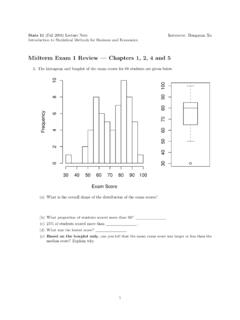
Midterm Exam 1 Review — Chapters 1, 2, 4 and 5
www.stat.ucla.eduStats 11 (Fall 2004) Lecture Note Instructor: Hongquan Xu Introduction to Statistical Methods for Business and Economics Midterm Exam 1 Review — Chapters 1, 2, 4 …
Estimation of Space–Time Branching Process Models in ...
www.stat.ucla.eduEstimation of Space–Time Branching Process Models in Seismology Using an EM–Type Algorithm Alejandro VEEN and Frederic P. SCHOENBERG Maximum likelihood estimation of branching point process models via numerical optimization procedures can be unstable and computa-tionally intensive. We explore an alternative estimation method based on the ...
Distributions related to the normal distribution - Website
www.stat.ucla.eduDistributions related to the normal distribution Three important distributions: Chi-square (˜2) distribution. tdistribution. Fdistribution. Before we discuss the ˜2;t, and F distributions here are few important things about the gamma distribution.
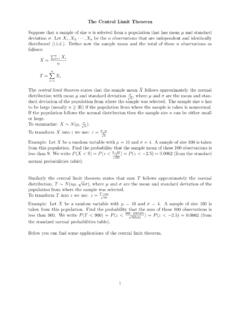
The Central Limit Theorem - Main Concepts
www.stat.ucla.eduCentral limit theorem - proof For the proof below we will use the following theorem. Theorem: Let X nbe a random variable with moment generating function M Xn (t) and Xbe a random variable with moment generating function M X(t). If lim n!1 M Xn (t) = M X(t) then the distribution function (cdf) of X nconverges to the distribution function of Xas ...
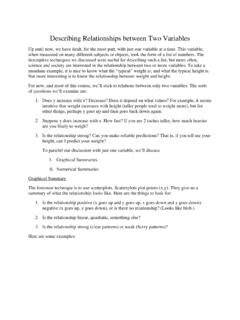
Describing Relationships between Two Variables
www.stat.ucla.eduIs the relationship strong (clear patterns) or weak (fuzzy patterns)? Here are some examples: This data comes from class. The picture comes from plotting each person’s height and weight. For example ( 74, 180), (69, 175), (76, 170), etc. This is a positive relation, fairly …

Covariance and correlation - Main Concepts
www.stat.ucla.eduCorrelation: However, the covariance depends on the scale of measurement and so it is not easy to say whether a particular covariance is small or large. The problem is solved by standardize the value of covariance (divide it by ˙ X˙ Y), to get the so called coe cient of correlation ˆ XY. ˆ= cov(X;Y) ˙ X˙ Y; Always, 1 ˆ 1 cov(X;Y) = ˆ ...
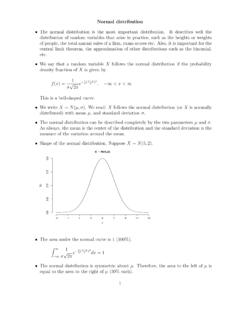
Normal distribution - University of California, Los Angeles
www.stat.ucla.eduWe say that a random variable X follows the normal distribution if the probability density function of Xis given by f(x) = 1 ˙ p 2ˇ e 1 2 (x ˙)2; 1 <x<1 This is a bell-shaped curve. We write X˘N( ;˙). We read: Xfollows the normal distribution (or Xis normally distributed) with mean , and standard deviation ˙.
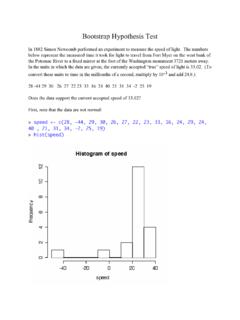
Bootstrap Hypothesis Test - University of California, Los ...
www.stat.ucla.eduWhat if we used the t-test? Since the data now look normal, there’s no reason not to. > t.test(betterspeed,alternative="two.sided",mu=33.02) One Sample t-test data: betterspeed t = -4.6078, df = 17, p-value = 0.0002508 alternative hypothesis: true mean is not equal to 33.02 95 percent confidence interval: 23.83863 29.60582 sample estimates ...
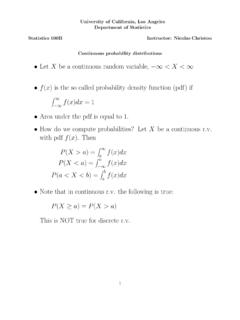
Z f x dx = 1 be a continuous r.v. f x
www.stat.ucla.eduSuppose Xfollows the exponential distribution with = 1. If Y = p X nd the pdf of Y. Example 2 Let X ˘N(0;1). If Y = eX nd the pdf of Y. Note: Y it is said to have a log-normal distribution. Example 3 Let Xbe a continuous random variable with pdf f(x) = 2(1 x);0 x 1. If Y = 2X 1 nd the pdf of Y. Example 4 Let Xbe a continuous random variable ...
Related documents
Probability, Statistics, and Stochastic Processes
ramanujan.math.trinity.eduthe chapters on statistical inference and stochastic processes would benefit from sub-stantial extensions. To accomplish such extensions, I decided to bring in Mikael Andersson, an old friendand colleague fromgraduateschool. Being five days my ju-

1 Discrete-time Markov chains - Columbia University
www.columbia.eduStochastic processes are meant to model the evolution over time of real phenomena for which randomness is inherent. For example, X n could denote the price of a stock ndays from now, the population size of a given species after nyears, the amount of bandwidth in use in a telecommunications network after nhours of operation, or the amount of ...

1 IEOR 6711: Notes on the Poisson Process
www.columbia.edu1.1 Point Processes De nition 1.1 A simple point process = ft n: n 1gis a sequence of strictly increas-ing points 0 <t 1 <t 2 < ; (1) with t n!1 as n!1 . With N(0) def= 0 we let N(t) denote the number of points that fall in the interval (0;t]; N(t) = maxfn: t n tg. fN(t) : t 0gis called the counting process for . If the t

Basics of Applied Stochastic Processes - Yale University
www.stat.yale.edu2 1MarkovChains 1.1 Introduction This section introduces Markov chains and describes a few examples. A discrete-time stochastic process {X n: n ≥ 0} on a countable set S is a collection of S-valued random variables defined on a probability space (Ω,F,P).The Pis a probability measure on a family of events F (a σ-field) in an event-space Ω.1 The set Sis the state space of the …

Discrete Stochastic Processes, Chapter 4: Renewal Processes
ocw.mit.edu158 CHAPTER 4. RENEWAL PROCESSES In most situations, we use the words arrivals and renewals interchangably, but for this type of example, the word arrival is used for the counting process {N(t); t > 0} and the word renewal is used for {Nr(t); t > 0}.The reason for being interested in {Nr(t); t > 0} is that it allows us to analyze very complicated queues such as this in two stages.

Essentials of Stochastic Processes - Duke University
services.math.duke.eduStochastic Processes to students with many different interests and with varying degrees of mathematical sophistication. To allow readers (and instructors) to choose their own level of detail, many of the proofs begin with a nonrigorous answer to the question “Why is this true?” followed by a Proof that fills in the missing details.
Introduction to Stochastic Processes - Lecture Notes
web.ma.utexas.eduIntroduction to Stochastic Processes - Lecture Notes (with 33 illustrations) Gordan Žitković Department of Mathematics The University of Texas at Austin
1 Chapter 6: Random Processes - NTPU
web.ntpu.edu.twY. S. Han Random Processes 4 • A stochastic process is said to be discrete-time if the index set I is a countable set. • A continuous-time stochastic process is one in which I is continuous. Example: Let ζ be a number selected at random from the interval S = [0,1], and let b1b2 ··· be the binary expansion of ζ ζ = X∞ i=1 bi2 −i b ...