Transcription of CORN BASIS -- HEREFORD, TX - Daily Livestock …
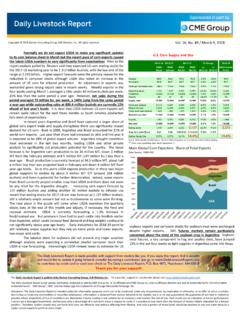
1 December 19, 2006 Volume 5, Issue 243 Over the past year the corn BASIS between West-Central Ne-braska and the South Plains (two major cattle feeding regions) has ex-ploded to reside in a range of $ to extremes of $ cents per bushel. Given the usual requirement of 56 bushels of corn per head for yearlings, that amounts to a production cost advantage of about $ per head for Nebraska. While a corn price advantage for Nebraska is nothing new, the advantage is usually offset by weather advantages (both temperature and precipitation) in the South Plains. The current price disparity between the two locations far outweighs any weather advantages to the south, unless there is a sustained period of severe weather in the northern feeding area.
2 Because of limited water availability, the South Plains has be-come almost totally dependent on railed-in corn . The limited supply of local corn is under such strong demand from local dairies for silage that cattle feeders have been priced out of the local market. The first big jump in South Plains corn BASIS was last summer when fuel prices reached an all time high. The second spike was driven by increased demand for corn because of increased ethanol production in the corn Belt. The combined effect has caused South Plains BASIS vs. Chicago to go from a historical trading range of $ with spike highs of $ to the current range of $ to over $ (see graph at left).
3 The $ to $ increase in BASIS , when added to the $ increase in corn futures over a year ago, has driven cash corn to a peak of just under $ per bushel in the South Plains. That translates into costs of gain in the upper $ to $ per pound level for finishing yearling steers. With feeder cattle prices well above a $ and cost of gain run-ning near or above the current fed steer price, variable costs are barely being covered maybe. With at least fixed costs lost, the only choice for feeders is to substantially lower costs or alter production at existing fed cattle prices. The Texas weekly choice grading percentage rate has declined from 43% in early September to a spike low in early November of just over 37%.
4 That 6% drop in just over sixty days suggests that feeders are ag-gressively liquidating fed cattle inventory. Over the same period, percent choice in Nebraska has generally remained between 58% and 60% indi-cating that Nebraska feeders have not been under nearly as much pres-sure to reduce fed cattle numbers. What are the potential outcomes of this situation? First, corn prices and BASIS levels could return to more historical levels. Given etha-nol-driven corn demand and increased transportation cost, that isn t likely any time soon especially with growing supplies of DGS in the western cornbelt. Second, South Plains cattle feeders will be forced to find alterna-tive rations that are more competitive but it is not as though they haven t looked for those already, is it?
5 That leaves door number 3: Cattle feeding will start an escalating migration to the North. Will feed cost advantage remain large enough to offset inherent weather disadvantages? Please feel free to forward the Daily Livestock Report to others who you think will benefit from having this information. The DLR is published Daily by Steve Meyer and Len Steiner, and distributed courtesy of Chicago Mercantile Exchange, Inc. You can subscribe for free by going to To submit a comment or suggestion, please send an e-mail to: To unsubscribe from the DLR newsletter, go to Disclaimer: The Daily Livestock Report is intended solely for information purposes and is not to be construed, under any circumstances, by implication or otherwise, as an offer to sell or a solicita-tion to buy or trade any commodities or securities whatsoever.
6 Information is obtained from sources believed to be reliable, but is in no way guaranteed. No guarantee of any kind is implied or possible where projections of future conditions are attempted. Futures trading is not suitable for all investors, and involves the risk of loss. Past results are no indication of future performance. Futures are a leveraged investment, and because only a percentage of a contract s value is require to trade, it is possible to lose more than the amount of money initially deposited for a futures position. Therefore, traders should only use funds that they can afford to lose without affecting their lifestyle. And only a portion of those funds should be devoted to any one trade because a trader cannot expect to profit on every trade.
7 The Globe Logo and CME are trademarks of Chicago Mercantile Exchange Inc. Copyright 2006 CME. All rights reserved. E- Livestock Volume: 12/19 12/18 12/12 LE (E-Live Cattle): 530 667 1513 GF (E-Feeder Cattle): 2 15 1 HE (E-Lean Hogs): 698 441 666 corn BASIS -- HEREFORD, TX Rail to End Users2530354045505560657075 JFMAMJJASONDC ents/bushel200620055 Yr Avg