Transcription of Resistors - learn.sparkfun
1 Resistors a tutorialAvailable online at: a Stance, The Resist StanceResistor BasicsTypes of ResistorsDecoding resistor MarkingsPower RatingSeries and Parallel ResistorsExample ApplicationsPurchasing ResistorsResources and Going FurtherTake a Stance, The Resist StanceResistors - the most ubiquitous of electronic components. They are a critical piece in just about every circuit. And they play a major role in our favorite equation,Ohm's this, our pi ce de r sistance, we'll cover:What is a resistor ?! resistor unitsResistor circuit symbol(s) Resistors in series and parallelDifferent variations of resistorsColor coding decodingSurface mount resistor decodingExample resistor applicationsConsider of the concepts in this tutorial build on previous electronics knowledge. Before jumping into this tutorial, consider reading (at least skimming) these first:What is Electricity?
2 Voltage, Current, Resistance, and Ohm's LawWhat is a CircuitSeries vs. Parallel CircuitsHow to Use A Multimeter - Specifically check out the measuring resistance PrefixesLooking to get hands-on with Resistors ?We've got you covered!Page 1 of 16 resistor Kit - 1/4W (500 total)COM-10969$ Favorite 158 Wish ListResistor 330 Ohm 1/4 Watt PTH - 20 pack (Thick Leads)PRT-14490$ Favorite 8 Wish ListResistor 10K Ohm 1/4 Watt PTH - 20 pack (Thick Leads)PRT-14491$ Favorite 8 Wish ListPower resistor Kit - 10W (25 pack)KIT-13053$ Favorite 14 Wish ListSee all Resistors Page 2 of 16 resistor BasicsResistors are electronic components which have a specific, never-changing electrical resistance. The resistor 's resistance limits the flow of electrons through are passive components, meaning they only consume power (and can't generate it). Resistors are usually added to circuits where they complement activecomponents like op-amps, microcontrollers, and other integrated circuits.
3 Commonly Resistors are used to limit current, divide voltages, and pull-up I/O unitsThe electrical resistance of a resistor is measured in ohms. The symbol for an ohm is the greek capital-omega: . The (somewhat roundabout) definition of 1 isthe resistance between two points where 1 volt (1V) of applied potential energy will push 1 ampere (1A) of SI units go, larger or smaller values of ohms can be matched with a prefix like kilo-, mega-, or giga-, to make large values easier to read. It's very common tosee Resistors in the kilohm (k ) and megaohm (M ) range (much less common to see miliohm (m ) Resistors ). For example, a 4,700 resistor is equivalent to resistor , and a 5,600,000 resistor can be written as 5,600k or (more commonly as) .Schematic symbolAll Resistors have two terminals, one connection on each end of the resistor . When modeled on a schematic, a resistor will show up as one of these twosymbols:Two common resistor schematic symbols.
4 R1 is an American-style 1k resistor , and R2 is an international-style 47k terminals of the resistor are each of the lines extending from the squiggle (or rectangle). Those are what connect to the rest of the resistor circuit symbols are usually enhanced with both a resistance value and a name. The value, displayed in ohms, is obviously critical for both evaluatingand actually constructing the circuit. The name of the resistor is usually an R preceding a number. Each resistor in a circuit should have a unique example, here's a few Resistors in action on a 555 timer circuit:Page 3 of 16In this circuit, Resistors play a key role in setting the frequency of the 555 timer's output. Another resistor (R3) limits the current through an of ResistorsResistors come in a variety of shapes and sizes. They might be through-hole or surface- mount . They might be a standard, static resistor , a pack of Resistors , or aspecial variable and MountingResistors will come in one of two termination-types: through-hole or surface- mount .
5 These types of Resistors are usually abbreviated as either PTH (platedthrough-hole) or SMD/SMT (surface- mount technology or device).Through-hole Resistors come with long, pliable leads which can be stuck into a breadboard or hand-soldered into a prototyping board or printed circuit board(PCB). These Resistors are usually more useful in breadboarding, prototyping, or in any case where you'd rather not solder tiny, little SMD long leads usually require trimming, and these Resistors are bound to take up much more space than their surface- mount most common through-hole Resistors come in an axial package. The size of an axial resistor is relative to its power rating. A common W resistor measuresabout across, while a smaller W resistor is about half-watt ( W) resistor (above) sized up to a quarter-watt ( W).Surface- mount Resistors are usually tiny black rectangles, terminated on either side with even smaller, shiny, silver, conductive edges.
6 These Resistors areintended to sit on top of PCBs, where they're soldered onto mating landing pads. Because these Resistors are so small, they're usually set into place by a robot,and sent through an oven where solder melts and holds them in tiny 0603 330 resistor hovering over shiny George Washington's nose on top of a [ quarter]( (United_States_coin).SMD Resistors come in standardized sizes; usually either 0805 ( " long by " wide), 0603, or 0402. They're great for mass circuit-board-production, or indesigns where space is a precious commodity. They take a steady, precise hand to manually solder, though! resistor CompositionPage 4 of 16 Resistors can be constructed out of a variety of materials. Most common, modern Resistors are made out of either a carbon, metal, or metal-oxide film. Inthese Resistors , a thin film of conductive (though still resistive) material is wrapped in a helix around and covered by an insulating material.)
7 Most of the standard,no-frills, through-hole Resistors will come in a carbon-film or metal-film inside the guts of a few carbon-film Resistors . Resistance values from top to bottom: 27 , 330 and a . Inside the resistor , a carbon film is wrappedaround an insulator. More wraps means a higher resistance. Pretty neat!Other through-hole Resistors might be wirewound or made of super-thin metallic foil. These Resistors are usually more expensive, higher-end componentsspecifically chosen for their unique characteristics like a higher power-rating, or maximum temperature Resistors are usually either thick or thin-film variety. Thick-film is usually cheaper but less precise than thin. In both resistor types, a small film ofresistive metal alloy is sandwiched between a ceramic base and glass/epoxy coating, and then connected to the terminating conductive resistor PackagesThere are a variety of other, special-purpose Resistors out there.
8 Resistors may come in pre-wired packs of five-or-so resistor arrays. Resistors in these arraysmay share a common pin, or be set up as voltage array of five 330 Resistors , all tied together at one Resistors ( Potentiometers) Resistors don't have to be static either. Variable Resistors , known as rheostats, are Resistors which can be adjusted between a specific range of values. Similar tothe rheostat is the potentiometer. Pots connect two Resistors internally, in series, and adjust a center tap between them creating an adjustable voltage variable Resistors are often used for inputs, like volume knobs, which need to be smattering of potentiometers. From top-left, clockwise: a standard 10k trimpot, 2-axis joystick, softpot, slide pot, classic right-angle, and a breadboard friendly10k resistor MarkingsThough they may not display their value outright, most Resistors are marked to show what their resistance is.
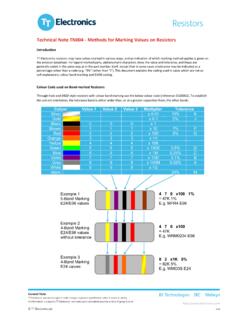
9 PTH Resistors use a color-coding system (whichPage 5 of 16really adds some flair to circuits), and SMD Resistors have their own value- marking the Color BandsThrough-hole, axial Resistors usually use the color-band system to display their value. Most of these Resistors will have four bands of color circling the resistor ,though you will also find five band and six band Band ResistorsIn the standard four band Resistors , the first two bands indicate the two most-significant digits of the resistor 's value. The third band is a weight value, whichmultiplies the two significant digits by a power of final band indicates the tolerance of the resistor . The tolerance explains how much more or less the actual resistance of the resistor can be compared towhat its nominal value is. No resistor is made to perfection, and different manufacturing processes will result in better or worse tolerances.
10 For example, a 1k resistor with 5% tolerance could actually be anywhere between and .How do you tell which band is first and last? The last, tolerance band is often clearly separated from the value bands, and usually it'll either be silver or and Six Band ResistorsFive band Resistors have a third significant digit band between the first two bands and the multiplier band. Five band Resistors also have a wider range oftolerances band Resistors are basically five band Resistors with an additional band at the end that indicates the temperature coefficient. This indicates the expectedchange in resistor value as the temperature changes in degrees Celsius. Generally these temperature coefficient values are extremely small, in the ppm resistor Color BandsWhen decoding the resistor color bands, consult a resistor color code table like the one below.