Transcription of Introduction to the Dobsonian Telescopes
1 1 Introduction to the Dobsonian TelescopesOne type of telescope that students in the astronomy class frequently use is a 10 - inchDobsonian telescope . These Telescopes are medium-size, as amateur Telescopes go (the amateurrage would be 4 to 20 inches in diameter); they are mechanically simplified for low price andease of almost all modern astronomical Telescopes , they are reflectors; the main optics is aconcave mirror located in thebottom of the tube. Light entersthe tube from a distant star on tothe main mirror at the bottom ofthe tube. From the main mirror,the light is then reflected to asecondary mirror, and thensideways out of the tube, on tothe lens of an attached eyepiecewhere the image is seen. (See thepicture).
2 This system of aconcave primary mirror and a plain secondary is called the Newtonian image formed by this system is viewed through an eyepiece. The magnification, M, ofthe telescope is calculated as followseyepieceobjectiveffM/=, where objectivef is the focal length of thetelescope, and eyepiecef is the focal length of the eyepiece. You can use various eyepieces of the telescope at an object needs some care. Due to magnification, the size of thefield you see in the eyepiece is little (not much more than the size of the Moon would fit in thetelescope), so you need to use an aiming device. Such a device, called a TELRAD, is mounted onthe side of the telescope . You ll need to get your star exactly in the middle of the bull s eye ,and then the star will show up in the eyepiece (you may want to dim the bull s eye so much thatit does not overwhelm the light of the star you are watching).
3 Once you aim your telescope at a star, you ll notice that it is moving and it quickly leavesthe field. Earth s rotation causes the sky turn (apparently), and the telescope magnifies thismotion. It takes only a minute or two for the star to move out of the field. As the stars move on a circle around the axis of Earth (which points at the North Star), once in 24 hours, thetelescope has to be turned around this same particular Telescopes are mounted such that they can turn around a vertical axis and ahorizontal axis. Such a mount is called an altazimuthal mount. When these Telescopes are used,the stars need to be tracked manually, by turning the telescope around both axes you have a star in the field, youhave to focus the telescope .
4 (Do not confusefocusing with aiming. When focusing, youmove the eyepiece closer or farther from themain mirror, making the image as sharp aspossible.) If you were glasses you shouldremove them and adjust the focus to your suityour vision (in order to place your eyes asclose to the eyepiece as possible). Turn thefocusing knob until the star appears to be assmall of a dot as you can make it. Every timeyou look in the telescope you ll need to focusit, because your eye changes all the time, andif other people use your telescope they will beadjusting the focus as that you want the stars to be as tinydots as you can make them. As you move theeyepiece far from focus in either direction, thestar looks like a large disk with a black hole inthe middle.
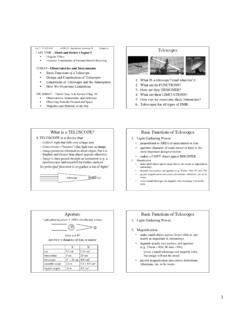
5 That is not the star s image youneed to turn the focuser knob to make the starlittle again and the black hole in the middleis simply the shadow of the secondary stars look like dots in a telescope ; their disks are so tiny that even the largest telescopescannot ever resolve telescope InformationHow we see images lens in the eye bends to a point called the focus .The distance from lens to the focus is the focal separation is how big an angle you can still perceive two separate stars as Human eye can only see 1/60th degree (1 arc minute)Also, the human eye transmits signal continuously to brain, so it cannot see very dim objects with them we can see much smaller angles and magnify the with them we can collect more light before saving the image, allowing us to see dimmer its essence, a telescope is an instrument that makes a far away object look closer.
6 To do this, a telescope has adevice that collects light from a distant object (objective lens or primary mirror) and brings that light (image) toa focus where a second device (eyepiece lens) magnifies the image and brings it to your are 2 types of Telescopes : Refracting(Uses Lenses)Example: 2 lenses -> 1 objective + 1 eyepieceWorks like eye with a focus from the front lens that meets the focus from the eyepiece. Reflecting(Uses Mirrors)Example: 1 main mirror + 1diagonal mirror + 1 eyepieceHas concave mirror at back that reflects light to another mirror that reflects into the eyepiece. How does the size of a telescope help see more? It can collect more light and give more angular sizes are referred to by the diameter of their primary mirror or lens.
7 ( 1 meter, 12 in)4 Basic telescope TermsDiverging -Lens or mirror that causes light to spread -Lens or mirror that causes light to come together to a focal Curved in. In a lens it causes light to diverge, but in mirror it causes light to converge toa focal -Curved out. In a mirror it causes light to diverge, but in lens it causes light to convergeto a focal of View - area of the sky that can be seen through the telescope with a given Length - distance required by a lens or mirror to bring the light to a Point or Focus - point at which light from a lens or mirror comes (power) - telescope 's focal length divided by the eyepiece's focal - how close two objects can be and yet still be detected as separate objects, usuallymeasured in arc-seconds (this is important for revealing fine details of an object, and is related to thetelescope's aperture).