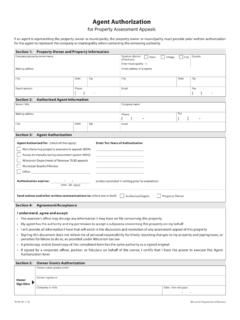
Transcription of 2019 Property Assessment Appeal Guide for Wisconsin Real ...
1 2020. Property Assessment Appeal Guide for Wisconsin real Property Owners (R. 1-20). 2020 Property Assessment Appeal Guide for Wisconsin real Property Owners Table of Contents I. Introduction .. 3. II. Property Taxes and Property Assessments .. 3. A. Property taxes.. 3. B. Property assessments.. 3. III. Assessment Process.. 4. A. Municipal assessor is responsible for the Assessment process .. 4. B. Assessment classification .. 4. IV. Municipal Assessor .. 6. A. Asssessment questions .. 6. B. Open Book .. 6. C. View of Property .. 7. V. Board of Review (BOR) .. 7. A. BOR members .. 7. B. BOR details .. 7. C. Removal of a BOR member .. 8. D. Review of Assessment by BOR .. 8. E. Appealing classification: agricultural, undeveloped or agricultural forest land .. 9. F. Appearance at the BOR .. 9. G. Evidence to present to the BOR .. 10. H. Witnesses/assessor .. 11. I. BOR decision .. 11. VI. Board of Assessors (BOA) .. 11. A. Cities with a BOA .. 11. B. BOA information.
2 11. VII. Appeal of BOR Determination .. 12. VIII. Reassessment .. 15. IX. Tax Appeals .. 15. X. Statutory References .. 17. XI. Glossary .. 17. XII. Form Examples .. 19. XIII. DOR Contact Information .. 21. Back to table of contents Wisconsin Department of Revenue 2. 2020 Property Assessment Appeal Guide for Wisconsin real Property Owners I. Introduction The purpose of this Guide is to help Property owners in Wisconsin understand how to Appeal an assessed value. II. Property Taxes and Property Assessments A. Property taxes Property taxes fund functions of government and education, including: Municipalities Counties Public Schools Technical Colleges State Reforestation Special Districts (sewer and lake rehabilitation). B. Property assessments Property assessments are the values the assessor places on taxable real and personal Property . An Assessment determines the portion of Property tax that is due from the Property . 1. Property assessments are based on: Amount a typical purchaser would pay for the Property under ordinary circumstances.
3 An exception is agricultural Property that is assessed based on its value in an agricultural use Note: Assessments should be uniform "at the full value which could ordinarily be obtained therefore at private sale" (sec. , Wis. Stats.). This is considered full value. 2. Classes of Property are assessed at different values 100 percent of full value Residential Commercial Manufacturing (state-assessed). Productive forest land Other (farm buildings and farm sites). Personal Property 50 percent of full value Undeveloped land Agricultural forest land Use-value Agricultural land Back to table of contents Wisconsin Department of Revenue 3. 2020 Property Assessment Appeal Guide for Wisconsin real Property Owners III. Assessment Process A. Municipal assessor is responsible for the Assessment process 1. Discover all real and personal Property is subject to tax unless exempted by law 2. List Property characteristics determine value 3. Value determine the value subject to Property tax B.
4 Assessment classification State law requires the assessor to classify land on the basis of use. Classification is important since it affects the assessed value. Drainage districts beginning with assessments as of January 1, 2017, the 2017 Wisconsin Act 115 created the following provision for drainage district corridors: the assessor shall assess the land within a district corridor described under s. in the same class under sub. (2)(a) as the land adjoining the corridor, if the adjoining land and the land within the corridor are owned by the same person.. Drainage districts are local governmental entities organized under a county drainage board for the primary purpose of draining lands for agriculture. A drainage district establishes a legal mechanism for managing drains and related facilities to ensure reliable drainage. Landowners who benefit from drainage must pay assessments to cover the cost of constructing, maintaining, and repairing district drains. Of the 72 counties in Wisconsin , 31 of them contain one or more drainage districts and can be located on an interactive map on the Wisconsin Department of Agriculture, Trade, and Consumer Protection website: Wisconsin Drainage Districts.
5 Eight statutory classifications for real Property 1. Residential (Class 1) sec. (2)(c)3., Wis. Stats. Any parcel or part of a parcel of untilled land that is not suitable for the production of row crops, on which a dwelling or other form of human abode is located Vacant land where the most likely use would be for residential development Mobile homes assessed as real Property are classified as residential Apartment buildings of up to three units are also classified as residential 2. Commercial (Class 2). Land and improvements primarily devoted to buying and reselling goods Includes the providing of services in support of residential, agricultural, manufacturing, and forest uses 3. Manufacturing (Class 3). State law (sec. , Wis. Stats.), provides for the state Assessment of manufacturing Property Contact the manufacturing district office for information on qualifying uses 4. Agricultural (Class 4). Sec. (2)(c)1g., Wis. Stats., defines agricultural as "land, exclusive of buildings and improvements, which is devoted primarily to agricultural use".
6 Land devoted primarily to the production of crops (excluding forestry operations) or the keeping, grazing, or feeding of livestock Buildings and dwellings associated with growing, production, and associated services enumerated above are classified as "Other" (Class 7). Agricultural Assessment Guide for Wisconsin Property Owners provides classification examples Back to table of contents Wisconsin Department of Revenue 4. 2020 Property Assessment Appeal Guide for Wisconsin real Property Owners 5. Undeveloped (Class 5) sec. (2)(c)4., Wis. Stats. Areas commonly called marshes, swamps, thickets, bogs, or wet meadows Fallow tillable land (assuming agricultural use is the land's highest and best use). Road right of way, ponds, depleted gravel pits Land because of soil or site conditions is not producing or capable of producing commercial forest products 6. Agricultural forest (Class 5m). Sec. (2)(c)1d, Wis. Stats., defines agricultural forest as land that is producing or is capable of producing commercial forest products, if the land satisfies any of the following: The forest land is contiguous to a parcel that has been classified in whole as agricultural land.
7 The forest land and the contiguous agricultural parcel must have the same owner. Contiguous includes separated only by a road. The forest land is located on a parcel that contains agricultural land for the January 1, 2004 Assessment , and on January 1 of the current Assessment year The forest land is located on a parcel where at least 50 percent of the acreage was converted to agricultural land for the January 1, 2005, Assessment year or thereafter Agricultural Assessment Guide for Wisconsin Property Owners provides classification examples 7. Productive forest land (Class 6) sec. (2)(c)2., Wis. Stats. Land, which is producing, or capable of producing commercial forest products. Forest land can no longer include buildings and improvements. Forested areas which are being managed or set aside to grow tree crops for "industrial wood" or to obtain tree products such as sap, bark, or seeds Forested areas with no commercial use made of the trees, including cutover Cherry orchards, apple orchards, and Christmas tree plantations are classified as agricultural Property Lands designated Forest Crop Land and Managed Forest Land by the Department of Natural Resources are entered separately in the Assessment roll Improvements on Forest Crop Lands and Managed Forest Land are to be listed as personal Property (secs.)
8 (1), and , Wis. Stats.). Forested areas primarily held for hunting, trapping, or in the operation of game preserves, should be classified as forest unless clearly operated as a commercial enterprise or exempt 8. Other (Class 7) sec. (2)(c)1m., Wis. Stats. Buildings and improvements on a farm (ex: houses, barns, and silos, along with the land necessary for their location and convenience). Back to table of contents Wisconsin Department of Revenue 5. 2020 Property Assessment Appeal Guide for Wisconsin real Property Owners IV. Municipal Assessor You (the owner) must contact the municipal assessor for your current Assessment and classification. DOR publishes the name of each municipality's assessor and contact information. Current year assessments are typically available before the fourth Monday in April. The assessor sends notification to each owner of real Property , or an owner with any improvements taxed as personal Property , whose total Assessment changed from the previous year.
9 The assessor is not required to provide notice if land is classified as agricultural land, as defined in sec. (2)(c)1g. Wis. Stats., for the current year and previous year and the difference between the assessments is $500 or less. If you do not receive a notice, it does not invalidate the Assessment . Under state law (sec. , Wis. Stats.), the notice must be in writing and mailed at least 15 days (30 days in revaluation years) before the Board of Review (BOR) meeting (or meeting of the Board of Assessors (BOA) if one exists). The notice contains the amount of the changed Assessment and the time, date, and place of the local BOR. (or BOA) meeting. The notice includes information on how to Appeal the Assessment . Note: The notice requirement does not apply to personal Property . A. Assessment questions Contact your assessor if you have questions about your Assessment When you meet with your assessor, review your Property records and discuss how your Assessment was made Assessors maintain a record of your Property , which includes a physical description and information on how your Assessment was developed These Property records are considered open records, which means the public has the right to inspect them.
10 This right does not include information gathered under a pledge of confidentiality or where access is restricted by law, such as personal Property returns You may also view the records for other properties Discussing your Assessment with the assessor may eliminate the need for a formal Appeal to the BOR. B. Open Book Attend the Open Book if you are unable to meet with your assessor highly recommended Open Book refers to a period of time (before BOR begins) when the completed Assessment roll is open for examination This period of time is an opportunity to discuss your Property value with the assessor and provide reason for changing the value, if appropriate Assessor must be present for at least two hours while the Assessment roll is open State law (sec. 70 .45, Wis. Stats.), requires the municipal clerk (or commissioner of assessments in first class cities) to publish or post a notice specifying the open book date(s) at least 15 days (30 days in revaluation years).