Example: barber
3. Carrier Modulation – Analog
Figure 3-1 Multiplication of a unit amplitude carrier by the factor k(t) ... the carrier amplitude increases and decreases in proportion to the information signal voltage. The modulation voltage is always positive and thus there are no ... calculated as the ratio of sideband power to total transmitted power. This is expressed below for
Tags:
Information
Domain:
Source:
Link to this page:
Documents from same domain
DS -V I G - EECS Instructional Support Group Home Page
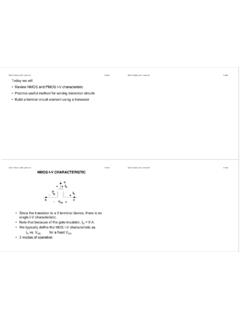
inst.eecs.berkeley.eduG D S I D I G-V DS + + V G S _ NMOS I-V CHARACTERISTIC • Since the transistor is a 3-terminal device, there is no single I-V characteristic. • Note that because of the gate insulator, I G = 0 A. • We typically define the MOS I-V characteristic as I D vs. V DS for a fixed V GS. • 3 modes of operation
Diodes and Transistors
inst.eecs.berkeley.eduDiodes and Transistors 1. ... basic semiconductor physics. We won’t discuss the details because the point of this ... switch. Below the specified ...
HSPICE Tutorial - University of California, Berkeley
inst.eecs.berkeley.eduHSPICE Tutorial Contents 1 Introduction 1 ... ee105 spice tutorial example 1 - simple rc circuit in the Results Browser and double-clicking vs and vo to plot them in the graph. You may have been able to guess from the netlist, but you’ll see that vsis a …
Introduction to LabVIEW - University of California, …
inst.eecs.berkeley.eduIntroduction to LabVIEW 1. Introduction Welcome to the LabVIEW component of EE100! This lab is just a simple introduction to the graphical circuit simulation ...
Introduction to LabVIEW For Use in Embedded …
inst.eecs.berkeley.eduUC Berkeley EE249 Hugo.Andrade@ni.com Introduction to LabVIEW For Use in Embedded System Development
EE105 –Fall 2015 Microelectronic Devices and Circuits
inst.eecs.berkeley.eduSummary of MOS Single-Transistor Amplifiers MOS Common Source Common Source with Deg. Common Drain Common Gate Ri ∞ ∞ ∞ Small Ro Large Very Large Small Large
Introduction to Digital Systems - University of …
inst.eecs.berkeley.eduDepartment of EECS EE100/42-43 Spring 2007 Rev. 1 Introduction to Digital Systems 0. Acknowledgments Many thanks to Prof. Bernhard Boser and National Instruments for funding this project in the
EE126: Probability and Random Processes - Lecture 1 ...
inst.eecs.berkeley.eduprobability 4 The probabilities summed over all of the base outcomes always equals 1 Example: Toss a fair coin twice 1 Base outcomes are HH,HT,TH,TT 2 This covers all the possibilities. M.E. 3 Each of these outcomes is equally likely 4 Assign each outcome a probability of 0:25. The list (set) of base outcomes is called the Sample Space.
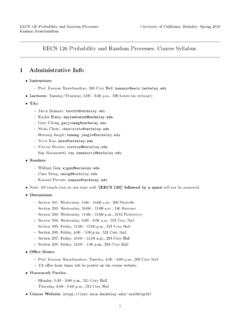
EECS 126 Probability and Random Processes: Course Syllabus ...
inst.eecs.berkeley.eduDescription: Probability is a mathematical discipline that allows one to reason about uncertainty: it helps us to predict uncertain events, to make better decisions under uncertainty, and to design and build systems. Throughout the course, we will teach you the fundamental ideas of probability and random processes along with the labs.
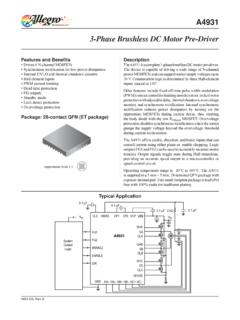
3-Phase Brushless DC Motor Pre-Driver
inst.eecs.berkeley.eduDescription The A4931 is a complete 3-phase brushless DC motor pre-driver . The device is capable of driving a wide range of N-channel power MOSFETs and can support motor supply voltages up to
Related documents

Lesson 7.2.2 Setting Up and Solving Proportions
images.pcmac.orgA ratio is the comparison of two quantities by division. We also, learned about proportions. A proportion states that 2 ratios are equal. We learned that you can use cross multiplication to determine if 2 ratios are equal to each other. We also solved proportions that had a variable. Anticipatory Set
The Mathematics of Ratios, Rates and Proportions Teaching ...
montereyinstitute.orgLesson 1: Ratio and Rates Topic 1: Simplifying Ratios and Rates Learning Objectives Write ratios and rates as fractions in simplest form. Find unit rates. Find unit prices. Lesson 2: Proportions Topic 1: Understanding Proportions Learning Objectives Determine whether a proportion is true or false. Find an unknown in a proportion.
NEWCOLORs basic math rev - Student Affairs & Diversity
students.iusb.eduA ratio is a comparison of two quantities with the same units. For example, a class with 23 students has a student–teacher ratio of 23:1 or . PROPORTIONS A proportion is a statement in which two ratios or rates are equal. An example of a proportion is the following statement: 30 dollars is to 5 hours as 60 dollars is to 10 hours. This is written.
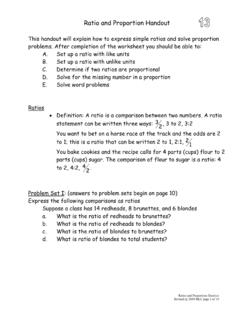
Ratio and Proportion Handout - Tri-Valley Local Schools
www.tri-valley.k12.oh.usD. Solve for the missing number in a proportion E. Solve word problems Ratios • Definition: A ratio is a comparison between two numbers. A ratio statement can be written three ways: 2 3 , 3 to 2, 3:2 You want to bet on a horse race at the track and the odds are 2 to 1; this is a ratio that can be written 2 to 1, 2:1, 1 2

1 Probability, Conditional Probability and Bayes Formula
www2.isye.gatech.edusymmetric. All sides are “equiprobable”. The probability of 6, in our example is a ratio of the number of favorable outcomes (in our example only one favorable outcome, namely, 6 itself) and the number of all possible outcomes, 1/6.2 1Piaget, J. and Inhelder B. The Origin of the Idea of Chance in Children, W. W. Norton & Comp., N.Y.