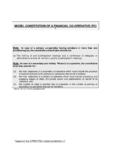
Transcription of Application for registration guideline for Co …
1 Application for registration guideline for Co-operative Financial Institution Guidance Note on Application for registration as a Co-operative Financial Institution 2 1. Introduction. guidelines are hereby provided for the completion of the Application to register as a CFI on form CBDA001 and should be read in conjunction with: The Co-operative Act No 14 of 2005 (The Act) The Co-operative Banks Act 40 of 2007, (Co-op Banks Act) Supervisory and regulatory rules (Rules) for CFIs applying for registration to the CBDA, and Government Notice as gazette from time to time, the latest being 35368, No 404 of May 2012 (Exemption Notice). 2. Legislations. A Co-operative Financial Institution (CFI) shall at all-time subject itself to the supervision and regulations of the CBDA as per The Exemption Notice Section 3(a), and the Rules for an Application to register a CFI will be considered once it: a) Meets all requirements for registration in term of the Co-operatives Act; b) Meets all requirements of the Exemption Notice; c) Meets the requirements of the CBDA Rules, prudential and operational standards published by the CBDA; and d) Meets all the requirements for membership of the representative body and provide a valid representative body membership certificate (if applicable).
2 Note: CFIs are requested to submit their completed applications directly to the CBDA until a representative body is registered and its administrative processes are set up to facilitate this process. 3. Minimum requirements for registration as CFI. Based on 2 ( ) above, for an Application to be considered for Application as a CFI, it must meet the following minimum requirements: a) 200 members b) R100,000 in share capital; Guidance Note on Application for registration as a Co-operative Financial Institution 3 c) The institution is solvent1; d) Members of a co-operatives that chooses to identify itself by use of the name Financial Co-operative, Financial Services Co-operative, Credit Union or Savings and Credit Co-operative; e) It meets the common bond requirements as per the Exemption Notice which requires its members to: i. Consist of persons who are employed by common employer(s) or who are employed within the same business district; or ii.
3 Have common membership in an association or organisation, including religious, social, co-operative, labour or educational groups; or iii. Reside within the same defined community, rural or urban district; or iv. Members of a secondary financial co-operative consisting of registered primary financial co-operatives. ) The co-operative must also comply with the following co-operative principles: a) Voluntary and open membership, (without gender, social, racial, political, or religious discrimination); b) Democratic member control, (co-operative is owned and controlled by their members, that one member has one vote); c) Member economic participation, (benefits to membership is in proportion to the transaction with the co-operative); d) Autonomy and independence, (co-operative is a self-help organisation controlled by their members); e) Education, training and information, (should be provided to the members and employees for the development of the co-operative); f) Co-operation among co-operative, (by working together with other co-operatives local, state, regional, national and international structures to strengthen the co-operative movement).
4 1 Solvency is defined as the degree to which the total assets of the institution exceed the total liabilities. It can also be defined as ability of an institution to meets its long term obligations. Solvency Ratio is equal to [(Total Assets + Allowances for Risk Assets) (Balance of Loans Delinquent greater than 12 months + (Balances of Loans Delinquent from 1 to 12 months) + Total liabilities + Problem Assets Total Savings)]/(Total Savings + Total Shares). Guidance Note on Application for registration as a Co-operative Financial Institution 4 g) Concern for community, (should work for the sustainable development of communities). ) Meets all the requirement of the Companies and Intellectual Property Commission (CIPC) for registration as a co-operative; ) Meets all the requirement of the CBDA as per the rules.
5 4. registration procedure for a co-operative with CIPC. It is important to remember that registering a deposit taking CFI requires that you have authorisation to take deposits. This can only be obtained after first applying for registration to the CBDA, who, on approving your Application , will forward all the above documentation to the CIPC. Your registration as a co-operative and financial co-operative is only completed once the CIPC approves your Application . Please note that before lodging an Application as a co-operative to CBDA, a formation meeting must been held ( ), a customer code must have been created ( ) and a reservation of name must have been reserved ( - if preferred), and supported by all relevant CIPC registration documentation requirements (please see below) ) Formation Meeting a) A Formation meeting is held once the founding members have done the initial ground work to establish the CFI.
6 This would include speaking to interested parties, drafting a constitution, business plan and various policies that will be required from the co-operative. b) Once all the above has been completed, the formation meeting needs to be held with all persons that are interested in establishing the co-operative. At the formation meeting: i. A chairperson is nominated for the meeting ii. The initiators will outlines the aims and objectives of the proposed co-operative; iii. All the arising questions should be answered; Guidance Note on Application for registration as a Co-operative Financial Institution 5 iv. Everyone, who meets the membership requirements, should be invited to join; v. Those interested should be given an Application form for Membership to complete; vi. The persons that have completed the above-mentioned Application confirm how many directors will be required to direct the co-operative; vii.
7 The signed up members will then elect the inaugural board of directors. c) The following are also discussed and agreed upon: i. The Objectives (exactly what the co-operative will do); ii. Chosen name for the co-operative (and alternative names in case the first name is already registered by another enterprise). See notes under for more information in this regard; iii. Where will the premises (co-operative office) be located; iv. The equipment, premises and other materials needed by the enterprise v. Table the business plan; vi. How will the co-operative be financed? How will the funds be obtained? vii. Complete and lodge the necessary Application documents explained hereunder, and viii. Register as a CIPC customer by creating a customer code and pay the required fees. (See notes fewer than for more information in this regard).
8 Customer Code a) Before a co-operative can transact with the CIPC for an Application as a co-operative, it needs to register as a Customer , and deposit sufficient funds into the online CIPC account required for the specific service. Guidance Note on Application for registration as a Co-operative Financial Institution 6 b) A customer is any natural or legal person requiring interaction with the CIPC. A customer code is required in order to perform any transactions on the CIPC website, and also monitoring applications submitted under the customer code. c) Customer code can be created by generating 6 digits and the registration is free of charge. d) A Customer can register as a CIPC Customer by doing the following: i. Registering Online at ii. Visit the CIPC Office in Pretoria (The DTI Campus, Block F, 77 Meintjies Street, Sunnyside, PRETORIA).
9 Iii. Visit the CIPC Provincial Partners ( Provincial SEDA) to register online. iv. After submitting the Application to register as a CIPC customer, the account will be activated immediately. e) Registering as a customer automatically establishes a virtual account in the name of the customer at CIPC. Before using any fee carrying services, a customer must deposit sufficient funds into his / her virtual account to perform such services. All prescribed disclosure and lodgement fees that are applicable will be deducted from the virtual account and ensuring that the reference number is clearly indicated, to enable CIPC to allocate the funds to the relevant customer account. f) To activate the virtual account (online account), into which you can deposit funds, email the Application with a customer code to or fax to: 086 673 8168.
10 G) The following payment options also exists: i. CIPC Office, (Only cash payments). ii. Electronic deposit (EFT, (You only need to quote your customer code in the reference field. The date and sequence number are not required). iii. Any ABSA bank. You need to quote your customer code - supplement it by the full date of payment and sequence number, to make sixteen Guidance Note on Application for registration as a Co-operative Financial Institution 7 characters MAKGOS1204201101. Allow 24 hours for funds to be allocated to your customer code. iv. Any other bank. Allow 2-3 days for funds to be allocated v. CIPC bank details are as follows: Bank ABSA Account Type Transmission Account Account Name CIPC Account Number 4055 68 1017 Branch Name Van der Walt Street Payment Reference CUSTOMER CODE DATE (DDMMYYYY) AND 01 (If the Reference Number is less than six characters long then use trailing zeros.)