Example: tourism industry
CHAPTER 7: THE CRYSTALLINE SOLID STATE
The conductivity of carbon nanotubes is a function of the diameter of the tubes, and spans the range associated with semiconductors to metallic conductors, up to approximately 1000 times the conductivity of copper (Section 8.6.1).
Tags:
Information
Domain:
Source:
Link to this page:
Documents from same domain
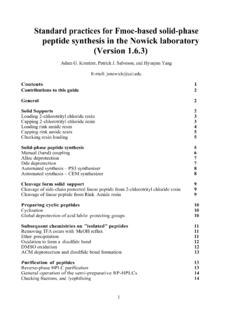
Standard practices for Fmoc-based solid-phase …
www.chem.uci.eduStandard practices for Fmoc-based solid-phase peptide synthesis in the Nowick laboratory (Version 1.6.1) Adam G. Kreutzer and Patrick J. Salveson

An Introduction to Fluorescence Spectroscopy
www.chem.uci.eduAn Introduction to Fluorescence Spectroscopy 3 Table of Contents ... molecular extinction coefficient of the compound; in other words, the corrected
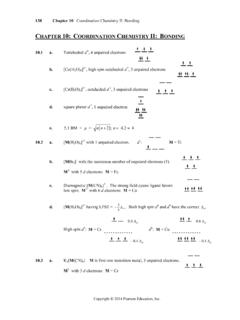
CHAPTER 10: COORDINATION CHEMISTRY II: BONDING
www.chem.uci.edu10.8 Co(II) is d 7. In tetrahedral complexes, it is generally high spin and has 3 unpaired electrons; in In tetrahedral complexes, it is generally high spin and has 3 unpaired electrons; in octahedral complexes, it is also typically high spin and also has 3 unpaired electrons; in square

Dynamic Light Scattering Training
www.chem.uci.eduwww.atascientific.com.au Mie Theory › Mie theory is an exact description of how spherical particles of all sizes and optical properties scatter light › When particles become larger than /10, the scattering changes from being isotropic to a distortion in the
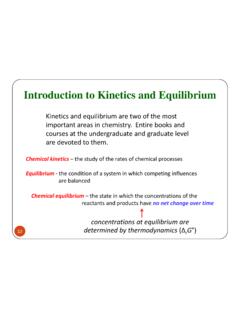
Introduction to Kinetics and Equilibrium
www.chem.uci.eduIntroduction to Kinetics and Equilibrium Kinetics and equilibrium are two of the most ... At iitill tii lPClA system initially containing only PCl 5 at t ti f 0 100t a concentration of 0.100 M has a Q c = 0, which is less than 0.030. What are the equilibrium concentrations

Introductionto FourierTransform InfraredSpectrometry ...
www.chem.uci.eduof material present. With modern software algorithms, infrared is an excellent tool for quantitative analysis. Older Technology. The original infrared instruments were of the . dispersive. type. These instruments separated the individual frequencies of energy emitted from the infrared source. This was accomplished by the use of a prism or grating.
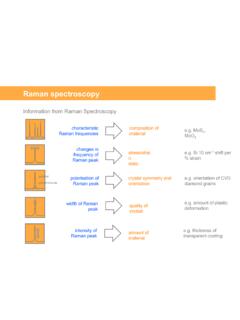
Raman spectroscopy
www.chem.uci.eduFrom the Renishaw Raman software the user can select: • a fixed grating measurement with a spectrum 'window' of 400 cm-1 to 1000 cm (configuration dependent) • a unique 'extended scanning' facility allowing the user to choose any Raman shift range up to about 10000 cm-1 (configuration dependent). Essential for extended range
A Second Application of Symmetry
www.chem.uci.eduWe can use character tables to determine the symmetry of all 18 motions and then assign them to translation, rotation, or vibration. We can also tell which vibrations are IR or Raman active. Procedure: 1. Assign x,y,z coordinates to each atom. 2. Determine how each axis transforms for every class of symmetry operation in the group.

Coordination Chemistry II: Ligand Field Theory Continued
www.chem.uci.eduCoordination Chemistry II: Ligand Field Theory Continued Chapter 10 Wednesday, November 25, 2015. Adding Metal Electrons e g e g * a1g a1g * t1u t1u * t2g Metal ions typically have some valence electrons that can be accommodated in the metal d …
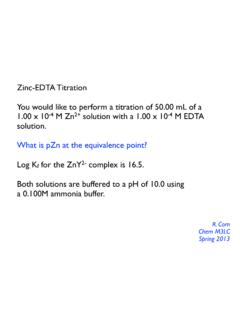
Zinc-EDTA Titration
www.chem.uci.eduZinc-EDTA Titration You would like to perform a titration of 50.00 mL of a 1.00 x 10⁻⁴ M Zn2+ solution with a 1.00 x 10⁻⁴ M EDTA solution. What is pZn at the equivalence point? Log K f for the ZnY2-complex is 16.5. Both solutions are buffered to a pH of 10.0 using
Related documents

Characterizing Carbon Materials with Raman Spectroscopy
assets.thermofisher.comCarbon Nanotubes: Carbon nanotubes are essentially rolled up graphene sheets that have been sealed to form hollow tubes. Single-wall carbon nanotubes (SWCNT) are cylindrical tubes with a single outer wall with diameters that are usually only 1 – 2 nm. There are also double-wall carbon nanotubes (DWCNT) which have a second layer of graphene ...

Environmental Impacts of Nanotechnology and Its Products
faculty.atu.eduCarbon nanotubes have applications in many materials for memory storage, electronic, batteries, etc. However, some scientists have concerns about carbon nanotubes because of unknown harmful impacts to the human body by inhalation into lungs, and initial data suggests that carbon nanotubes have similar toxicity to asbestos fiber11. Lam et al ...

High-cycle Fatigue Life Extension of Glass Fiber/ Polymer ...
www.jwutms.netcarbon nanotubes (CNTs) to the matrix results in a si gnificant increase in the high-cycle fatigue life. It is proposed that carbon nanotubes tend to inhibit the formation of large cracks by nucleating nano-scale damage zones. In addition, the contribution to energy absorption from the fracture of nanotubes

The Raman Spectroscopy of Graphene and the Determination ...
tools.thermofisher.comallotropes of carbon (i.e. diamond, carbon nanotubes, buckminster fullerenes, carbon nanoribbons, etc.) where the different forms differ only in the relative position of their carbon atoms and the nature of their bonding to one another. Indeed, Raman has evolved into an indispensable tool in laboratories pursuing research into the nascent field ...

Graphene’s health effects summarised in new guide
ec.europa.euAlmost all carbon nanomaterials are based on variations of graphene, a one atom thick honeycomb-like arrangement of carbon atoms. Graphene can be stacked, wrapped or rolled, to form graphite, football-like ‘buckyballs’ or carbon nanotubes (CNTs), respectively.
Engineering Project Proposal
deepblue.lib.umich.educarbon nanotubes (CNTs). CNTs show immense prospect in applications across many industries, including microelectronics and advanced composites. For many of these applications the growth of isolated vertical CNTs is required. Chemical vapor deposition (CVD) processes are currently commonplace for growing CNTs.

Nanoparticle Characterization and Application: An Overview
www.ijcmas.comsheets of carbon called graphene. These sheets are rolled at specific and discrete ("chiral") angles and the combination of the rolling angle and radius decides the nanotube properties; for example, whether the individual nanotube shell is a metal or semiconductor. Nanotubes are categorized as single-walled nanotubes (SWNTs) and
Carbon Nanotubes - University of Washington
courses.cs.washington.eduCarbon Nanotubes By Chris Scoville, Robin Cole, Jason Hogg, Omar Farooque, and Archie Russell Introduction The Amazing and Versatile Carbon – Chemical basis for life With an atomic number of 6, Carbon is the 4th most abundant element in the Universe by mass after

Hydrogen Storage - Energy
www.hydrogen.energy.gov• Doped single-wall nanotubes (SWNTs) synthesized and capacity measured to be ~2.5 - 3 wt.% hydrogen storage • Binding energies calculated and optimum compounds theoretically predicted for potential storage materials C C 48B 12[ScH(H 2) 5] 12 48B 12[ScH] 12 60H 2 Heben, Dillon, et al NREL, Golden, CO Potential for 8.8 wt%