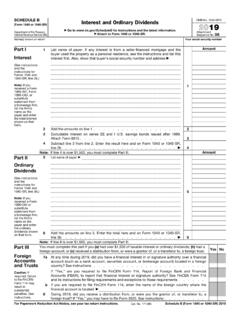
Transcription of Dividends Ordinary Interest and
1 Userid: CPMS chema: i1040xLeadpct: 100%Pt. size: 10 Draft Ok to PrintAH XSL/XMLF ileid: .. /I1040 SCHB/2020/A/XML/Cycle04/source(Init. & Date) _____Page 1 of 3 14:41 - 3-Nov-2020 The type and rule above prints on all proofs including departmental reproduction proofs. MUST be removed before of the TreasuryInternal Revenue Service2020 Instructions for Schedule BInterest and Ordinary DividendsUse Schedule B (Form 1040) if any of the following applies. You had over $1,500 of taxable Interest or Ordinary Dividends . You received Interest from a seller-financed mortgage and the buyer used the property as a personal residence.
2 You have accrued Interest from a bond. You are reporting original issue discount (OID) of less than the amount shown on Form 1099-OID. You are reporting Interest income of less than the amount shown on a Form 1099 due to amortizable bond premium. You are claiming the exclusion of Interest from series EE or I savings bonds issued after 1989. You received Interest or Ordinary Dividends as a nominee. You had a financial Interest in, or signature authority over, a financial account in a foreign country or you received a distribution from, or were a grantor of, or transfer-or to, a foreign references are to the Internal Revenue Code unless otherwise DevelopmentsFor the latest information about devel-opments related to Schedule B (Form 1040) and its instructions, such as legis-lation enacted after they were published, go to InstructionsYou can list more than one pay-er on each entry space for lines 1 and 5, but be sure to clearly show the amount paid next to each pay-er s name.
3 Add the separate amounts paid by the payers listed on an entry space and enter the total in the Amount column. If you still need more space, attach separate statements using the same format as lines 1 and 5, but show your totals on Schedule B. Put your name and social security number (SSN) on the statements and attach them at the end of your I. InterestLine 1. Report on line 1 all of your tax-able Interest . Taxable Interest generally should be shown on your Forms 1099-INT, Forms 1099-OID, or substi-tute statements. Include Interest from series EE, H, HH, and I savings TIPbonds.
4 Also include any accrued market discount that is includible in income and any gain on a contingent payment debt instrument that is includible in income as Interest income. List each payer s name and the amount. Don't report on line 1 any tax-exempt Interest . See Tax-exempt Interest , later, for more more information on stated inter-est, original issue discount (OID), mar-ket discount, contingent payment debt instruments, and premium, see Pub. 550 and Pub. financed mortgages. If you sold your home or other property and the buyer used the property as a personal residence, list first any Interest the buyer paid you on a mortgage or other form of seller financing.
5 Be sure to show the buyer s name, address, and SSN. You must also let the buyer know your SSN. If you don't show the buyer s name, ad-dress, and SSN, or let the buyer know your SSN, you may have to pay a $50 If you received a Form 1099-INT that includes Interest you re-ceived as a nominee (that is, in your name, but the Interest actually belongs to someone else), report the total on line 1. Do this even if you later distrib-uted some or all of this income to others. Under your last entry on line 1, put a subtotal of all Interest listed on line 1. Below this subtotal, enter Nominee Distribution and show the total Interest you received as a nominee.
6 Subtract this amount from the subtotal and enter the result on line you received Interest as a nominee, you must give the ac-tual owner a Form 1099-INT (unless the owner is your spouse) and file Forms 1096 and 1099-INT with the IRS. For more details, see the General Instructions for Certain Information Re-turns and the Instructions for Forms 1099-INT and Interest . When you buy bonds between Interest payment dates and pay accrued Interest to the seller, this Interest is taxable to the seller. If you received a Form 1099 for Interest as a purchaser of a bond with accrued in-terest, follow the rules earlier under Nominees to see how to report the ac-crued Interest .
7 But identify the amount to be subtracted as Accrued Interest . Original issue discount (OID). If you are reporting OID in an amount less than the amount shown in box 1 or box 8 of Form 1099-OID, follow the rules earlier under Nominees to see how to report the OID. But identify the amount to be subtracted as OID Adjust-ment. However, if the payer reported to you a net amount of OID on the bond re-flecting the offset of the gross amount of OID by any acquisition premium, no re-duction of the amount of OID income TIPB-1 Nov 03, 2020 Cat. No. 70541 YPage 2 of 3 Fileid: .. /I1040 SCHB/2020/A/XML/Cycle04/source14:41 - 3-Nov-2020 The type and rule above prints on all proofs including departmental reproduction proofs.
8 MUST be removed before to you by the payer may be needed on Schedule B for the bond premium. If you elect to reduce your Interest income on a taxable bond by the amount of taxable amortizable bond premium, follow the rules earlier under Nominees to see how to report the Interest . But identify the amount to be subtracted as ABP Ad-justment. However, if the payer repor-ted to you a net amount of Interest in-come on the bond reflecting the offset of the gross amount of Interest income by the amortizable bond premium, no re-duction of the amount of Interest income reported to you by the payer is needed on Schedule B for the Interest .
9 If you received any tax-exempt Interest (including any tax- exempt OID), such as from munici-pal bonds, each payer should send you a Form 1099-INT or a Form 1099-OID. In general, your tax-exempt stated Interest should be shown in box 8 of Form 1099-INT or, for a tax-exempt OID bond, in box 2 of Form 1099-OID, and your tax-exempt OID should be shown in box 11 of Form 1099-OID. Enter the total on line 2a of your Form 1040 or 1040-SR. However, if you acquired a tax- exempt bond at a premium, only re-port the net amount of tax-exempt inter-est on line 2a of your Form 1040 or 1040-SR (that is, the excess of the tax- exempt Interest received during the year over the amortized bond premium for the year).
10 Also, if you acquired a tax-exempt OID bond at an acquisition premium, only report the net amount of tax-exempt OID on line 2a of your Form 1040 or 1040-SR (that is, the excess of the tax-exempt OID for the year over the amortized acquisition premium for the year). See Pub. 550 for more informa-tion about OID, bond premium, and ac-quisition include on line 2a of your Form 1040 or 1040-SR, any exempt- Interest Dividends from a mutual fund or other regulated investment company. This amount should be shown in box 11 of Form an amount is shown in box 9 of Form 1099-INT, you must generally re-port it on line 2g of Form 6251.