Transcription of ELECTROPHILIC AROMATIC SUBSTITUTION …
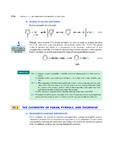
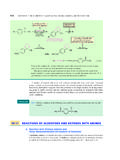
1 762 CHAPTER 16 THE CHEMISTRY OF BENZENE AND ITS Show two different Friedel Crafts acylation reactions that can be used to prepare the follow-ing following compound reacts with AlCl3followed by water to give a ketone Awith the for-mula C10H10O. Give the structure of Aand a curved-arrow mechanism for its AROMATIC SUBSTITUTION reactions OF SUBSTITUTED BENZENESA. Directing Effects of SubstituentsWhen a monosubstituted benzene undergoes an ELECTROPHILIC AROMATIC SUBSTITUTION reaction,three possible disubstitution products might be obtained. For example, nitration of bromoben-zene could in principle giveortho-,meta-,orpara-bromonitrobenzen e.
2 If SUBSTITUTION weretotally random, an ortho : meta : para product ratio of 2 : 2 : 1 would be expected. (Why?) It isfound experimentally that this SUBSTITUTION isnotrandom, but ELECTROPHILIC SUBSTITUTION reactions of bromobenzene also give mostly ortho and paraisomers. If a substituted benzene undergoes further SUBSTITUTION mostly at the ortho and parapositions, the original substituent is called an ortho, para-directing , bromine isan ortho, para-directing group, because all ELECTROPHILIC SUBSTITUTION reactions of bromoben-zene occur at the ortho and para contrast, some substituted benzenes react in ELECTROPHILIC AROMATIC SUBSTITUTION to givemostly the meta disubstitution product.
3 For example, the bromination of nitrobenzene gives onlythe meta ELECTROPHILIC SUBSTITUTION reactions of nitrobenzene also give mostly the meta a substituted benzene undergoes further SUBSTITUTION mainly at the meta position, the origi-( )NO2 NO2 Mi"iBr"nitrobenzenem-bromonitrobenzene(o nly product observed)Br2 FeBr3heat( )iBrNO2 NO2 MNO2 M"iBr"iBr"iBr""o-bromonitrobenzene(36%)p -bromonitrobenzene(62%)m-bromonitrobenze ne(2%)HNO3acetic acid++bromobenzeneCOClLLLSLH3 CCH2CH2 LLLSOCCH3CH3CH3cc)) 11/26/08 9:07 AM Page ELECTROPHILIC AROMATIC SUBSTITUTION reactions OF SUBSTITUTED BENZENES763nal substituent group is called a meta-directing , the nitro group is a meta-directing group because all ELECTROPHILIC SUBSTITUTION reactions of nitrobenzene occur at themeta substituent group is either an ortho, para-directing group or a meta-directing group inall ELECTROPHILIC AROMATIC SUBSTITUTION reactions ;that is, no substituent is ortho, para directingin one reaction and meta directing in another.
4 A summary of the directing effects of commonsubstituent groups is given in the third column of Table Using the information in Table , predict the product(s) of(a)Friedel Crafts acylation of anisole (methoxybenzene) with acetyl chloride (structure inEq. ) in the presence of one equivalent of AlCl3 followed by H2O.(b) Friedel Crafts alkylation of a large excess of ethylbenzene with chloromethane in thepresence of of Directing and Activating or Deactivating Effects of Some Common Functional Groups (Groups are listed in decreasing order of activation.)Activating or Substituent groupName of groupDirecting effectdeactivatingaminohydroxyalkoxyacyl aminoLRalkylacyloxyphenyl,halogensacylLS O3 Hsulfonic acidLCNcyanoLNO2nitroC$RO*Lcarboxy, carboxamido,carboalkoxyC,$OHO*LC,$NH2O*L C$ORO*LF311LI311 LBr311 LCl311L,,,LCO$RO*LL22 CNH$RO*LL2 ORL22 OHL22NH2,L2NR2L2 TABLE , 11/26/08 9:07 AM Page 763764 CHAPTER 16 THE CHEMISTRY OF BENZENE AND ITS DERIVATIVEST hese directing effects occur because ELECTROPHILIC SUBSTITUTION reactions at one position ofa benzene derivative are much faster than the same reactions at another position.
5 That is, thesubstitution reactions at the different ring positions are in competition. For example, in , o- and p-bromonitrobenzenes are the major products because the rate of nitration isgreater at the ortho and para positions of bromobenzene than it is at the meta position. Under-standing these effects thus requires an understanding of the factors that control the ratesofaromatic SUBSTITUTION at each , Para-Directing GroupsAll of the ortho, para-directing substituents in Table either alkyl groupsor groups that have unshared electron pairs on atoms directly attachedto the benzene other types of ortho, para-directing groups are known, the prin-ciples on which ortho.
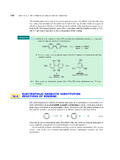
6 Para-directing effects are based can be understood by considering elec-trophilic SUBSTITUTION reactions of benzene derivatives containing these types of imagine the reaction of a general electrophile E|with anisole (methoxybenzene). No-tice that the atom directly attached to the benzene ring (the oxygen of the methoxy group) hasunshared electron pairs. Reaction of E|at the para position of anisole gives a carbocation in-termediate with the following four important resonance structures:The colored structure shows that the unshared electron pair of the methoxy group candelocalize the positive charge on the carbocation.
7 This is an especially important structure be-cause it contains more bonds than the others, and every atom has an the electrophile reacts with anisole at the meta position, the carbocation intermediatethat is formed has fewer resonance structures than the ion in Eq. In particular, thecharge cannot be delocalized onto the LOCH3group when reaction occurs at the is no structure that corresponds to the colored structure in Eq. the oxygen to delocalize the charge, it must be adjacent to an electron-deficient carbon, asin Eq. The resonance structures show that the positive charge is shared on alternatecar-( )E||||OCH3rMOCH312 MOCH31212 MOCH312M!
8 !EHH"ss))EH))EH)) Draw the carbocation that results from the reaction of the electrophile at the ortho positionof anisole; show that this ion also has four resonance ( )OCH3HE||r12 MOCH312MM!p|OCH312 MtHE))HE))para!|OCH312M|OCH31(toHE))HE)) 11/26/08 9:07 AM Page ELECTROPHILIC AROMATIC SUBSTITUTION reactions OF SUBSTITUTED BENZENES765bons of the ring. When meta SUBSTITUTION occurs, the positive charge is not shared by the carbonadjacent to the now use the resonance structures in Eqs. and (as well as those you drew inProblem ) to assess relative rates. The logic to be used follows the general outline givenin Study Problem , page 715.
9 A comparison of Eq. and the structures you drew forProblem with Eq. shows that the reaction of an electrophile at either the ortho orpara positions of anisole gives a carbocation with more resonance structures that is, a morestable carbocation. The rate-limiting step in many ELECTROPHILIC AROMATIC SUBSTITUTION reactionsis formation of the carbocation s postulate (Sec. ) suggests thatthe more stable carbocation should be formed more rapidly. Hence, the products derived fromthe more rapidly formed carbocation the more stable carbocation are the ones the reaction of the electrophile at an ortho or para position of anisole gives a more sta-ble carbocation than the reaction at a meta position, the products of ortho, para SUBSTITUTION areformed more rapidly, and are thus the products observed (see Fig.)
10 This is why theLOCH3group is an ortho, para-directing summarize: Substituents containing atoms with unshared electron pairs adjacent to thebenzene ring are ortho, para directors in ELECTROPHILIC AROMATIC SUBSTITUTION reactions becausetheir electron pairs can be involved in the resonance stabilization of the carbocation imagine the reaction of an electrophile E|with an alkyl-substituted benzene such astoluene. Alkyl groups such as a methyl group have no unshared electrons, but the explanationreaction coordinatesCH3O21rMCH3O21+ E|DG8 (para SUBSTITUTION )(a)`more stablecarbocationintermediateCH3O21`!