Example: barber
Entropy Changes in Reversible and Irreversible Processes
The entropy is an extensive property measured in joule per Kelvin per mole (JK. −1. mol. −1). The most important significance of entropy is that it can be used to measure the randomness in the system. Entropy Changes in Reversible Processes Suppose that the heat absorbed by the system and heat lost by the surrounding are under completely
Tags:
Information
Domain:
Source:
Link to this page:
Documents from same domain

Schrodinger Wave Equation for a Particle in One ...
www.dalalinstitute.comEntropy Changes in Reversible and Irreversible Processes ..... 87 Variation of Entropy with Temperature, Pressure and Volume ..... 92 Entropy Concept as a Measure of Unavailable Energy and Criteria for the Spontaneity of Reaction

π-Bonding and Molecular Orbital Theory
www.dalalinstitute.comHence, the crystal field splitting Δ o increases and the bond between the ligand and the metal strengthens when metal to ligand bonding takes place. 3. When ligand π-orbitals are empty as well as filled: There are many ligands, like I–, which have both filled p-orbitals as well as vacant d-orbitals of π symmetry.
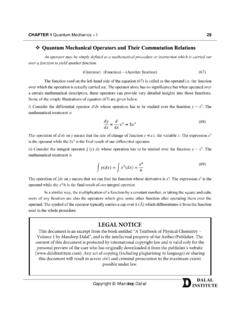
Quantum Mechanical Operators and Their Commutation …
www.dalalinstitute.comVolume 1 by Mandeep Dalal”, and is the intellectual property of the Author/Publisher. The content of this document is protected by international copyright law and is valid only for the ... Quantum Mechanical Operators and Their Commutation Relations ...
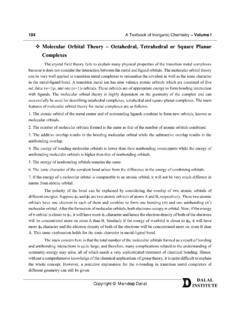
Molecular Orbital Theory – Octahedral, Tetrahedral or ...
www.dalalinstitute.commolecular orbital. After the formation of molecular orbitals, both electrons occupy σ-orbital. Now, if the energy of σ-orbital is closer to ϕA, it will have more ϕA character and hence the electron density of both of the electrons will be concentrated more on atom A than B. Similarly if the energy of σ-orbital is closer to ϕB, it will have

Jahn-Teller Effect - Dalal Institute
www.dalalinstitute.comCFSE due to distortion = Energy of the distorted complex (E2) − Energy of the complex without distortion (E1) E1o) E1o E2o – δ2/3) E2o – δ2/3 CFSE due to distortion = E2 – E1 = –δ2/3 Hence, the crystal field stabilization due to z-out distortion is –δ1/3. Moreover, it is worthy to note that this
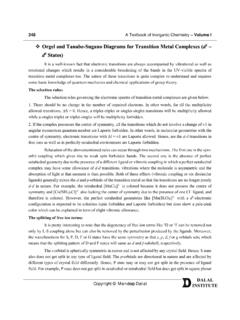
Orgel and Tanabe-Sugano Diagrams for Transition Metal ...
www.dalalinstitute.comcomplex may have some allowance of d-d transitions. vibrations where the molecule is asymmetric and the absorption of light at that moment is then possible. Both of these effects (vibronic coupling or six dissimilar ligands) generally mixes the d and p-orbitals of the transition metal so that the transitions are no longer purely d-d in nature.
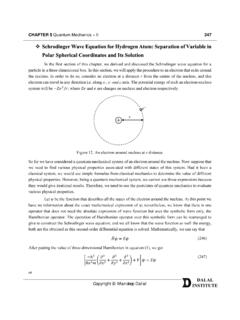
Schrodinger Wave Equation for Hydrogen Atom: Separation …
www.dalalinstitute.comSchrodinger Wave Equation for Hydrogen Atom: Separation of Variable in Polar Spherical Coordinates and Its Solution In the first section of this chapter, we derived and discussed the Schrodinger wave equation for a particle in a three-dimensional box. In this section, we will apply the procedure to an electron that exits around the nucleus.

Mechanism of Electron Transfer Reactions – Types; Outer ...
www.dalalinstitute.comThe mechanism by which the electron transfer occurs in transition metal complexes can be classified into two types as given below. Outer Sphere Electron Transfer Mechanism In this mechanism, there is a direct transfer of electrons from the reductant to oxidant and the coordination sphere remains intact.
Related documents
Principle of Maximum Entropy - Massachusetts Institute of ...
mtlsites.mit.eduThe entropy has its maximum value when all probabilities are equal (we assume the number of possible states is finite), and the resulting value for entropy is the logarithm of the number of states, with a possible scale

Lecture 1: Entropy and mutual information
www.ece.tufts.edu• Maximum entropy: Let X be set from which the random variable X takes its values (sometimes called the alphabet), then H(X) ≤ log|X|. (10) The above bound is achieved when X is uniformly distributed. • Non increasing under functions: Let X be a random variable and let g(X) be some deterministic function of X. We have that: H(X) ≥ H(g(X ...
Entropy and Partial Differential Equations
math.berkeley.edua. Computing entropy/entropy flux pairs b. Kinetic formulation VI. Hamilton–Jacobiandrelatedequations A. Viscosity solutions B. Hopf–Lax formula C. A diffusion limit 1. Formulation 2. Construction of diffusion coefficients 3. Passing to limits VII.Entropyanduncertainty A. Maxwell’s demon B. Maximum entropy 1. A probabilistic model …

Decision Trees: Information Gain - University of Washington
courses.cs.washington.edu•What is the entropy of a group in which all examples belong to the same class? –entropy = -1 log21 = 0 •What is the entropy of a group with 50% in either class? –entropy = -0.5 log 20.5 –0.5 log 20.5 =1 Minimum impurity Maximum impurity Based on slide by Pedro Domingos H (x)= Xn i=1 Entropy P (x = i)log 2 P (x = i)
Handout 7. Entropy - Stanford University
micro.stanford.eduHandout 7. Entropy January 26, 2011 Contents 1 Reaching equilibrium after removal of constraint 2 2 Entropy and irreversibility 3 3 Boltzmann’s entropy expression 6 4 Shannon’s entropy and information theory 6 5 Entropy of ideal gas 10 In this lecture, we will rst discuss the relation between entropy and irreversibility. Then we
Maximum Entropy Inverse Reinforcement Learning
www.aaai.orgMaximum Entropy Inverse Reinforcement Learning Brian D. Ziebart, Andrew Maas, J.Andrew Bagnell, and Anind K. Dey School of Computer Science Carnegie Mellon University Pittsburgh, PA 15213 bziebart@cs.cmu.edu, amaas@andrew.cmu.edu, dbagnell@ri.cmu.edu, anind@cs.cmu.edu Abstract Recent research has shown the benefit of framing problems

A Mathematical Theory of Communication
people.math.harvard.edumean that the teletype channel will always be transmitting information at this rate — this is the maximum possible rate and whether or not the actual rate reaches this maximum depends on the source of information which feeds the channel, as will appear later.
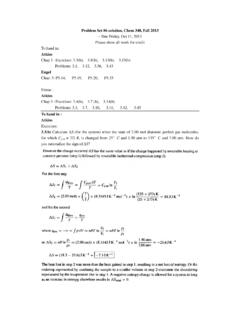
Problem Set #6, Chem 340, Fall 2013
www2.chem.uic.eduProblems: 3.1 Calculate the difference in molar entropy (a) between liquid water and ice at −5°C, (b) between liquid water and its vapour at 95°C and 1.00 atm. The differences in heat capacities on melting and on vaporization are 37.3 J K−1mol−1 and −41.9 J K−1 mol−1, respectively.Distinguish