Example: air traffic controller
Functional Groups - Purdue University
G. Amines • contain an “amino” group – a N atom bonded to 1, 2, or 3 carbon atom groups by single bonds H. Aldehydes and Ketones • contain a C=O (“carbonyl”) group • note that in condensed structural formulas, the aldehyde group may be written as –CH=O or as –CHO I. Carboxylic Acids
Tags:
Information
Domain:
Source:
Link to this page:
Documents from same domain

20.1 Mass Spectrometry Fundamentals - Purdue …
www.chem.purdue.edu20.1 Mass Spectrometry Fundamentals ... The mass spectrum can be used to determine molecular structure, to quantify single compounds or mixtures of

Ch. 7 - Enolates - Purdue University
www.chem.purdue.edu651.06 209 Enolates Enolates are the conjugate anions of carbonyl compounds. Although they have been known and used since the turn of the 20th Century, it was the development of “specific
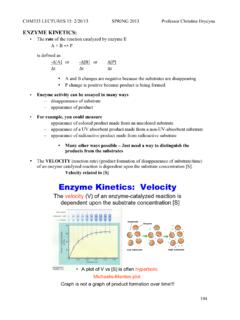
Enzyme Kinetics: Velocity - Purdue University
www.chem.purdue.edu• Enzyme activity can be assayed in many ways ... Enzyme Kinetics: Velocity . CHM333 LECTURES 15: 2/20/13 SPRING 2013 Professor Christine Hrycyna 105 • An example of how to do a ... • V is the reaction rate (velocity) at a substrate concentration [S]

PURDUE UNIVERSITY INSTRUMENT VAN PROJECT
www.chem.purdue.eduFACTORS AFFECTING ENZYME ACTIVITY PURDUE UNIVERSITY INSTRUMENT VAN PROJECT QUESTIONS 1. In what way is the rate of the reaction dependent on the concentration of the enzyme?
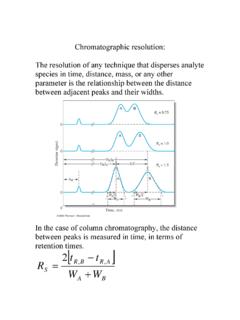
how to determine HETP from a peak - Purdue University
www.chem.purdue.eduChromatographic resolution is defined as the ratio of the difference of the retention times of two components to the sum of the peaks widths at the

The Fermentation of Pyruvate - Purdue University
www.chem.purdue.eduundergo lactate fermentation. Two pyruvates are converted to two lactic acid molecules, which ionize to form lactate. In this process two NADH + H+ are converted to two NAD+. Our muscle cells can undergo this process when they are in oxygen debt. If enough oxygen is not present to undergo aerobic respiration, pyruvate will undergo lactic acid
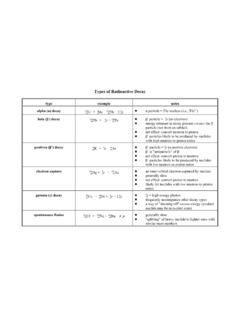
Types of Radioactive Decay - Purdue University
www.chem.purdue.eduTypes of Radioactive Decay type example notes alpha (α) decay 23 9 8 2 U 6 4 2 He + 23 9 4 0 Th + 2 0 0γ! α particle = 4 2 He nucleus (i.e., 4 2 He 2+) beta (β-) decay 23 9 4 0 Th 6! 0 1 e + 23 9 4 1 Pa! β-particle = ! 0 1 e (an electron)! energy released in decay process creates the β-particle (not from an orbital)! net effect: convert ...

Experiment 2: Acid / base titration - Purdue University
www.chem.purdue.eduExperiment 2: Acid / base titration cunknown =±62.0 0.5 mM @ 95% confidence level Nikolai Skrynnikov TA: Boone Prentice Section number: 1 25 Jan 2008 (data courtesy of Ike Fehrenbacher, 2004) 1

THEORY OF XRF - Purdue University
www.chem.purdue.eduXRF, and Chapter 4 describes how this physics is applied to spectrometers and their components. Chapter 5 explains how an XRF analysis is done. It describes the process of sample taking, measuring the sample and calculating the composition from the measurement results.
Purdue University: Department of Chemistry: Home
www.chem.purdue.eduSep 21, 2009 · Draw the structure of the peptide LCYRAIDCG as it would exist at pH 6.5 under oxidizing conditions. Be sure to draw any disulfide bonds that could form. EH — O-NA- Label the N-terminus of the peptide you drew in 3B above with a V. Label the C-terminus of the peptide you drew in 3B above with a Calculate the net charge of LCYRAIDG at pH 1.5.
Related documents

Chapter 17: Amines and Amides - latech.edu
www.chem.latech.eduAmines with fewer than six carbon atoms are infinitely soluble in water. Solubility results from hydrogen bonding between the amines and water. Even tertiary amines are water-soluble because of its ability to form hydrogen bonds. Odor or smell Methylamines (mono-, di-, and tri-) and ethylamine (gases) have ammonia-like smell.
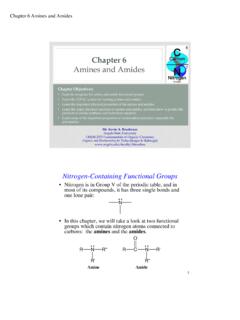
Ch 06 Amines and Amides - Angelo State University
www.angelo.edu• Amines in the IUPAC system: the “e” ending of the alkane name for the longest chain is replaced with –amine. The amine group is located by the position number. Groups that are attached to the nitrogen atom are located using “N” as the position number. More complex primary amines are named

Classification and Nomenclature of Amines
www.angelo.edu• Amines in the IUPAC system: the “e” ending of the alkane name for the longest chain is replaced with –amine. The amine group is located by the position number. Groups that are attached to the nitrogen atom are located using “N” as the position number. More complex primary amines are named
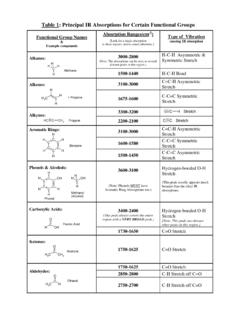
Table 1: Principal IR Absorptions for Certain Functional ...
academics.wellesley.eduAmines—Secondary: N-H Stretch N CH3 H N-Methylethylamine 1550-1450 N-H Bend Nitriles: C C N H H H Methanenitrile 2300-2200 CNStretch 1600-1500 N=O Stretch Nitro Groups: H C 3 N + O O Nitromethane (Note: Both peaks are <200 cm-1 apart.) 1400-1300 N=O Bend 3500-3100 N-H Stretch (similar to amines) 1670-1600 C=O Stretch Amides: H C 3 C NH 2 O ...

UE1 : Biomolécules (1) : Acides aminés et protéines ...
unf3s.cerimes.frdécarboxylation : synthèse amines biogènes (ex : histamine) Réactions du NH 2 N-alkylation : méthylés (ex: bétaïne) N-arylation : analyse ( DNP avec fluorodinitrobenzéne) N-acylation : synthèse peptidique Analyse Anhydride, halogénure Formation de bases de Schiff : réaction avec aldéhyde Désamination, transamination réaction globale
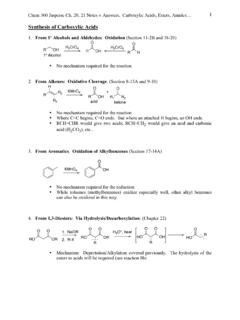
Synthesis of Carboxylic Acids
web.mnstate.eduNaOH (or other bases, including amines) Na carboxylate salt (basic) • Mechanism: Required (deprotonation) • Reverse Mechanism: Required (protonation) • Carboxylic acids are completely converted to carboxylate salts by base • Carboxylate salts are completely neutralized back to carboxylic acids by strong acid

Chemical Classes of Opioids (Updated 10/1/2018 ...
opioidcalculator.practicalpainmanagement.comAMINES MORPHINE PENTAZOCINE FENTANYL METHADONE TRAMADOL Buprenorphine* Butorphanol* Codeine Dextromethorphan* Dihydrocodeine Heroin (diacetyl-morphine) Hydrocodone* Hydromorphone* Levorphanol* Methylnaltrexone** Morphine (Opium, conc) Nalbuphine* Naloxone* Naloxegol* Naltrexone** Oxycodone*

TECHNIQUES: Principes de la chromatographie
zysman-colman.com6 11 Deux facteurs interviennent lors de l’interaction entre l’ éluant et le soluté (mélange de composés à séparer): • la solubilité: on doit être en mesure de dissoudre le soluté dans l’éluant pour que la migration se fasse. • la polarité de l’éluant va déterminer à quelle vitesse le composé migre. Moins un composé est polaire, moins il s’accroche à l ...

Consider the following reaction sequence starting from ...
drwainwright.weebly.com(c) €€€€The amine CH3CH2CH2NH2 can be prepared by two different routes. Route A is a two-stage process and starts from CH3CH2Br. Route B is a one-stage process and starts from CH3CH2CH2Br. (i)€€€€€€Identify the intermediate compound in Route A.