Transcription of Lecture 21: Multiplier Circuits
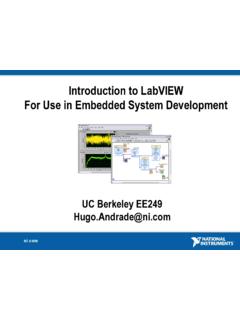
1 EE141 EECS151/251A Spring 2018 Digital Design and Integrated CircuitsInstructors: John Wawrzynek and Nick WeaverLecture 21: Multiplier CircuitsPage Multiplication a3 a2 a1 a0 Multiplicand b3 b2 b1 b0 Multiplier X a3b0 a2b0 a1b0 a0b0 a3b1 a2b1 a1b1 a0b1 Partial a3b2 a2b2 a1b2 a0b2 products a3b3 a2b3 a1b3 a0b3 .. a1b0+a0b1 a0b0 Product Many different Circuits exist for multiplication. Each one has a different balance between speed (performance) and amount of logic (cost).2 Page Shift and Add Multiplier Sums each partial product, one at a time. In binary, each partial product is shifted versions of A or Algorithm: 1. P 0, A multiplicand, B Multiplier 2. If LSB of B==1 then add A to P else add 0 3. Shift [P][B] right 1 4.
2 Repeat steps 2 and 3 n-1 times. 5. [P][B] has product. Cost n, = n clock cycles. What is the critical path for determining the min clock period?3 Page Shift and Add MultiplierSigned Multiplication: Remember for 2 s complement numbers MSB has negative weight: ex: -6 = 110102 = 0 20 + 1 21 + 0 22 + 1 23 - 1 24 = 0 + 2 + 0 + 8 - 16 = -6 Therefore for multiplication: a) subtract final partial product b) sign-extend partial products Modifications to shift & add circuit: a) adder/subtractor b) sign-extender on P shifter register 4EE141 Outline Combinational Multiplier Latency & Throughput Wallace Tree Pipelining to increase throughput Smaller multipliers Booth encoding Serial, bit-serial Two s complement multiplier5EE141 Unsigned Combinational MultiplierPage Array MultiplierEach row: n-bit adder with AND gatesWhat is the critical path?
3 Single cycle multiply: Generates all n partial products Multiplier (unsigned) X3 X2 X1 X0 * Y3 Y2 Y1 Y0 -------------------- X3Y0 X2Y0 X1Y0 X0Y0 + X3Y1 X2Y1 X1Y1 X0Y1 + X3Y2 X2Y2 X1Y2 X0Y2 + X3Y3 X2Y3 X1Y3 X0Y3 ---------------------------------------- - Z7 Z6 Z5 Z4 Z3 Z2 Z1 Z0 HAx3 FAx2 FAx1 FAx2 FAx1 HAx0 FAx1 HAx0 HAx0 FAx3 FAx2 FAx3x3x2x1x0z0z1z2z3z4z5z6z7y3y2y1y0 Propagation delay ~2 NmultiplicandmultiplierPartial products, one for each bit in Multiplier (each bit needs just one AND gate)8 Page Carry-Save Addition Speeding up multiplication is a matter of speeding up the summing of the partial products. Carry-save addition can help.
4 Carry-save addition passes (saves) the carries to the output, rather than propagating them. Example: sum three numbers, 310 = 0011, 210 = 0010, 310 = 0011 310 0011 + 210 0010 c 0100 = 410 s 0001 = 110 310 0011 c 0010 = 210 s 0110 = 610 1000 = 810 carry-save addcarry-save addcarry-propagate add In general, carry-save addition takes in 3 numbers and produces 2. Whereas, carry-propagate takes 2 and produces 1. With this technique, we can avoid carry propagation until final addition 9 Page Carry-save Circuits When adding sets of numbers, carry-save can be used on all but the final sum. Standard adder (carry propagate) is used for final sum. Carry-save is fast (no carry propagation) and cheap (same cost as ripple adder)10 Page Array Multiplier using Carry-save AdditionFast carry-propagate adder11 Page Carry-save AdditionCSA is associative and communitive.
5 For example: (((X0 + X1) + X2 ) + X3 ) = ((X0 + X1) +( X2 + X3 )) A balanced tree can be used to reduce the logic delay. This structure is the basis of the Wallace Tree Multiplier . Partial products are summed with the CSA tree. Fast CPA (ex: CLA) is used for final sum. Multiplier delay log3/2N + log2N12EE141 Increasing Throughput: Pipelining= registerIdea: split processing across several clock cycles by dividing circuit into pipeline stages separated by registers that hold values passing from one stage to the = 1/4tPD,FA instead of 1/8tPD,FA13EE141 Smaller Combinational MultipliersEE141 Booth Recoding: Higher-radix mult. AN-1 AN-2 .. A4 A3 A2 A1 A0 BM-1 BM-2 .. B3 B2 B1 +1,K*A = 0*A 0 = 1*A A = 2*A 4A 2A = 3*A 4A AIdea: If we could use, say, 2 bits of the Multiplier in generating each partial product we would halve the number of columns and halve the latency of the Multiplier !
6 Booth s insight: rewrite 2*A and 3*A cases, leave 4A for next partial product to do! 15EE141 Booth recodingBK+1 0 0 0 0 1 1 1 1BK 0 0 1 1 0 0 1 1BK-1 0 1 0 1 0 1 0 1action add 0 add A add A add 2*A sub 2*A sub A sub A add 0A 1 in this bit means the previous stage needed to add 4*A. Since this stage is shifted by 2 bits with respect to the previous stage, adding 4*A in the previous stage is like adding A in this stage!-2*A+A-A+Afrom previous bit paircurrent bit pair(On-the-fly canonical signed digit encoding!)BK+1,K*A = 0*A 0 = 1*A A = 2*A 4A 2A = 3*A 4A A16 Page Bit-serial Multiplier Bit-serial Multiplier (n2 cycles, one bit of result per n cycles): Control Algorithm:repeat n cycles { // outer (i) loop repeat n cycles{ // inner (j) loop shiftA, selectSum, shiftHI } shiftB, shiftHI, shiftLOW, reset }Note: The occurrence of a control signal x means x=1.
7 The absence of x means x= MultipliersEE141 Combinational Multiplier (signed!) (-3) * (-2) (-3) 1 0 1 (X) (-2) * 1 1 0 (Y) -------------------- 0 0 0 0 0 0 Y0*X = 0 + 1 1 1 0 1 2Y1*X = -6 - 1 1 0 1 4 Y 2 * X = - 1 2 ---------------------- (+6) 0 0 0 1 1 019EE141 Combinational Multiplier (signed) X3 X2 X1 X0 * Y3 Y2 Y1 Y0 -------------------- X3Y0 X3Y0 X3Y0 X3Y0 X3Y0 X2Y0 X1Y0 X0Y0 + X3Y1 X3Y1 X3Y1 X3Y1 X2Y1 X1Y1 X0Y1 + X3Y2 X3Y2 X3Y2 X2Y2 X1Y2 X0Y2 - X3Y3 X3Y3 X2Y3 X1Y3 X0Y3 ---------------------------------------- - Z7 Z6 Z5 Z4 Z3 Z2 Z1 Z0x3 FAx2 FAx1 FAx2 FAx1 FAx0 FAx1 HAx0 HAx0 FAx3 FAx2 FAx3x3x2x1x0z0z1z2z3z4z5z6z7y3y2y1y0 FAFAFAFAFAFAFA1 There are tricks we can use to eliminate the extra circuitry we s Complement Multiplication(Baugh-Wooley)
8 X3 X2 X1 X0 * Y3 Y2 Y1 Y0 -------------------- X3Y0 X3Y0 X3Y0 X3Y0 X3Y0 X2Y0 X1Y0 X0Y0 + X3Y1 X3Y1 X3Y1 X3Y1 X2Y1 X1Y1 X0Y1 + X3Y2 X3Y2 X3Y2 X2Y2 X1Y2 X0Y2 - X3Y3 X3Y3 X2Y3 X1Y3 X0Y3 ---------------------------------------- - Z7 Z6 Z5 Z4 Z3 Z2 Z1 Z0 X3Y0 X2Y0 X1Y0 X0Y0 + X3Y1 X2Y1 X1Y1 X0Y1 + X2Y2 X1Y2 X0Y2 + X3Y3 X2Y3 X1Y3 X0Y3 + 1 + 1 1 Step 1: two s complement operands so high order bit is 2N-1. Must sign extend partial products and subtract the last oneStep 2: don t want all those extra additions, so add a carefully chosen constant, remembering to subtract it at the end. Convert subtraction into add of (complement + 1).
9 Step 3: add the ones to the partial products and propagate the carries. All the sign extension bits go away!Step 4: finish computing the : multiplying 2 s complement operands takes just about same amount of hardware as multiplying unsigned operands! X3Y0 X2Y0 X1Y0 X0Y0 + X3Y1 X2Y1 X1Y1 X0Y1 + X2Y2 X1Y2 X0Y2 + X3Y3 X2Y3 X1Y3 X0Y3 + + 1 - 1 1 1 1 X3Y0 X3Y0 X3Y0 X3Y0 X3Y0 X2Y0 X1Y0 X0Y0 + 1 + X3Y1 X3Y1 X3Y1 X3Y1 X2Y1 X1Y1 X0Y1 + 1 + X3Y2 X3Y2 X3Y2 X2Y2 X1Y2 X0Y2 + 1 + X3Y3 X3Y3 X2Y3 X1Y3 X0Y3 + 1 + 1 - 1 1 1 1 B = ~B + 121EE1412 s Complement MultiplicationFAx3 FAx2 FAx1 FAx2 FAx1 HAx0 FAx1 HAx0 HAx0 FAx3 FAx2 FAx3HA11x3x2x1x0z0z1z2z3z4z5z6z7y3y2y1y0 22EE141 Multiplication in VerilogYou can use the * operator to multiply two numbers:wire [9:0] a,b; wire [19:0] result = a*b; // unsigned multiplication!
10 If you want Verilog to treat your operands as signed two s complement numbers, add the keyword signed to your wire or reg declaration: wire signed [9:0] a,b; wire signed [19:0] result = a*b; // signed multiplication!Remember: unlike addition and subtraction, you need different circuitry if your multiplication operands are signed vs. unsigned. Same is true of the >>> (arithmetic right shift) operator. To get signed operations all operands must be signed. To make a signed constant: 10 sh37 Cwire signed [9:0] a; wire [9:0] b; wire signed [19:0] result = a*$signed(b); 23