Example: quiz answers
Measuring and managing soil organic matter
Organic matter adds to soil fertility and overall soil health by enhancing the physical, chemical and biological properties of soil (Figure 2): Fresh plant residues fuel biological life in soil The amount of active decomposing organic matter in soil has a large impact on biological properties, nutrient cycling and soil structure
Tags:
Information
Domain:
Source:
Link to this page:
Documents from same domain
Principles of soil management - .NET Framework
projectblue.blob.core.windows.netOrganic matter Structure Water 12 Principles to improve soil health 15 Soil-related problems 18 Soil assessments Physical condition Chemical condition Biological condition 19 Further information This publication was created as part of the …

Nutrient Management Guide (RB209)
projectblue.blob.core.windows.net3. Assess soil structure and take action to remove soil compaction if necessary. Poor soil structure can restrict crop growth and results in poor nutrient use efficiency. 4. Carry out soil analysis for pH, P, K and Mg every 3–5 years (page 19). Target values to maintain in arable rotations are: • Soil pH 6.5 (5.8 on peat soils) • Soil P ...

Principles, installations and maintenance
projectblue.blob.core.windows.netDrainage may be needed to reduce vulnerability to compression, slaking and compaction Light-textured soils: These soils are highly permeable but drainage may be required to provide water table control in low-lying areas Springs: Drains are used to intercept springs before they reach the surface; this helps prevent erosion,

Nutrient Management Guide (RB209)
projectblue.blob.core.windows.netUsing the Nutrient Management Guide (RB209) The Nutrient Management Guide (RB209) helps you make the most of organic materials and balance the benefits of fertiliser use against the costs – both economic and environmental. The guide outlines the value of nutrients and soil, and explains why good nutrient management is about more than just

Nutrient Management Guide (RB209)
projectblue.blob.core.windows.net2. Understand if the field is within a nitrate vulnerable zone (NVZ) and check the rules for application rates and timing for organic materials and fertilisers. 3. Assess soil structure. 4. Ensure drainage systems are maintained and functioning correctly. 5. Calibrate the fertiliser spreader. 6.

Barley growth guide - .NET Framework
projectblue.blob.core.windows.netstages (GS21, GS31, GS39, GS59, GS71 and GS87). Detailed information on the growth stages is published near the back of this guide. Development can only be altered by variety choice and sowing date. Subsequent management decisions aim to influence growth during development (eg by controlling disease or applying fertiliser).

Understand how to influence farmers' decision-making …
projectblue.blob.core.windows.netexchange with farmers and other practitioner groups. 6. Recruit ‘peer champions’ to shape AHDB advice and literature – where face-to-face knowledge exchange is not possible, consider the value of including testimonies of peer groups (e.g. fellow farmers or advisors) in advice booklets. Results suggest that farmers listen more

2019 pig cost of production in selected countries
projectblue.blob.core.windows.netFigure 1. Cost of production in selected countries, 2019 The average cost of production in the EU in 2019 for the countries above was £1.42 per kg deadweight – a 1% decrease on the previous year. Costs of production in Great Britain for pork from indoor sows were the same as the EU average at £1.42,

Beef yield guide - .NET Framework
projectblue.blob.core.windows.netBeef carcase to primal cuts – yield information The information in this brochure is based on a 303kg carcase (side weight 151.5kg) , Classification R4H (after 2 weeks maturation). Therefore, the weights/percentages of cuts are intended to act as a guide only, as butchery techniques, carcase weights and types may vary from one business to another.
Related documents
Comprehensive Assessment of Soil Health
css.cornell.eduSoil health is defined as the continued capacity of the soil to function as a vital living ecosystem that sustains plants, ani-mals and humans (NRCS, 2012). Characteristics of a healthy soil include good soil tilth, sufficient rooting depth, good
Increasing soil organic carbon of agricultural land
www.dpi.nsw.gov.auimprove soil health and can help to mitigate climate change. •Although there is a limit on the amount of organic carbon that can be stored in soils, the large losses in the past means that many Australian agricultural soils have the potential for large increases.
COLOR INTERPRETATION AND SOIL TEXTURES
www.floridahealth.govFlorida Department of Health Division of Disease Control and Health Protection Bureau of Environmental Health Onsite Sewage Programs 850-245-4570 COLOR INTERPRETATION AND SOIL TEXTURES ACT PRESENTATION 1 SEPTEMBER 2013 •
Sustainable Soil Management
www.fao.orgSoil quality /health is reduced through human-induced degradation processes (erosion, nutrient mining, compaction, acidification, pollution, etc.) Soil quality: the capacity of a specific kind of soil to function, within natural or managed ecosystem boundaries, to …
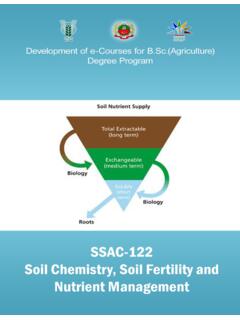
Soil Chemistry, Soil Fertility & Nutrient Management
agrimoon.comsoil that contribute to pedogenesis or that affect plant growth. Since then concerns have grown about environmental pollution, organic and inorganic soil contamination and potential ecological health and environmental health risks. Consequently, the emphasis in soil chemistry has shifted from pedology and ...
Introduction to Soil Science ICAR e-Course - AgriMoon
agrimoon.comGenerally soil refers to the loose surface of the earth as identified from the original rocks and minerals from which it is derived through weathering process. Whitney (1892): Soil is a nutrient bin which supplies all the nutrients required for plant growth Hilgard (1892): Soil is more or less a loose and friable material in which plants, by means
SOIL SCREENING GUIDANCE: USER'S GUIDE
semspub.epa.govMar 08, 1990 · 1.2 Role of Soil Screening Levels In identifying and managing risks at sites, EPA considers a spectrum of contaminant concentrations. The level of concern associated with those concentrations depends on the likelihood of exposure to soil contamination at levels of potential concern to human health or to ecological receptors. Screening