Transcription of Mueller Hinton Agar - himedialabs.com
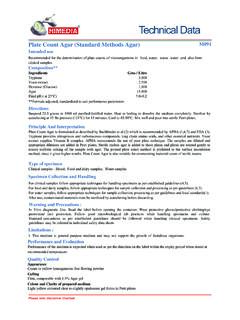
1 The Kirby-Bauer procedure is based on agar diffusion of antimicrobial substances impregnated on paper discs. This method employs disc with a single concentration of antimicrobial agent and the zone diameters observed are correlated with minimum inhibitory concentration (MIC) values (1, 2, 6). A standardized suspension of the organism is swabbed over the entire surface Please refer disclaimer Hinton AgarIntended Use:Recommended for determination of susceptibility of microorganisms to antimicrobial agents isolated from clinical samples. Composition**IngredientsGms / LitreHM infusion B from # ## pH ( at 25 C) **Formula adjusted, standardized to suit performance parametersDirectionsSuspend grams in 1000 ml distilled water. Heat to boiling to dissolve the medium completely. Sterilize by autoclaving at 15 lbs pressure (121 C) for 15 minutes.
2 Cool to 45-50 C. Mix well and pour into sterile Petri plates. Note: The performance of this batch has been tested and standardised as per the current CLSI (formerly, NCCLS) document M6-protocols for Evaluating Dehydrated Mueller Hinton And InterpretationThe Mueller Hinton formulation was originally developed as a simple, transparent agar medium for the cultivation of pathogenicNeisseria species (1). Other media were subsequently developed that replaced the use of Mueller Hinton agar for the cultivationof pathogenic Neisseria species, but it became widely used in the determination of sulfonamide resistance of gonococci andother organisms. Mueller Hinton agar is now used as a test medium for antimicrobial susceptibility testing (2). Mueller HintonAgar is recommended for the diffusion of antimicrobial agents impregnated on paper disc through an agar gel as described inCLSI Approved Standard (3).
3 Mueller Hinton agar has been selected by the CLSI for several reasons:i. It demonstrates good batch-to-batch reproducibility for susceptible It is low in sulfonamide, trimethoprim and tetracycline It supports the growth of most non-fastidious bacterial pathogens andiv. Many data and much experience regarding its performance have been recorded (9).Kirby-Bauer et al recommended this medium for performing antibiotic susceptibility tests using a single disc of high concentration (4). WHO Committee on Standardization of Susceptibility Testing has accepted Mueller Hinton agar for determining the susceptibility of microorganisms because of its reproducibility (5). Mueller Hinton agar with 5% sheep blood and Mueller Hinton agar with Hemoglobin have been recommended for antimicrobial susceptibility testing ofStreptococcus pneumoniae and Haemophilus influenzae.
4 HM infusion B from and acicase provide nitrogenous compounds, carbon, sulphur and other essential nutrients. Starch acts as a protective colloid against toxic substances present in the medium. Starch hydrolysis yields dextrose, which serves as a source of energy. These ingredients are selected for low thymine and thymidine content as determined by MIC values for Enterococcus faecalis with sulfamethoxazoletrimethoprim (SXT).# - Equivalent to Beef infusion from## - Equivalent to Casein acid hydrolysateHiMedia LaboratoriesTechnical DataPlease refer disclaimer the medium. Paper discs impregnated with specific amounts of antimicrobial agents are then placed on the surface of themedium, incubated and zones of inhibition around each disc are measured. The susceptibility is determined by comparingwith CLSI standards (7). The various factors, which influence disc diffusion susceptibility tests, are agar depth, disc potency,inoculum concentration, pH of the medium and beta-lactamase production by test organisms (7, 9).
5 Mueller Hinton agar is not appropriate for assay by disc diffusion method with slow growing organisms, anaerobes andcapnophiles. With slow growing organisms, increased incubation may cause deterioration of diffusing antibiotic and produceunprecise readings (8).Type of specimenClinical samples : Pure cultures isolated from urine , stool, blood Collection and HandlingFor clinical samples follow appropriate techniques for handling specimens as per established guidelines (10,11). Warning and PrecautionsIn Vitro diagnostic use only. Read the label before opening the container. Wear protective gloves/protective clothing/eye protection/face protection. Follow good microbiological lab practices while handling specimens and culture. Standardprecautions as per established guidelines should be followed while handling clinical specimens.
6 Safety guidelines may bereferred in individual safety data medium is recommended for susceptibility testing of pure cultures density may effect the zone size. Heavy inoculum may result in smaller zones or too less inoculum may result in bigger organisms may not grow on this medium and may require supplementation of anarobes may not grow on this medium. As antimicrobial susceptibility is carried with antibiotic disc, proper storage of the disc is desired which may effect the potency of the certain circumstances, the in vitro results of antibiotic susceptibility may not show the same in vivo Performance and EvaluationPerformace of the medium is expected when used as per the direction on the label within the expiry period when stored atrecommended ControlAppearanceCream to yellow homogeneous free flowing powderGellingFirm, comparable with agar and Clarity of prepared mediumLight amber coloured clear to slight opalscent gel froms in Petri of w/v aqueous solution at 25 C.
7 PH : ResponseCultural characteristics observed after incubation at 30-35 C for 18 -24 hours for bacterial cultures. For : The medium was supplemented with 5% Sheep blood and incubated at 35 C for 16-18 hours at 5% CO2 For testing : The medium was supplemented with 5g/l of Yeast extract & 2 vials /l of Haemophilus Growth Supplement (FD117 containing 15 mg/l of Haematin + 15 mg/l of NAD) and incubated at 35 C for 20-24 hours at 5% CO2 Antibiotic Sensitivity testVarious discs were tested for standard ATCC strains and zone of inhibition were measured after an incubation 30-35 C for 18 hours. (As per the latest CLSI Protocol M6 & Standards as per the current CLSI M100)Thymine/Thymidine Content# The zones for these discs are indicative of the Thymine/Thymidine content of the Cation ContentHiMedia LaboratoriesTechnical DataPlease refer disclaimer Overleaf.
8 $The zones for these discs are indicative of the Divalent Cation content of the mediumCultural ResponseOrganismGrowthStandard ZoneZone ofinhibitionObservedEscherichia coli ATCC 25922 (00013*)Cephalothin CEP 30mcg29-37 mm29 -37 mmChloramphenicol C 30 mcg21-27 mm21 -27 mmCo-Trimoxazole COT 25mcg #23-29 mm23 -29 mmCefotaxime CTX 30 mcg29-35 mm29 -35 mmGentamicin GEN 10 mcg19-26 mm19 -26 mmSulphafurazole SF 300 mcg15-23 mm15 -23 mmStaphylococcus aureus subsp. aureus ATCC 25923 (00034*)Co-Trimoxazole COT 25mcg ## 20 mm (Clearzone)>=20 mmCefoxitin CX 30 mcg23-29 mm23 -29 mmErythromycin E 15 mcg22-30 mm22 -30 mmLinezolid LZ 30 mcg25-32 mm25 -32 mmOxacillin OX 1mcg18-24 mm18 -24 mmPristinomycin RP 15 mcg21-28 mm21 -28 mmTetracycline TE 30 mcg $18-25 mm18 -25 mmCiprofloxacin CIP 5mcg22-30 mm22 -30 mmPseudomonas aeruginosa ATCC 27853 (00025*)
9 Ceftazidime CAZ 30 mcg22-29 mm22 -29 mmCiprofloxacin CIP 5mcg30-40 mm30 -40 mmTobramycin TOB 10 mcg $19-25 mm19 -25 mmAmikacin AK 30 mcg $18-26 mm18 -26 mmAztreonam AT 3mcg23-29 mm23 -29 mmCephotaxime CTX 30 mcg18-22 mm18 -22 mmGentamicin GEN 10 mcg $16-21 mm16 -21 mmImipenem IPM 10 mcg20-28 mm20 -28 mmPiperacillin PI 100 mcg12-18 mm25 -33 mmEscherichia coli ATCC35218 Amoxyclav AMC 30 mcg18-24 mm18 -24 mmPiperacillin/Tazobactam PIT100/10 mcg24-30 mm24 -30 mmTicarcillin TI 75 mcg6 mm6 -6 mmTicarcillin/Clavulanic acidTCC 75/10mcg20-28 mm20 -28 mmAmpicillin AMP 10 mcg16-22 mm16 -22 mmAmpicillin/Sulbactam A/S10/10 mcg29-37 mm29 -37 mmEnterococcus faecalis ATCC 29212 (00087*)Trimethoprim TR 5 mcg ## 20 mm>=20 mmVancomycin VA 30 mcg17-21 mm17 -21 mmStaphylococcus aureus subsp. aureusATCC 43300 (MRSA) (00211*)Oxacillin OX 1 mcgVery Hazy toNo ZoneNo zoneKey : *Corresponding WDCM LaboratoriesTechnical DataPlease refer disclaimer and Shelf LifeStore between 10-30 C in a tightly closed container and the prepared medium at 20-30 C.
10 Use before expiry date on the label. On opening, product should be properly stored dry, after tightly capping the bottle inorder to prevent lump formation due to the hygroscopic nature of the product. Improper storage of the product may lead to lump formation. Store in dry ventilated area protected from extremes of temperature and sources of ignition Seal the container tightly after use. Use before expiry date on the performance is best if used within stated expiry period. DisposalUser must ensure safe disposal by autoclaving and/or incineration of used or unusable preparations of this product. Follow established laboratory procedures in disposing of infectious materials and material that comes into contact with clinical sample must be decontaminated and disposed of in accordance with current laboratory techniques (10,11).