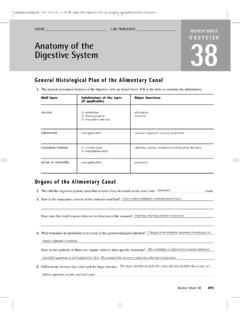
Transcription of NAME LAB TIME/DATE REVIEW SHEET Human …
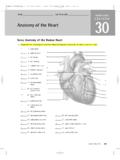
1 NAME _____LAB TIME/DATE _____REVIEW SHEET exercise33 AHuman CardiovascularPhysiology: blood Pressureand pulse DeterminationsReview SHEET 33A269 Cardiac identify valve closings and openings, chamber pressures, and volume lines, and the ECG and heart sound scanlines on the diagram below by matching the diagram labels with the terms to the right of the (sec) (ml) pressure (mm Hg)MvDiastolecdefghkijlmn12b345 NAME _____LAB TIME/DATE _____1. aortic and semilunarvalves closed2. aortic pressure3. aortic valve closes4. aortic valve opens5.
2 Atrial pressure6. AV valve closes7. AV valve opens8. cardiac cycle9. dicrotic notch10. heart sound12. second heart sound13. ventricular diastole14. peak of ventricularsystole15. ventricular volumefdeajigoclmnhbkighapmLre33apg269_2 74 5/12/04 3:10 PM Page 269 impos03 302:bjighapmL:ighapmLrevshts: the following terms:systole:diastole:cardiac the following questions, which concern events of the cardiac cycle:When are the AV valves closed? Open? What event within the heart causes the AV valves to open? What causes them to close?
3 When are the semilunar valves closed? Open? What event causes the semilunar valves to open? To close? Are both sets of valves closed during any part of the cycle? If so, when? Are both sets of valves open during any part of the cycle? At what point in the cardiac cycle is the pressure in the heart highest? Lowest? What event results in the pressure deflection called the dicrotic notch? the key below, indicate the time interval occupied by the following events of the cardiac :a. secb. secc. secd. sec1. the length of the normal cardiac cycle 3.
4 The quiescent period, or pause2. the time interval of atrial systole 4. the ventricular contraction an individual s heart rate is 80 beats/min, what is the length of the cardiac cycle? What portion of the cardiac cycle is shortened by this more rapid heart rate? 270 REVIEW SHEET 33 AContraction of the ventricles (general usage)Ventricular relaxation (general usage)One complete heartbeat including atrial and ventricular contractionDuring ventricular systoleDuring atrial contraction and ventricular diastoleVentricular pressure atrial pressureVentricular pressure atrial pressureDuring the period of relaxation of the heart as a whole and during atrial ventricular systoleVentricular pressure pressure in great arteriesVentricular pressure pressure in great arteriesYe sMomentarily after atrial contraction and ventricular systoleVentricular diastoleThe momentary increase in aortic
5 pressure that occurs when its semilunar valves snap secQuiescent period (ventricular relaxation period).ighapmLre33apg269_274 5/12/04 3:10 PM Page 270 impos03 302:bjighapmL:ighapmLrevshts: two factors promote the movement of blood through the heart? and Heart the following statements:The monosyllables describing the heart sounds are first heart sound is a result of closure of the 2valves, whereas the second is a result of closure of the 3valves. The heart chambers that have just been filled when you hear the first heart sound are the4, and the chambers that have just emptied are the5.
6 Immediately after the second heart sound, the6are filling with blood , and the7are you listened to the heart sounds during the laboratory session, what differences in pitch, length, and amplitude (loudness) of the two sounds did you observe? where you would place your stethoscope to auscultate most accurately the following:closure of the tricuspid valve: closure of the aortic semilunar valve: apical heartbeat: Which valve is heard most clearly when the apical heartbeat is auscultated? one expects you to be a full-fledged physician on such short notice; but on the basis of what you have learned about heartsounds, how might abnormal sounds be used to diagnose heart problems?
7 The pulse . REVIEW SHEET heart sound is longer, louder, and lower in pitch than the second heart sound, which isshort, sharp, and or right sternal border of the 5th intercostal sternal border of the 2nd intercostal intercostal space in line with the middle of the left sounds such as swishing sounds after valvular closure or high-pitched sounds arising when blood is forced throughconstricted (valve) openings might indicate valvular surges in an artery occurring during each contraction and relaxation of the left contraction and relaxation of the myocardiumopening and closing of the heart valves (which is responsive topressure gradients).
8 IghapmLre33apg269_274 5/12/04 3:10 PM Page 271 impos03 302:bjighapmL:ighapmLrevshts: the procedure used to take the pulse . the artery palpated at each of the pressure points the wrist: on the dorsum of the foot: in front of the ear: at the side of the neck: you were palpating the various pulse or pressure points, which appeared to have the greatest amplitude or tension? Why do you think this was so? someone has been injured in an auto accident and is hemorrhaging badly. What pressure point would you compressto help stop bleeding from each of the following areas?
9 The thigh: the calf: the forearm: the thumb: could you tell by simple observation whether bleeding is arterial or venous? may sometimes observe a slight difference between the value obtained from an apical pulse (beats/min) and that froman arterial pulse taken elsewhere on the body. What is this difference called? blood pressure blood the phase of the cardiac cycle to which each of the following pressure : diastolic pressure : is the name of the instrument used to compress the artery and record pressures in the auscultatory method of deter-mining blood pressure ?
10 Are the sounds of Korotkoff? What causes the systolic sound? The disappearance of sound? 272 REVIEW SHEET 33 APlace the first 2-3 fingertips of one hand over an arterial pressure point. Compressfirmly and then release the pressure slightly to palpate the pedisTemporalCarotidCarotid arteryThe carotid artery(ies) is the major artery delivering blood to the brain (against gravity).Femoral arteryPopliteal arteryBrachial arteryRadial arteryIf it spurts, it is arterial. It will flow evenly ifit is venous deficitPressure exerted by blood against the walls of the blood (ventricular contraction)Diastole (relaxation)SphygmomanometerSounds that can be auscultated over a partially occluded of turbulent blood flow as it first begins to move through the constricted is flowing freely; the artery is no longer 5/12/04 3:10 PM Page 272 impos03 302:bjighapmL:ighapmLrevshts: 145/85/82.