Transcription of Protocols book - Abcam
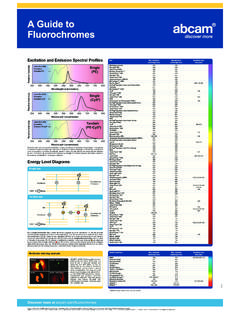
1 Protocols book 2017/18. Contents Welcome to Abcam About us.. 5. Extensive validation.. 5. Comprehensive information .. 5. 100% support.. 5. Fast global delivery.. 6. Abreviews .. 6. Sign up for an Abcam account .. 6. Protocols Section1: Antibodies and antibody structure.. 7. Section 2: Formats of antibody and antibody purification.. 11. Section 3: Choosing an antibody and antibody dilution .. 13. Section 4: Fluorescence .. 16. How single fluorochromes work.. 16. Fluorochrome table (excitation and emission wavelengths) .. 18. Section 5: Western blot .. 19. Sample preparation .. 22. Lysis buffers.. 22. Protease and phosphatase inhibitors .. 22. Preparation of lysate from cell culture.. 24. Preparation of lysate from tissues.. 24. Determination of protein concentration.. 24. Preparation of samples for loading into gels.. 24. Electrophoresis.. 26. Preparation of PAGE gels .. 26. Positive controls.. 27. Molecular weight markers .. 28. Loading samples and running the gel.. 28. Use of loading controls.
2 28. Transfer of proteins and staining .. 29. Visualization of proteins in gels.. 29. Transfer.. 29. Visualization of proteins in membranes: Ponceau Red .. 31. Blocking the membrane.. 31. Incubation with the primary antibody.. 32. Incubation with the secondary antibody.. 32. Development methods.. 33. Western blot references .. 33. Troubleshooting tips Western blotting.. 33. 3. Contents Section 6: Immunohistochemistry and Immunocytochemistry.. 38. IHC-Paraffin embedded.. 38. Optimizing a new antibody for IHC-P.. 40. Fixation.. 40. Deparaffinization.. 41. Antigen retrieval .. 41. Immunostaining and detection protocol .. 45. Resources.. 50. IHC-Frozen sections (IHC-Fr).. 50. Immunocytochemistry (ICC) .. 51. IHC and ICC fixation and permeabilization tips.. 52. Perfusion fixation.. 53. Mouse on mouse staining tips.. 55. Troubleshooting tips IHC/ICC.. 56. Section 7: ELISA.. 59. Indirect ELISA.. 59. Direct ELISA.. 62. Sandwich ELISA.. 64. Troubleshooting tips - ELISA.. 67. Section 8: Immunoprecipitation (IP) protocol .
3 70. Lysis buffers.. 70. Preparation of lysates .. 71. Pre-clearing the lysates .. 72. Immunoprecipitation .. 73. Choosing the correct beads .. 74. Procedure for crosslinking the antibody to the beads.. 75. Using IgM antibodies for immunoprecipitation .. 76. Protein L beads .. 76. Troubleshooting tips - IP .. 78. Section 9: ChIP.. 80. X-ChIP .. 80. Troubleshooting tips - ChIP .. 85. Section 10: Buffers and stock solutions .. 87. Standard PBS, TBS, TBS Tween.. 87. Western blot .. 87. IHC .. 89. ELISA.. 91. IP .. 91. ChIP .. 91. Section 11: Antibody storage guide .. 93. 4. Welcome to Abcam About us As an innovator in reagents and tools, our purpose is to serve life science researchers globally to achieve their mission, faster. Providing the research and clinical communities with tools and scientific support, we offer highly validated biological binders and assays to address important targets in critical biological pathways. Extensive validation Our stringent quality control and validation processes use a variety of techniques, including western blot, ICC/IF, IHC, flow cytometry, ELISA, ChIP, IP and peptide array.
4 Whether it is antibodies, kits or biochemicals the validation process is continuous and the data obtained is available on our product datasheets and Protocols . This ensures our products are of a high standard. Comprehensive information Our products are accompanied by a wealth of technical data: Comprehensive datasheets Customer reviews (Abreviews ). Protocols and troubleshooting tips Frequently asked questions We have a policy of honesty and so we share everything that we know about our products, as soon as we know it it's all on the datasheet. 100% support We're committed to providing the highest levels of support to our customers, which is why our technical teams are scientists from a wide range of research backgrounds, experienced in protein detection. As part of our Abpromise, we guarantee high product quality and expert support including: A refund or replacement if the product doesn't work as stated on the datasheet Support in six languages and a response to your inquiry within 24 hours Extensive multi-media resources pathways, posters, technical webinars and 5.
5 Fast global delivery We currently ship to 140 countries. To get our products to you as quickly as possible we have extended our cut off times for same day despatch of in-stock orders. Customers in North America can now place orders up to EST, and in mainland Europe up to GMT, for next day delivery in most countries. Abreviews - independent customer reviews Our Abreviews system allows customers to feedback about the performance of our products. We share this information with all of our customers on our datasheets, whether the review is positive or negative. This up-to-date information provides useful data about new applications, optimal dilution conditions and images of our products at work. For further information visit: Sign up for an Abcam account! Take full advantage of the numerous benefits of opening an Abcam account: Get direct access to expert scientific support Buy quickly and efficiently online Create and submit Abreviews Receive information about special offers, events and news View all orders, inquiries and conference registrations To register visit: 6.
6 Section 1: Antibodies and antibody structure Antibodies, also called immunoglobulins (Ig), are glycoproteins that are capable of specifically binding to antigens that caused their production in a susceptible animal. They are produced in response to the invasion of foreign molecules in the body. Antibodies exist as one or more copies of a Y-shaped unit, composed of four polypeptide chains. Each Y contains two copies of a heavy chain, and two copies of a light chain, named as such by their relative molecular weights. The top of the Y shape contains the variable region, which is the antigen binding site. The light chains of any antibody can be classified as either a kappa ( ) or lambda ( ). type (based on small polypeptide structural differences); however, the heavy chain determines the class, or isotype, of each antibody. Antibody structure: light chain k or l N N. N N. VH. VH. VL. VL. antigen Fab (Fab')2. binding CH 1. CH. 1. SS SS. CL. CL. S S. S S. biological C C. activity CH2.
7 CH2. CHO CHO. Fc Region g CH3. CH3. heavy chain C C. Heavy chains There are five types of mammalian Ig heavy chains denoted by the Greek letters: alpha ( ), delta ( ), epsilon ( ), gamma ( ), and mu ( ). These chains are found in IgA, IgD, IgE, IgG, and IgM antibodies, respectively. Distinct heavy chains differ in size and composition; and contain approximately 450 amino acids, while and have approximately 550 amino acids. Each heavy chain has two regions, the constant region and the variable region. The constant region is identical in all antibodies of the same isotype, but differs in antibodies of different isotypes. Heavy chains , and have a constant region composed of three tandem (in a line) Ig domains, and a hinge region for added flexibility; heavy chains . and have a constant region composed of four Ig domains. The variable region of the 7. heavy chain differs in antibodies produced by different B cells, but is the same for all antibodies produced by a single B cell or B cell clone.
8 The variable region of each heavy chain is approximately 110 amino acids long and is composed of a single Ig domain. Light chains In mammals there are only two types of light chains, which are called lambda ( ) and kappa ( ). A light chain has two successive domains: one constant domain and one variable domain. The approximate length of a light chain is 211 to 217 amino acids. Each antibody contains two light chains that are always identical; only one type of light chain, or , is present per antibody in mammals. Other types of light chains, such as the iota ( ) chain, are found in lower vertebrates like Chondrichthyes (cartilaginous fishes) and Teleostei (ray-finned fishes). Fab and Fc regions Direct-conjugated antibodies are labeled with an enzyme or fluorochrome in the Fc region. The Fc region also anchors the antibody to the plate in ELISA procedures and is also recognized by secondary antibodies in immunoprecipitation, immunoblots and immunohistochemistry. Antibodies can be cleaved into two F(ab) and one Fc fragments by the proteolytic enzyme papain, or into just two parts: one F(ab)2 and one Fc at the hinge region by the proteolytic enzyme pepsin.
9 Fragmenting IgG antibodies is sometimes useful because F(ab) fragments (1) will not precipitate the antigen;. and (2) will not be bound by immune cells in live studies because of the lack of an Fc region. Often, because of their smaller size and lack of crosslinking (due to loss of the Fc region), Fab fragments are radiolabeled for use in functional studies. Interestingly, the Fc fragments are often used as blocking agents in histochemical staining. Antibody isotypes: . IgG3. IgM cell IgG1,2+4. light chain k or l N N. IgD. N N. VH. VH. VL. VL. antigen binding CH 1. CH. 1. SS SS. CL. CL. S S. S S. biological C C. activity IgM IgE. CH2. CH2. CHO CHO. g CH3. CH3. heavy chain C C. IgA. 8. In mammals, antibodies can be divided into five isotypes or classes: IgG, IgM, IgA, IgD. and IgE, based on the number of Y units and the type of heavy chain. Heavy chains of IgG, IgM, IgA, IgD, and IgE, are known as gamma ( ), mu ( ), alpha ( ), delta ( ), and epsilon ( ), respectively. The isotypes differ in their biological properties, functional locations and ability to deal with different antigens, as depicted in the table below: Class/ Heavy Light Molecular Structure Function subclass chain chain weight (kDa).
10 Most produced Ig. Found in mucosal areas, such as the gut, IgA1 1 Monomer respiratory and urogenital tract, or 150 to 600. IgA2 2 to tetramer and prevents their colonization by pathogens. Resistant to digestion and is secreted in milk. Function unclear; Works with IgM. IgD or 150 Monomer in B-cell development; mostly B-cell bound. Binds to allergens and triggers histamine release from mast cells, IgE or 190 Monomer and is involved in allergy. Also protects against parasitic worms. Major Ig in serum. Provides the IgG . 1 majority of antibody-based IgG2a 2 immunity against invading IgG2b or 150 Monomer 3 pathogens. Moderate IgG3. 4 complement fixer (IgG3); can IgG4. cross placenta. First response antibody. Expressed on the surface of B. cells and in a secreted form IgM or 900 Pentamer with very high avidity. Eliminates pathogens in the early stages of B cell-mediated immunity before there is sufficient IgG. 9. Chicken IgY. There are several advantages to choosing chickens, rather than rabbits or goats to produce polyclonal antibodies.