Transcription of Registered Tax Return Preparer Exam Study Guide
1 0 | Page Registered Tax Return Preparer Exam Study Guide Accompaniment to the RTRP Exam Simulator Course 1 | Page A Service of 1040 Education, LLC Registered Tax Return Preparer Exam Study Guide RTRP Simulator Course Accompaniment 2 | Page Table of Contents Exam Overview .. 2 Actual Exam Day .. 3 Test Tips and 3 Exam Domain 1 Preliminary Work and Collection of Taxpayer 7 Domain 2 Treatment of Income and Domain 3 Deductions and Credits ..51 Domain 4 Other Taxes ..79 Domain 5 Completion of the Filing Domain 6 Practices and Domain 7 Ethics: Circular 230 Subparts A, B, and C (excluding D,E)..115 3 | Page Exam Overview On Friday, Jan. 18, 2013, the United States District Court for the District of Columbia enjoined the Internal Revenue Service from enforcing the regulatory requirements for Registered tax Return preparers . In accordance with this order, tax Return preparers covered by this program are not required to complete competency testing.
2 As of the date of this publication, the administering of the RTRP exam has been suspended indefinitely pending the court case. Paid preparers may still take continuing education related to the RTRP exam for CE credit, but the actual test is not available. For more details, visit The Registered Tax Return Preparer (RTRP) Exam is designed to identify individuals who meet minimum competency to Preparer 1040-series tax returns. The IRS has undergone significant efforts to develop questions based on general tax rules covered in the IRS publications. This Study Guide , along with the exam simulator course, will help you become proficient in passing the test should it become available. To assist in test preparation, the following is a list of recommended by the IRS as Study materials. This list is not all-encompassing, but a highlight of what the test candidates will need to know. Form 1040 Form 1040 Instructions Publication 17: Your Federal Income Tax Circular 230 (Rev.)
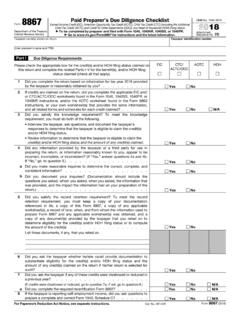
3 8-2011): Regulations Governing Practice Before the Internal Revenue Service Publication 334: Tax Guide for Small Business Publication 970: Tax Benefits for Education Form 6251: Alternative Minimum Tax Individuals Form 6251 Instructions Form 8879: IRS e-File Signature Authorization Publication 596: Earned Income Credit Form 8867: Paid preparers Earned Income Credit Checklist Form 2848 (Rev. October 2011): Power of Attorney and Declaration of Representative Form 2848 Instructions (Rev. October 2011) Form 8821 (Rev. October 2011): Tax Information Authorization Publication 1345 (Rev. 3-2009): Handbook for Authorized IRS e-file Providers Publication 4600 (Rev. October 2008): Safeguarding Taxpayer Information Quick Reference 4 | Page Actual Exam Day On the exam day, you should arrive at least 30 minutes before your scheduled time. Bring an official government-issued photo ID containing your signature.
4 Personal items are NOT allowed in the exam area and must be stored in a locker. You may want to bring a light jacket or sweater with you. The following three reference materials will be the only items accessible electronically during the exam: Publication 17 Form 1040 Form 1040 instructions Test Tips and Strategies You will be successful in passing the exam if you adequately prepare and effectively execute your knowledge during the exam. The exam covers seven major areas, which are also known as IRS domains. The exam coverage will be broken down as follows: Domain 1: Preliminary Work and Collection of Taxpayer Data-15% Domain 2: Treatment of Income and Assets-22% Domain 3: Deductions and Credits-22% Domain 4: Other Taxes-11% Domain 5: Completion of the Filing Process-10% Domain 6: Practices and Procedures-5% Domain 7: Ethics-15% Follow these tips: 5 | Page 1) Become very familiar with Publication 17.
5 The exam DOES expect for you to know form numbers and threshold or qualifying amounts for certain deductions and credits. Use the Publication 17 index hyperlinks wisely. The test simulator you purchased is designed to help you become acclimated with looking up pertinent data on Publication 17. We highly suggest you utilize the test simulator s hints to look up answers. Doing so will train you in become adept in navigating Publication 17 quickly. 2) Try to determine the correct answer and eliminate incorrect answers that are obviously wrong. 3) Manage the clock. Do not become stuck on a question. 4) Guess if necessary. Do not leave any blank answers. Blank answers will be counted as wrong. 5) Practice exam questions. The best way to prepare for the actual test is to take practice tests that mimic exam conditions. Exam Details Number of RTRP Test questions The Registered Tax Return Preparer competency test contains 120 questions, 100 scored questions, and 20 experimental questions in multiple-choice and true or false format.
6 You will have hours to complete the test. Exam Time Limit The actual test will be limited to 2 hours. You may take an optional pre-test computer system tutorial. Experimental Questions The RTRP test will include 20 experimental questions. These questions are the source for future test questions. These questions do not count as part of your score, but you will not be told which questions they are. Since you will not know which questions are experimental, try your best on every question. RTRP Test scores You will receive a notice at the end of your test indicating that you have completed the test. Printed test results will be provided immediately following the test. Scaled scores are determined by calculating the number of questions answered correctly from the total number of questions in the test and converting to a scale that ranges from 50 to 500. Some test questions may be weighted. The IRS has set the scaled passing score at 350, which corresponds to a minimum level of knowledge 6 | Page deemed acceptable for the tasks performed by a minimally competent Registered Tax Return Preparer .
7 Privacy of Test Scores Individual test results are confidential and the IRS will not reveal your results to anyone but you. NO ONE knows your score except the IRS and the candidate. 7 | Page Disclaimer This publication is intended for educational purposes and to provide accurate and authoritative information in regard to the subject matter covered. This publication is not intended to render any legal, accounting, or professional advice. If legal advice or other expert advice or service is required, a competent professional should be sought. The author and affiliated parties are not legally bound by this text, any accompanying electronic media, or lecture in the rendering of legal, tax, accounting, or similar professional services. While the legal, tax, and accounting issues discussed in this material have been reviewed with sources believed to be reliable, concepts discussed can be affected by changes in the law or in the interpretation of such laws since this text was printed.
8 For that reason the accuracy and completeness of this information and the author's opinions based thereon cannot be guaranteed. In addition, state or local tax laws and procedural rules may have a material impact on the general discussion. As a result, the strategies suggested may not be suitable for every individual. Before taking any action, all references and citations should be checked and updated accordingly. Copyright 2012 by 1040 Education. LLC All rights reserved. Course materials may not be reproduced or stored in a retrieval system without prior written permission of the publisher and in no case for profit. 8 | Page Domain 7 | Page 1. Review prior year s Return for accuracy, comparison, and carryovers for current year Return . preparers should exercise care and review the client s prior-year tax Return for carryovers ( depreciation, NOL, and capital loss carryforwards). If the client is new, the Preparer should request at least one prior year tax Return .
9 Carryforwards, such as prior depreciation, capital loss, and NOLs need to be accurately accounted for on the current Return . Every Return must be complete and accurate. Check the prior Return to ensure the following: Use of correct forms. There are many forms that may be used. Be sure that each entry has the associated corresponding schedule (when applicable). If carryforwards are present, they should be presented on the current Return . Each entry contains accurate and correct information. Each form used must be complete. Data contained on each form should be consistent across all forms. 8 | Page 2. Collect taxpayer s biographical information ( , date of birth, age, marital status, citizenship, dependents) The taxpayer s personal biographic information must be accurate and complete. Name If the taxpayer s name has legally changed, the name change should be reported to the Social Security Administration before the tax Return is filed.
10 The name reported to the IRS should match the Social Security Administration s information. Date of Birth Although the taxpayer s date of birth is not directly input on the Return , it is needed to determine certain calculations such as the additional standard deduction for those who are 65 and over. For tax purposes, the taxpayer s age is calculated using the day before his birthday. Example: Sonny was born on January 1, 1947. He is considered to be age 65 on December 31, 2011. Marital Status The taxpayer s marital status is determined based on the last day of the year ( if a client is becomes legally married on December 31, 2012, he is considered married for tax year 2012). Citizenship In most cases, citizens or resident aliens living abroad must file a tax Return . The type of tax Return to file is dependent upon whether the alien taxpayer is considered to be a resident alien, nonresident alien, or dual-status taxpayer.