Transcription of Reporting Instructions for Schedules A through S
1 FFIEC 101 FFIEC 101 Reporting Instructions for Schedules A through S FFIEC 101 Effective March 2014 (Page B-10, line 23, updated May 2, 2014)FFIEC 101 CONTENTS FFIEC 101 i CONTENTS (3- 14) Instructions FOR PREPARATION OF FFIEC 101 Regulatory Capital Reporting for Institutions Subject to the Advanced Capital Adequacy Framework TABLE OF CONTENTS General Instructions schedule A: Advanced Approaches Regulatory Capital schedule B: Summary Risk-Weighted Asset Information for Banks Approved to Use Advanced Internal Ratings-Based and Advanced Measurement Approaches for Regulatory Capital Purposes schedule C: Wholesale Exposure - Corporate schedule D: Wholesale Exposure Bank schedule E: Wholesale Exposure Sovereign schedule F: Wholesale Exposure IPRE schedule G: Wholesale Exposure HVCRE schedule H: Wholesale Exposure Eligible Margin Loans, Repo-Style Transactions and OTC Derivatives (With Cross-Product Netting) schedule I: Wholesale Exposure Eligible Margin Loans, Repo-Style Transactions (No Cross-Product Netting) schedule J: Wholesale Exposure OTC Derivatives (No Cross-Product Netting) schedule K: Retail Exposure Residential Mortgage Closed-end First Lien Exposures schedule L: Retail Exposure Residential Mortgage Closed-end Junior Lien Exposures schedule M: Retail Exposure Residential Mortgage Revolving Exposures schedule N: Retail Exposure Qualifying Revolving Exposures schedule O: Retail Exposure Other Retail Exposures FFIEC 101 CONTENTS FFIEC 101 ii CONTENTS (3- 14) TABLE OF CONTENTS (Continued) schedule P: Securitization Exposures schedule Q: Cleared Transactions schedule R: Equity Exposures schedule S.
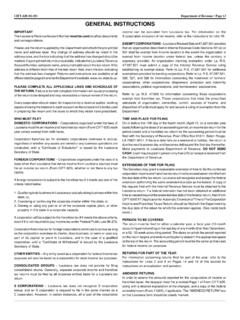
2 Operational Risk FFIEC 101 GENERAL Instructions FFIEC 101 1 GENERAL Instructions (3- 14) GENERAL Instructions Who Must Report A. Scope and Reporting Criteria An institution (that is a bank, savings association, bank holding company, or savings and loan holding company) must apply the advanced approaches risk-based capital rule if the institution: (i) Has consolidated total assets (excluding assets held by an insurance underwriting subsidiary) on its most recent year-end regulatory report equal to $250 billion or more; (ii) Has consolidated total on-balance sheet foreign exposure on its most recent year-end regulatory report equal to $10 billion or more (excluding exposures held by an insurance underwriting subsidiary); (iii) Is a subsidiary of a depository institution that uses the advanced approaches pursuant to subpart E of 12 CFR part 3 (OCC), 12 CFR part 217 (Board), or 12 CFR part 325 (FDIC) to calculate its total risk-weighted assets.
3 (iv) Is a subsidiary of a bank holding company or savings and loan holding company that uses the advanced approaches pursuant to 12 CFR part 217 to calculate its total risk-weighted assets; or (v) Elects to use the advanced approaches to calculate its total risk-weighted An institution meeting any of the above criteria (the first four of which are the threshold criteria) must submit an FFIEC 101 report in accordance with the timing requirements discussed in Section B of these General Instructions . For purposes of this report, the advanced approaches risk-based capital rule is referred to as the advanced approaches rule throughout these An institution that is subject to the advanced approaches rule remains subject to the rule unless its primary federal supervisor determines in writing that application of the rule is not appropriate in light of the institution s asset size, level of complexity, risk profile, or scope of operations.
4 B. FFIEC 101 Reporting Requirements The institutions specified in Section A above must begin Reporting on the FFIEC 101, schedule A, except for a few specific line items, at the end of the quarter after the quarter in which the institution triggers one of the threshold criteria for applying the advanced approaches rule or elects to use the advanced approaches rule (an opt-in institution),4 and must begin Reporting data on the remaining Schedules of the FFIEC 101 at the end of the first quarter in which they have begun their parallel run period. (See Section K of these General Instructions for further information on confidentiality.) All institutions specified in Section A will continue to file the regulatory capital schedule in the Call Report or FR Y-9C, as appropriate, as well as the FFIEC 101. 2 See the revised regulatory capital rules: 78 FR 62018, October 11, 2013 (Board and OCC); 78 FR 55340, September 10, 2013 (FDIC).
5 3 See Subpart E of the revised regulatory capital rules. 4 An institution is deemed to have elected to use the advanced approaches rule on the date that its primary federal supervisor receives from the institution a board-approved implementation plan pursuant to section 121(b)(2) of the revised regulatory capital rules. After that date, in addition to being required to report on the FFIEC 101, schedule A, the institution may no longer apply the AOCI opt-out election in section 22(b)(2) of the revised regulatory capital rules and it becomes subject to the supplementary leverage ratio in section 10(c)(4) of the revised regulatory capital rules and its associated transition provisions. FFIEC 101 GENERAL Instructions FFIEC 101 2 GENERAL Instructions (3- 14) Consistent with section 100 of the advanced approaches rule, an institution identified in Section A above remains subject to the FFIEC 101 Reporting requirements until the institution is no longer subject to the rule as described in Section A.
6 What Must Be Reported C. Reporting Schedules and Instructions The information contained in the attached Reporting Schedules must be completed in accordance with the Instructions accompanying these Schedules . The Schedules and Instructions are collectively referred to as the FFIEC 101. D. Organization of the Instructions These Instructions cover the FFIEC 101 report Schedules . They are divided into the following sections: (1) The General Instructions that describe overall Reporting requirements. (2) Line item Instructions for each schedule of the FFIEC 101. The Instructions and definitions in (1) and (2) are not necessarily self-contained; reference to the advanced approaches rule may be needed for more detailed definitions and regulatory capital treatments. Where to Submit the Reports E. Electronic Submission All Reporting institutions must submit their completed reports electronically using the Federal Reserve s Internet Electronic Submission (IESUB) application.
7 Reporting institutions with questions about Reporting via IESUB should contact their Reporting and Reserves District Contact ( #RR). Each institution is responsible for ensuring that the data reported each quarter reflects fully and accurately the line item Reporting requirements for that report date, including any changes that may be made from time to time. This responsibility cannot be transferred or delegated to software vendors, servicers, or others outside the Reporting entity. F. Frequency of Reporting Each Reporting institution must submit a report as of the end of each quarter on a calendar year basis. The as-of date for each Reporting period is March 31, June 30, September 30, and December 31 of each calendar year. G. When to Submit the Reports For report dates before a Reporting institution has completed its parallel run period, the information required to be reported in its FFIEC 101 must be submitted electronically via IESUB within 60 days after the as-of date of the report.
8 That is, the March 31 report must be submitted by May 30, the June 30 report is due by August 29, the September 30 report is due by November 29, and the December 31 report is due by March 1 (or February 29 if a leap year) of the subsequent year. Before the completion of a Reporting institution s parallel run period, if the submission deadline falls on a weekend or holiday, the report must be received on the first business day after the Saturday, Sunday, or holiday. FFIEC 101 GENERAL Instructions FFIEC 101 3 GENERAL Instructions (3- 14) For report dates after a Reporting institution has completed its parallel run period, the submission date for each FFIEC 101 report will be the same as the submission date for the Reporting institution s Call Report or FR Y-9C, as appropriate. The report is due by the end of the Reporting day on the submission date (5:00 ). H. Preparation of the Reports Each Reporting institution must prepare and file the FFIEC 101 report in accordance with the Instructions provided.
9 All reports must be prepared in a consistent manner. Questions and requests for interpretations of matters appearing in any part of the Instructions should be addressed to the Reporting entity s primary federal supervisor. Regardless of whether a Reporting entity requests an interpretation of a matter appearing in these Instructions , when the Reporting entity s primary federal supervisor s interpretation of the Instructions differs from that of the Reporting entity, the federal supervisor may require the Reporting entity to prepare its FFIEC 101 report in accordance with its interpretation and may require amended filings for previously submitted reports. I. Rounding For Reporting ins titutions with total assets of less than $10 billion, all dollar amounts must be reported in thousands, with the figures rounded to the nearest thousand. Items less than $500 will be reported as zero. For Reporting institutions with total assets of $10 billion or more, all dollar amounts may be reported in thousands, but each institution, at its option, may round the figures reported to the nearest million, with a zero reported in the thousands column.
10 For Reporting institutions exercising this option, amounts less than $500,000 will be reported as zero. Report to two decimal places any weighted averages, except as otherwise noted. J. Negative Entries Except as indicated in the Reporting Instructions for specific Reporting items, negative entries are generally not appropriate in this report. K. Confidentiality and Parallel Run For report dates before a Reporting institution has completed its parallel run period, schedule A will be available to the public, except for items 78 (total eligible credit reserves calculated under the advanced approaches rules); 79 (amount of eligible credit reserves includable in tier 2 capital); 86 (expected credit loss that exceeds eligible credit reserves); 87 (advanced approaches risk-weighted assets); 88 (common equity tier 1 capital ratio calculated using the advanced approaches); 89 (additional tier 1 capital ratio calculated using the advanced approaches); and 90 (total capital ratio using the advanced approaches).