Transcription of Sponsored by - dailylivestockreport.com
1 Vol. 12, No. 37 / February 21, 2014 Sponsored by The Daily Livestock Report is published by Steve Meyer & Len Steiner, Inc., Adel, IA and Merrimack, NH. To subscribe, support or unsubscribe visit Copyright 2014 Steve Meyer and Len Steiner, Inc. All rights reserved. The Daily Livestock Report is not owned, controlled, endorsed or sold by CME Group Inc. or its affiliates and CME Group Inc. and its affiliates disclaim any and all responsibility for the informa on contained herein. CME Group , CME and the Globe logo are trademarks of Chicago Mercan le Exchange, Inc.
2 Disclaimer: The Daily Livestock Report is intended solely for informa on purposes and is not to be construed, under any circumstances, by implica on or otherwise, as an offer to sell or a solicita on to buy or trade any commodi es or securi es whatsoever. Informa on is obtained from sources believed to be reliable, but is in no way guaranteed. No guarantee of any kind is implied or possible where projec ons of future condi ons are a empted. Futures trading is not suitable for all investors, and involves the risk of loss.
3 Past results are no indica on of future performance. Futures are a leveraged investment, and because only a percentage of a contract s value is require to trade, it is possible to lose more than the amount of money ini ally deposited for a futures posi on. Therefore, traders should only use funds that they can afford to lose without affec ng their lifestyle. And only a por on of those funds should be devoted to any one trade because a trader cannot expect to profit on every trade. The Daily Livestock Report is made possible with support from readers like you.
4 If you enjoy this report, find if valuable and would like to sustain it going forward, consider becoming a contributor. Just go to to contribute by credit card or send your check to The Daily Livestock Report, Box 2, Adel, IA 50003. First, we have to correct a few omissions in yester-day s edition regarding negative stories on the meat industry. We neglected to activate the links in our .pdf version yesterday, so CLICK HERE go to s story on the PEDv-related video and CLICK HERE to go to s story on the recently-released book.
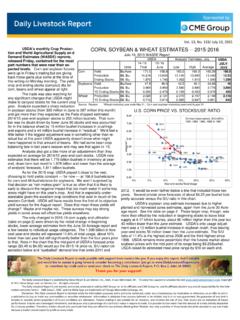
5 CLICK HERE to read HSUS s own state-ment about replacing meat in human diets. In addition, we failed to properly attribute the charts in yes-terday s issue. The Livestock Marketing Information Center, various USDA agencies and Iowa State University should have been credit-ed for them and we apologize for omitting the proper references. Copies of all three charts with proper attribution appear on page 2. An expert panel of animal care specialists set up by the Center for Food Integrity has examined the video referenced in yesterday s issue regarding the use of animal tissues to inocu-late pigs for porcine epidemic diarrhea virus.
6 The panel high-lighted that feedback is the only control method available for the disease at the present time and that pigs in confinement barns are not more prone to the disease than those raised in outdoor settings . They also stated that the ethical problem of cannibalism raised by HSUS should be trumped by the ethical responsibility to prevent diseases and the loss of additional animals. The panel did agree with HSUS on one issue: That the practice may be, at least in a technical sense, illegal in Kentucky due to a decades-old regulation that prohibits feeding garbage and defines garbage as material con-taining animal tissue.
7 That regulation (and ones similar to it in other states) was aimed primarily at preventing the spread of classical swine fever ( hog cholera), hoof and mouth disease and trichi-nosis. The first two diseases have not been present in the for decades while the incidence of trichinosis is extremely low and, to our knowledge, completely limited to wildlife and rare instances where pigs could interact with wildlife. It appears to us that the feed-back process is fundamentally different from garbage feeding in that the source of the animal tissue is known, controlled and used for a specific purpose.
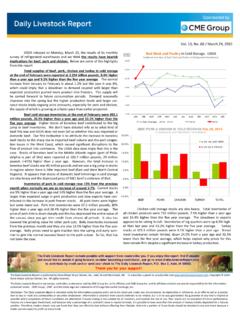
8 But laws should be respected or properly changed and the panel s attention to this detail is, we think, absolutely proper. For a thorough summary of the panel s report, CLICK HERE to see an article from Feedstuffs Newspaper. USDA s estimate of the retail price of All Fresh beef set a new record in January while the retail prices for all other spe-cies remained within 10 cents per pound of their all-time rec-ords. As can be seen in the chart above right, the increase in the All Fresh beef price, which includes all grades of beef sold in retail stores, was especially abrupt from December to January.
9 The price reach a record-high $ per pound, up from December and from one year ago. It also puts the All Fresh price just cents per pound below the Choice beef price, the closest that those two prices have ever been. As can be seen in the chart, there have been few such sharp monthly price changes for any of USDA s retail prices for any month since 2000 and even back to 1990 in the historical data set. The only larger one was in November 2003 when the Choice beef price jumped cents per pound ( ) in one month.
10 That increase was in the aftermath of Canada s first BSE case in May of that year and the subsequent banning of Canadian feeder and slaughter cattle from the By that fall, beef supplies had tightened sharply, pushing prices to then-record levels. The All Fresh beef price jumped by cents per pound or that month as well. We are a little suspicious of this abrupt jump in the All Fresh price. The Choice-Select wholesale value spread (ie. the dif-ference between USDA s Choice and Select cutout values) has been tight in absolute terms and record tight in percentage terms since late December.