Simulating Data with SAS
• Use the DATA step to simulate data from univariate and uncorrelated multivariate distributions. You can use the RAND function to generate random values from more than 20 standard univariate distributions. You can combine these elementary distributions to build more complicated distributions. From Simulating Data with SAS ®. Full book available
Download Simulating Data with SAS

Information
Domain:
Source:
Link to this page:
Documents from same domain
027-2009: Tips and Tricks for Creating the Reports …
support.sas.comPaper 027-2009 TIPS AND TRICKS FOR CREATING THE REPORTS YOUR CLIENTS NEED TO SEE Michael J Molter, INC Research, Raleigh, NC ABSTRACT Advanced reporting tools such as PROC REPORT have progressed by leaps and …
Step-by-Step Programming with Base SAS Software
support.sas.comThe correct bibliographic citation for this manual is as follows: SAS Institute Inc. 2001. Step-by-Step Programming with Base SAS® Software.Cary, NC: SAS Institute Inc.
227-2012: Executing a PROC from a DATA Step - …
support.sas.com2 Using RUN_MACRO to execute a PROC from a DATA step requires writing three blocks of code, described in the Introduction: a macro to execute a PROC, a user-written function to execute the macro, and a DATA step to call the
149-2012: Queries, Joins, and WHERE Clauses, Oh …
support.sas.comPaper 149-2012 Queries, Joins, and WHERE Clauses, Oh My!! Demystifying PROC SQL Christianna S. Williams, Chapel Hill, NC ABSTRACT Subqueries, inner joins, outer joins, HAVING expressions, set operators…just the terminology of PROC SQL might
158-2010: How to Use Arrays and DO Loops: Do I …
support.sas.com1 Paper 158-2010 How to Use ARRAYs and DO Loops: Do I DO OVER or Do I DO i? Jennifer L Waller, Medical College of Georgia, Augusta, GA ABSTRACT
248-2009: Learning When to Be Discrete: …
support.sas.com1 Paper 248–2009 Learning When to Be Discrete: Continuous vs. Categorical Predictors David J. Pasta, ICON Clinical Research, San Francisco, CA ABSTRACT
338-2011: An Introduction to Survival Analysis …
support.sas.com2 (Censored) Study Ends (From Applied Survey Data Analysis, p. 306) Figure 1. Prospective View of Event History Survey Data Time can be regarded as continuous or discrete and this basic distinction affects the analytic approach selected.
Dongsheng Yang and Jarrod E. Dalton - SAS
support.sas.com1 Paper 335-2012 A unified approach to measuring the effect size between two groups using SAS® Dongsheng Yang and Jarrod E. Dalton Departments of Quantitative Health Sciences and Outcomes Research

SAS/STAT 9.2 User's Guide: Introduction to Power …
support.sas.comSAS/STAT ® 9.2 User’s Guide Introduction to Power and Sample Size Analysis (Book Excerpt) SAS® Documentation
249-2012: A Tutorial on the SAS® Macro Language
support.sas.com1 Paper 249-2012 A Tutorial on the SAS® Macro Language John J. Cohen, Advanced Data Concepts LLC, Newark, DE ABSTRACT The SAS macro language is another language layering on top of regular SAS code.
Related documents
Computer Organization and Architecture Input/Output …
aturing.umcs.maine.eduInput/Output Computer Organization and Architecture Input/Output Problems • Computers have a wide variety of peripherals —Delivering different amounts of data, at different speeds, in different formats • Many are not connected directly to system or expansion bus • Most peripherals are slower than CPU and RAM; a few are faster
Using Bloomberg to get the Data you need
people.stern.nyu.eduWHERE TO FIND THE DATA This is a listing of all of the financial data that you will need to analyze your company and where exactly on the Bloomberg output you will find the data. Once you have identified what you would like to look up, use the item number and go to the specified page number on Bloomberg to look it up.
C++ Input/Output: Streams - Virginia Tech
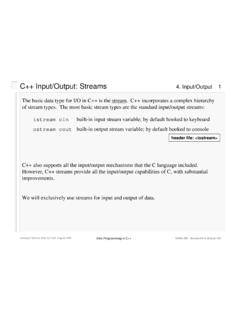
courses.cs.vt.eduThis sets up the file streams to read data from a file called "readme.data" and write output to a file called "writeme.data". Computer Science Dept Va Tech August, 2001

SAS® ODS Destination for Microsoft Excel: Use the STYLE ...
www.sas.comcollection of attributes that affect some output of a SAS program. Second, as a style attribute, which is a name-value pair that describes an output behavior or visual result that you want to apply to output data. A style attribute change is the most specific way to directly change how your data looks.
Excellent Ways of Exporting SAS Data to Excel
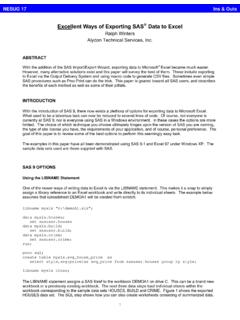
lexjansen.comallow you to save the data as a CSV or TXT file and performs simple filtering and sorting of data. This software will also support some cross-platform SAS data sets, so it is a great tool for multiple OS environments. The following example use the sample data set SASUSER.CLASS. • Start the SAS System Viewer.
Instruction Sets: Characteristics and Functions Addressing ...
www.csee.umbc.eduData Transfer Instructions •Are responsible for moving data around inside the processor as well as brining in data or sending data out •Examples: Store, load, exchange, move, set, push, pop •Each Instruction should have: •source and destination (memory, register, input/output port) •amount of data
Using SAS® Macro Variable Lists to Create Dynamic Data ...
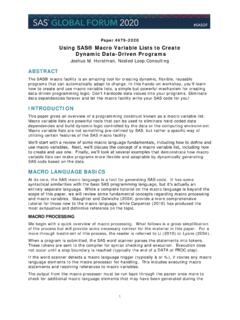
www.sas.comThe output from the macro processor must be run back through the parser once more to ... to values which have been read from data sets and placed in the program data vector. We simply provide a macro variable name and the value to be assigned as …

Helland Cosmos Big Data and Big Challenges - microsoft.com
www.microsoft.com–Changed to deal with input and output streams • SCOPE is a high level declarative language for data manipulation –It translates very naturally into parallel computation 10 Scope Job Stream-1 Stream-2 Stream-3 Stream-A Stream-B Input Output Input Arrives as Sets of Records Computation Occurs as Sets of Records Output Written as
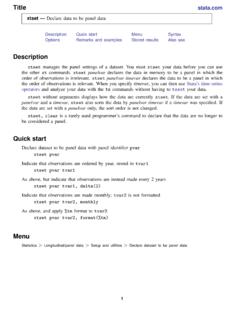
Title stata.com xtset — Declare data to be panel data
www.stata.comto use the xt commands. You do not need to set both, but it will not matter if you do. xtset and tsset are different, however, when you set just a panelvar—you type xtset panelvar— or when you set just a timevar—you type tsset timevar. If you save your data after xtset, the data will be remembered to be a panel and you will not