Thermodynamics
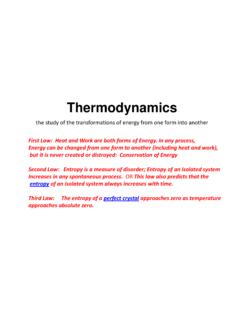
Thermodynamics the study of the transformations of energy from one form into another First Law: Heat and Work are both forms of Energy. in any process,
Download Thermodynamics

Information
Domain:
Source:
Link to this page:
Documents from same domain

Ziegler-Natta polymerization of olefins - …
www.chem.tamu.eduZiegler-Natta polymerization of olefins - stereoselectivity CHEM 462: Inorganic/Organometallic Chemistry Haomiao Xie & Xu Ye . …
Average, Standard Deviation and Relative Standard …
www.chem.tamu.eduAverage, Standard Deviation and Relative Standard Deviation How will your data compare with other people’s data? Let’s find out. We will do this by pulling together everybody’s

Selected Bond Energies and Bond Lengths
www.chem.tamu.eduSelected Bond Energies and Bond Lengths Arranged according to families. Energy (D) in kJ/mol. Bond length (r) in picometers. Hydrogen Compounds

Paramagnetism and Diamagnetism - Department of Chemistry
www.chem.tamu.edu1 Paramagnetism and Diamagnetism zAtoms with unpaired ↑electrons are called paramagnetic. • Paramagnetic atoms are attracted to a magnet. zAtoms with paired ↑↓electrons are called diamagnetic. • Diamagnetic atoms are repelled by a magnet.

NMR spectroscopy of paramagnetic complexes. Part 39 ...
www.chem.tamu.eduMAGNETIC RESONANCE IN CHEMlSTRY, VOL. 31, 2-6 (1993) NMR Spectroscopy of Paramagnetic Complexes Part 39*-Natural Abundance *H NMR of Paramagnetic Sandwich Compounds Janet Blumel, Peter Hofmann and Frank H. Kohlert Anorganisch-chemisches Institut, Technische Universitat Miinchen, D-8046 Garching, Germany
Chemistry 689 A Brief Introduction to Symmetry and Group ...
www.chem.tamu.eduA Brief Introduction to Symmetry and Group Theory in Chemistry Instructor: Dr. Timothy Hughbanks Time: TTh 12:45 - 2:00 PM; Room 2121 ... After a brief introduction to the abstract theory of groups is ... Franzen Physical Chemistry of Solids, Basic Principles …

Electron Paramagnetic Resonance: Hyperfine Interactions
www.chem.tamu.edu§ Abragam & Bleaney Electron Paramagnetic Resonance of Transition Ions; § Carrington & McLachlan, Introduction to Magnetic Resonance; § Wertz & Bolton, Electron Spin Resonance. 2. ... • Basic ideas from MO theory and ligand field theory must be familiar. 6. Experimental Aspects • EPR performed at fixed frequency (i.e., field is

Oxidation Numbers: Rules
www.chem.tamu.edu1 Oxidation Numbers: Rules 1) The oxidation number of the atoms in any free, uncombined element, is zero 2) The sum of the oxidation numbers of all atoms

CO2 Reduction Catalysts and Catalysis
www.chem.tamu.eduCO2 Reduction Catalysts and Catalysis CHEM 462 Kristina Goldstein . Soomin Park . 1

Coordination Chemistry Transition Metal Complexes
www.chem.tamu.eduCoordination Chemistry Transition Metal Complexes Direct Application of Lewis AB and Hard/Soft AB “Theories” A TEP (Thermal Ellipsoid Plot) of ... Metals may exhibit multiple oxidation states 3. Metals may exhibit paramagnetism dependent on …
Related documents
Lectrure Thermal Analysis
web.abo.fiOxidation (exothermic) Reduction (endothermic) Break down reactions (endo – or exothermic) Chemisorption (exothermic) Solid state reactions (endo – or exothermic) Evaluation and interpretation of DTA curves T Sample –T Reference Temperature 5 K /min, 1.3 mg 5 K /min, 6, 3 mg 10 K /min, 6, 3 mg 20 K /min, 6, 3 mg
Interpreting Unexpected Events and Transitions in DSC …
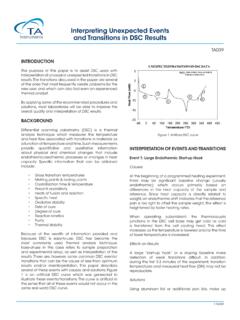
www.tainstruments.comEvent 5: Baseline Shift After Endothermic or Exothermic Peaks Causes Baseline shifts are caused by changes in sample weight, heating rate, or the specific heat of the sample. A change in specific heat often occurs after the sample has gone through a transition such as curing, crystallization, or melting. Sample weight often changes
Reactions of Aromatic Compounds - Rutgers University
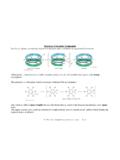
crab.rutgers.eduThe formation of the sigma complex is an endothermic and energetically unfavorable process - it is therefore the rate determining step. The second step is exothermic since it regenerates the aromatic system. The overall reaction is exothermic by about -11 kcal/mol (-45kJ/mol).
CH301 Worksheet 11 (Answer Key)
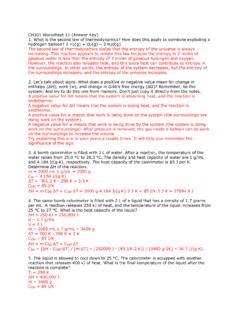
laude.cm.utexas.eduendothermic. A negative value for ΔH means that the system is losing heat, and the reaction is exothermic. A positive value for w means that work is being done on the system (the surroundings are doing work on the system). A negative value for w means that work is being done by the system (the system is doing work on the surroundings).
Reactions of Alcohols - Rutgers University
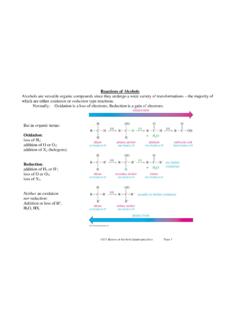
crab.rutgers.eduThe first step is the exothermic protonation of the hydroxyl, followed by the slow, endothermic, rate determining ionization to generate the cation. The fast deprotonation is exothermic and produces the alkene. Since the RDS is the formation of the carbocation, the ease of formation dictates the reaction rates of 3° > 2° > 1°.
Endothermic Exothermic Reactions - Extension
extension.uga.eduEndothermic & Exothermic Reactions Written by Chris Papadopoulos This lesson focuses on the use of technology to collect, graph and analyze data from an exothermic and an endothermic reaction. Hypothesis Chemical reactions are systems that exchange heat/energy with their surroundings.

Chapter 10 Worksheet #2 Answer
www.lcps.org7. Are the following processes exothermic or endothermic? a. the combustion of gasoline in a car engine Exothermic b. water condensing on a cold pipe Endothermic c. CO 2 (s) CO 2 (g) Endothermic d. F2 (g) 2 F (g) Exothermic 8. Why does ice float on the surface of liquid water? It is less dense then water (the Crystallized structure). 9.
Steps to Predicting the Products of Chemical Reactions
www.oakparkusd.orgbe spontaneous and exothermic ! ... be endothermic (NO REACTION) PREDICTING REACTION PRODUCTS: SINGLE REPLACEMENT REACTIONS. Mg + AlCl 3 Al + MgCl 2 PREDICT IF THESE REACTIONS WILL OCCUR Al + MgCl 2 Can magnesium replace aluminum? Activity Series YES, magnesium is more reactive than aluminum.