
Types of Control: Open loop, feedback, feedforward
Why use feedback control • or better, why do you need a control system at all? • consider ovens, A/C units, airplanes, manufacturing, pumping stations, etc • What are we controlling? some physical quantity (constant) a dynamic behavior (a function of time) • We need to 'tell' the system how we want it to behave
Download Types of Control: Open loop, feedback, feedforward

Information
Domain:
Source:
Link to this page:
Documents from same domain
1 Finite Element Analysis Methods - Rice University
www.clear.rice.edu1 Finite Element Analysis Methods ... it is often referred to as finite element analysis (FEA). FEA is the most common tool for stress and structural ...

Lecture 1 Introduction to ANSYS Workbench - Rice …
www.clear.rice.eduThis training course covers the basics of using ANSYS Mechanical in performing structural and thermal analyses. It is intended for all new or occasional ANSYS Mechanical users, regardless

Lecture 9 Thermal Analysis - Rice University
www.clear.rice.eduthermal resistance. q TCC T target T contact The amount of heat flow across a contact interface is defined by the contact heat flux expression ^q” shown here: • T contact is the temperature of the contact surface and • T target is the temperature of the target surface. … Thermal ontact

curved beam strength - Rice University
www.clear.rice.edukr σθθ=− − + = r r ... iar r m ari y r i r iar m yri ari ayri ar r m yrai r

Introduction to ANSYS Mechanical
www.clear.rice.edu– The “2D” switch must be set on the Project page prior to importing geometry. •Each node in a 2D element has two translational degrees of freedom (UX and UY) for structural or one temperature DOF for thermal. •2D solids are used to represent three types of 3D geometry, “Axisymmetric”, “Plane stress” and “Plane strain”.

8 Flat Plate Analysis - Rice University
www.clear.rice.eduThen, the plots are pretty, but wrong. If the edges of the plate are simply sitting on top of to walls, then the wall could not pull down on the corner. ... reaction forces appear, then move the split line away from the corner and repeat the process. It may be a slow procedure, but it can lead you to the correct lift off regions. ...

Lecture 7 Static Structural Analysis
www.clear.rice.edu•Thermal expansion coefficient is required if a temperature load is applied. ... Example: a Frictionless Support applied to the face of the block shown would indicate that the Z degree of freedom is no longer free (all other DOF are free). ... –Adjustment (length)

12 Buckling Analysis - Rice University
www.clear.rice.eduthose terms even though finite element analysis lets you conduct buckling studies in 1D, 2D, and 3D. For a material, stiffness refers to either its elastic modulus, E, or to its shear modulus, G = E / (2 + 2 v) where v is Poisson’s ratio.
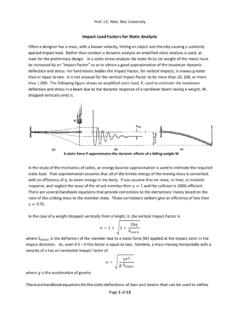
Impact Load Factors - Rice University
www.clear.rice.eduMaximum horizontal stress (143 MPa) is at the center plane top and bottom Of course, since the static model is linear there is no need to re-run the model (unless you want pretty plots). The static maximum fiber stress (SX) of 26.0 MPa could be multiplied by the 5.48 vertical Impact Factor to find the dynamic maximum SX stress of 143 MPa.

Space Truss and Space Frame Analysis - Rice University
www.clear.rice.eduspace frame is a combination of individual beam‐column elements that resists loadings by a combination of bending, axial member forces, and transverse (shear) forces, and axial torsion. Therefore, it is a more efficient
Related documents
Chapter 5 Dynamic and Closed-Loop Control
cwrowley.princeton.eduFeedback control has been used for centuries to regulate engineered systems. In the 17th century, Cornelius Drebbel invented one of the earliest devices to use feed-back, an incubator that used a damper controlled by a thermometer to maintain a constant temperature. 1. Feedback devices became more prevalent during the indus-

The Power of Feedback - Columbia University
www.columbia.edufeedback interventions that were not confounded with other manipulations, included at least a control group, measured performance, and included at least 10 participants. Many of their studies were not classroom based. From the 131 studies, they estimated 470 effect sizes on the basis of 12,652 participants and 23,663 observations (reflect-

Hand Hygiene: Education, Monitoring and Feedback
www.cdc.govfeedback on adherence to hand hygiene in the healthcare setting. Your facility is likely having ongoing discussions about hand hygiene. The word cloud on the right visually represents words and phrases collected from frontline healthcare personnel in conversations about improving hand hygiene with the most
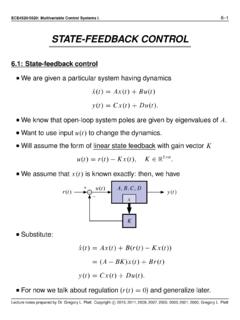
STATE-FEEDBACK CONTROL
mocha-java.uccs.eduSTATE-FEEDBACK CONTROL 6.1: State-feedback control We are given a particular system having dynamics x.t/P D Ax.t/CBu.t/ y.t/D Cx.t/CDu.t/: We know that open-loop system poles are given by eigenvalues of A. Want to use input u.t/ to change the dynamics. Will assume the form of linear state feedback with gain vector K u.t/ D r.t/!Kx.t/; K2 R1"n:

Auditing and Feedback of PPE Use - Centers for Disease ...
www.cdc.govfeedback, if you notice errors in PPE use or your auditing reveals user gaps. This slide identifies the three essential components of feedback: it must be specific, it must be timely and it must be given in a non-threatening manner.

Systems Analysis and Control
control.asu.eduRouth’s Method Step 3 Complete the third row. Call the new entries b 1; ;b k I The third row will be the same length as the rst two b 1 = det 4 a a 2 a 3 a 1 0 a 3 b 2 = det 4 a a a 3 0 a 3 b 3 = det a 4 0 a 3 0 a 3 The denominator is the rst entry from the previous row.

16.30 Topic 5: Introduction to state-space models
ocw.mit.eduSep 21, 2010 · 16.30/31 Feedback Control Systems State-Space Systems • What are state-space models? • Why should we use them? • How are they related to the transfer functions used in classical control design and how do we develop a state-space model? • What are the basic properties of a state-space model, and how do we analyze these? •

16.30 Topic 11: Full-state feedback control
ocw.mit.eduOct 17, 2010 · So the feedback control can modify the pole at s = 1, but it cannot move the pole at s = 2. • System cannot be stabilized with full-state feedback. • Problem caused by a lack of controllability of the e2t mode.
Feedback Control Theory - University of Toronto
www.control.utoronto.caof feedback control system design that captures the essential issues, can be applied to a wide range of practical problems, and is as simple as possible. 1.1 Issues in Control System Design The process of designing a control system generally involves many steps. A …