Transcription of 166 CHAPTER 4 • INTRODUCTION TO ALKENES. …
1 166 CHAPTER 4 INTRODUCTION TO alkenes . structure AND REACTIVITY state of lower energy than the transition state for protonation to give a primary carbocation. Thestabilities of the carbocations themselvesdo not determine which reaction is faster; the relativefree energies of the transition states for carbocation formationdetermine the relative rates ofthe two processes. Only the validity of Hammond s postulate allows us to make the connectionbetween carbocation energy and transition-state n e e d H a m m o n d s p o s t u l a t e b e c a u s e t h e s t r u c t u r e s o f t r a n s i t i o n s t a t e s a r e u n c e r t a i n ,whereas the structures of reactants, products, and reactive intermediates are known.
2 There-fore, knowing that a transition state resembles a particular species (for example, a carbocat-ion) helps us to make a good guess about the transition-state structure . In this text, we ll fre-quently analyze or predict reaction rates by considering the structures and stabilities ofreactive intermediates such as carbocations. When we do this, we are assuming that the tran-sition states and the corresponding reactive intermediates have similar structures and energies;in other words, we are invoking Hammond s Apply Hammond s postulate to decide which reaction is faster: addition of HBr to 2-methyl-propene or addition of HBr to trans-2-butene.
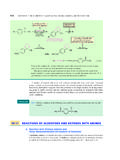
3 Assume that the energy difference between thestarting alkenes can be ignored. Why is this assumption necessary? reactions take place much more rapidly in the presence of certain substances that arethemselves left unchanged by the reaction. A substance that increases the rate of a reactionwithout being consumed is called a practical example of a catalyst is platinum inthe catalytic converter on the modern automobile. The platinum catalyst in the converter(CH3)2 CACH2+ HBr(CH3)2 CACH2+ HBr(CH3)2 CHCH2 LBrreaction coordinatereaction coordinateslower reaction(CH3)3 CLBr(CH3)3C|Br_faster reaction(CH3)2 CHCH2Br_|STANDARD FREE ENERGY higher-energytransition state lower-energytransition state DG DG less stableintermediatemore stableintermediate Figure reaction free-energy diagram for the two possible modes of HBr addition to s postulate states that the energy of each transition state is approximated by the energy of the corre-sponding carbocation.
4 The formation of tert-butyl bromide (right panel) is faster than the formation of isobutylbromide (left panel) because it involves the more stable carbocation intermediate and therefore the transitionstate of lower 11/26/08 8:39 AM Page CATALYSIS167brings about the rapid oxidation (combustion) of hydrocarbon exhaust emissions. This reac-tion would not occur were it not for the catalyst; yet the catalyst is left unchanged by the com-bustion reaction. The catalyst increases the rate of the combustion reaction by many orders are some important points about A catalyst increases the reaction rate.
5 This means that it lowers the standard free energyof activation for a reaction (Fig. ).2. A catalyst is not consumed. It may be consumed in one step of a catalyzed reaction, butif so, it is regenerated in a subsequent implication of points 1 and 2 is that a catalyst that strongly accelerates a reactioncan be used in very small amounts. Many expensive catalysts are practical for this A catalyst does not affect the energies of reactants and products. In other words, a cata-lyst does not affect the DG of a reaction and consequently also does not affect the equi-librium constant (Fig.)
6 4. A catalyst accelerates both the forward and reverse of a reaction by the same factor. The last point follows from the fact that, at equilibrium, the rates of a reaction and its re-verse are equal. If a catalyst does not affect the equilibrium constant (point 3) but increases thereaction rate in one direction, equality of rates at equilibrium requires that the rate of the re-verse reaction must be increased by the same a catalyst and the reactants exist in separate phases, the catalyst is called aheterogeneous catalyst in the catalytic converter of an automobile is a hetero-geneous catalyst because it is a solid and the reactants are gases.
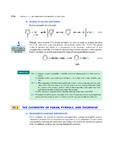
7 In other cases, a reaction insolution may be catalyzed by a soluble catalyst. A catalyst that is soluble in a reaction solutionis called a homogeneous catalyst. G G G + catalystno catalysta catalyst does notchange G a catalyst increases therate (decreases G )productsreaction coordinatereactants STANDARD FREE ENERGYF igure reaction free-energy diagram comparing a hypothetical catalyzed reaction (red curve) to the un-catalyzed reaction (blue curve). 11/26/08 8:39 AM Page 167168 CHAPTER 4 INTRODUCTION TO alkenes . structure AND REACTIVITYA large number of organic reactions are catalyzed.
8 In this section, we ll introduce the ideaof catalysis by considering three examples of catalyzed alkene reactions. The first example,catalytic hydrogenation,is a very important example of heterogeneous catalysis. The secondexample, hydration,is an example of homogeneous catalysis. The last example involves catal-ysis of a biological reaction by an Catalytic Hydrogenation of AlkenesWhen a solution of an alkene is stirred under an atmosphere of hydrogen, nothing if the same solution is stirred under hydrogen in the presence of a metal catalyst, the hy-drogen is rapidly absorbed by the solution.
9 The hydrogen is consumed because it undergoesan additionto the alkene double reactions are examples of catalytic hydrogenation,an addition of hydrogen to analkene in the presence of a catalyst. Catalytic hydrogenation is one of the best ways to convertalkenes into alkanes. Catalytic hydrogenation is an important reaction in both industry and thelaboratory. The inconvenience of using a special apparatus for the handling of a flammable gas(dihydrogen) is more than offset by the great utility of the the preceding reactions, the catalyst is written over the reaction arrows.
10 Pt/C is read as Platinum supported on carbon or simply Platinum on carbon. This catalyst is a finely di-vided platinum metal that has been precipitated, or supported, on activated charcoal. A num-ber of noble metals, such as platinum, palladium, and nickel, are useful as hydrogenation cat-alysts, and they are often used in conjunction with solid support materials such as alumina(Al2O3), barium sulfate (BaSO4), or, as in the previous examples, activated carbon. Hydro-genation can be carried out at room temperature and pressure or, for especially difficult cases,at higher temperature and pressure in a bomb (a closed vessel designed to withstand highpressures).