Transcription of 9.6 THE SN1 AND E1 REACTIONS - Sapling Learning
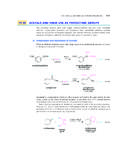
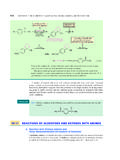
1 412 CHAPTER 9 THE CHEMISTRY OF ALKYL SN1 AND E1 REACTIONSU ntil now, the discussion has stressed the REACTIONS of alkyl halides with species that are eitherstrong bases or good nucleophiles. When a primary alkyl halide is dissolved in an alcohol sol-vent with no added base, the SN2 reaction that occurs takes two weeks or more (depending onthe temperature and the alkyl halide), because a neutral, un-ionized alcohol is a weak base andthus a poor nucleophile. When a tertiary alkyl halide such as tert-butyl bromide is subjected tothe same conditions, however, both substitution and elimination REACTIONS occur readily.
2 ( )The reaction of an alkyl halide with a solvent in which no other base or nucleophile has beenadded is called a solvolysis(literally, bond breaking by solvent). The substitution that occursin the solvolysis of tert-butyl bromide cannot involve an SN2 mechanism because chainbranching at the a-carbon retards the SN2 reaction. That is, if the solvolysis of a primary alkylhalide by an SN2 mechanism is very slow, then the solvolysis of a tertiary alkyl halide by thesame mechanism should be even elimination that occurs in this solvolysis cannotoccur by an E2 mechanism because a strong base is not present.
3 Because both substitution andelimination REACTIONS occur readily, they must then involve mechanisms that are different fromthe SN2 and E2 mechanisms. This new mechanism is the subject of this Rate Law and Mechanism of SN1 and E1 ReactionsThe solvolysis of tert-butyl bromide follows a first-order rate law:rate= k[(CH3)3 CBr]( )Any involvement of solvent in the reaction cannot be detected in the rate law because the con-centration of the solvent cannot be changed. However, the nature of the solvent does play acritical role in this reaction. The solvolysis REACTIONS of tertiary alkyl halides are fastest inpolar, protic, donor solvents,such as alcohols, formic acid, and mixtures of water with sol-vents in which the alkyl halide is soluble (for example, aqueous acetone).
4 Notice that thesesolvents are the ones that are best at solvating ions (Sec. ).The occurrence of both substitution and elimination products shows that two competing re-actionsare involved. The first step in bothreactions involves the ionization of the alkyl halideto a carbocation and a halide ion:This step, which is a Lewis acid base dissociation(Sec. ), is the rate-limiting step ofboth the substitution and elimination REACTIONS . In other words, when a tertiary alkyl halide isdissolved in a polar, protic solvent such as ethanol, it reacts by dissociating slowly into a car-bocation and a halide ion; the carbocation then rapidly reacts to give both substitution and( )carbocationintermediate(CH3)3C|(rate-li miting step)22Br_33L(CH3)3C22Br3 LLL""CCH3CH3 BrHOH3CC2H5+++LLL""CCH3CH3OH3CC2H555 CAC$H3CH3C)CH2tert-butyl bromidetert-butyl ethyl ether (72%)2-methylpropene (28%)C2H5OH2Br_|(ionized form ofHBr in ethanol)ethanol(solvent) 11/26/08 12:25 PM Page THE SN1 AND E1 REACTIONS413elimination products.
5 Thus, substitution and elimination products arise from competing reac-tions of the first the formation of the substitution product. This product is formed by theLewis acid base association of a solvent molecule with the carbocation . Even though the sol-vent is a poor nucleophile, the reaction occurs rapidly because the solvent is present in veryhigh concentration and because the carbocation is a very powerful Lewis acid.( )The nucleophile that reacts with the carbocation is ethanol, notethoxide ion; such a strongbase is not presentin a solvolysis reaction; furthermore, if significant amounts of such a basewere added, elimination by the E2 mechanism would be observed exclusively.
6 The product ofEq. is the conjugate acid of an ether, and it is a strong acid (Sec. ). The final step of the substitution reaction is a Br nsted acid base reaction in which the pro-tonated ether (the Br nsted acid) loses a proton to solvent (the Br nsted base) to give the etherand the conjugate acid of the Br nsted base involved in this reaction is ethanol, not ethoxide ion. As we noted in dis-cussing the previous step of the reaction, ethoxide ion is not present; nor is it necessary, be-cause the protonated ether is a strong acid. Notice that the protonated solvent plus bromide ion(that is, C2H5O|H2Br_) is the form of ionized HBr in ethanol substitution mechanism that involves a carbocation intermediate is called an SN1 REACTIONS that take place by the SN1 mechanism are called SN1 meaning of the SN1 nickname is as follows:The word unimolecularmeans that a single molecule the alkyl halide is involved in therate-limiting consider the formation of the elimination product of Eq.
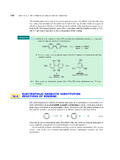
7 , which involves a dif-ferent reaction of the carbocation intermediate. Loss of a b-proton (a proton from the carbonadjacent to the electron-deficient carbon) gives the alkene.( )CH3CH3$$H2 CCA+LCH2 LHC|CH3CH3""22Br_33 LOLHC2H522abHH$$|OLC2H5222Br_33(ionized form ofHBr in ethanol)substitutionunimolecularSN1nucle ophilic( )L(CH3)3C22OC2H5 HOC2H522Br_HL(CH3)3C2|OC2H5"+Br_HOC2H52H "|(ionized formof HBr in ethanol)(CH3)3C|22Br_33 HOC2H52222Br_33H|L(CH3)3C2OC2H5" 11/26/08 12:25 PM Page 413414 CHAPTER 9 THE CHEMISTRY OF ALKYL HALIDESThe base that removes a b-proton from the carbocation is typically a solvent ethanol is a very weak base, the reaction occurs readily because ethanol, as the sol-vent, is present in very high concentration and because the carbocation is a very strongBr n-sted acid (its pKahas been estimated to be about -8).
8 The base is notethoxide ion; no ethox-ide ion is present. Notice that ionized HBr is produced in this reaction as b-elimination mechanism that involves carbocation intermediates is called an E1 mech-anism; REACTIONS that occur by E1 mechanisms are called E1 meaning of theE1 nickname is as follows:B. Rate-Limiting and Product-Determining StepsThe SN1 and E1 REACTIONS have a common rate-limiting step. That is, the rate at which the alkylhalide disappears as it undergoes both competing REACTIONS is determined by its rate of ioniza-tion the rate at which it forms the carbocation . The relative amounts of substitution andelimination products are determined by the relative rates of the steps that followthe rate-lim-iting step: reaction of the solvent as a nucleophile with the carbocation to give a substitutionproduct, and loss of a b-proton to solvent from the carbocation to give the elimination prod-uct.
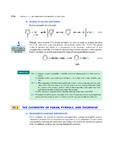
9 For example, more substitution than elimination product is formed in Eq. Thismeans that the rate of formation of the substitution product from the carbocation is greaterthan the rate of formation of the elimination product. Because the relative rates of these stepsdetermine the ratio of products, they are said to be the product-determining the rates of the product-determining steps have nothing to do with the rate at which thealkyl halide reaction free-energy diagram in Fig. summarizes these ideas. The first step, ion-ization of the alkyl halide to a carbocation , is the rate-limiting step and thus has the transitionstate of highest free energy.
10 The rate of this step is the rate at which the alkyl halide reacts. Therelative free-energy barriers for the product-determining steps determine the relative amountsof products for Product-Determining StepsImagine a very slow toll collector on a very busy freeway near Chicago. After drivers go through thetoll booth, they can choose to go either south to Indiana or north to Wisconsin. Suppose that therate at which cars pass through the toll station is determined by how rapidly the collector works.( )++rate-limiting step: the rate of this step is the rate at which alkyl halide disappearsproduct-determining steps: the relative rates of these stepsdetermine the relative amounts of different productsC2H5 OHC2H5 OHH3 CCH3CH3 LLLLOC2H5Br_Br_C2H5OH2|(CH3)3 CBrCBr_H3 CCH3CH3 LLLLCH3CH3 CCH2C2H5OH2 LLCA||(two steps) 11/26/08 12:25 PM Page THE SN1 AND E1 REACTIONS415 The competition between the SN1 and E1 REACTIONS is different from the competition be-tween the SN2 and E2 REACTIONS .