Transcription of Environmental Justice - UFRGS
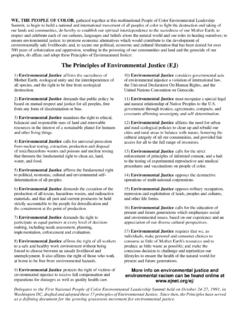
1 222 United Nations Environment ProgrammeUFRGSMUN | UFRGS Model United Nations Journal ISSN: 2318-3195 | v1, 2013| JusticeMarina de Oliveira FingerFelipe Bortoncello Zorzi1. Historical backgroundTh e Environmental Justice movement has been inspired by diff erent sources around the world. Europeans have used Marxian thinking on class hierarchy, non-Western nations sought its inspiration in the critiques of colonialism and the Civil Rights Movement was its precursor in the United States of America (Keller 2011). Th e concept of Environmental Justice , though, has its origins in the struggles of color communities and lower income-communities against uneven Environmental burdens in the United States of America in the late 70 s and early 80 s.
2 In the context of racial progress and civic activism, the term was used to designate the racial and ethnic inequalities in exposure to Environmental hazard (pollutions, toxic waste, fl ooding) and, at the same time, the exclusion of minority groups, like African Americans, Hispanics and Native Americans, from the decision making and application of national Environmental policies (Laurent, Environmental Justice and Environmental Inequalties: an European Perspective 2010). Th e term environment was given then a diff erent meaning. Instead of that of the traditional Environmental movement, accused of not properly addressing the environment as people of color and the poor experience it, it was redefi ned as the place where people live, work and play (Loh 2012).
3 Advocates of the cause began to concentrate extensively on the matter of equity, or either equities. In most of Environmental Justice missions, three broad categories of equity started appearing as important topics: procedural, geographic and social equities. Procedural equity is concerned about nondiscriminatory manner or fairness on the appliances of governing rules, regulations, evaluation criteria and enforcement of Environmental policies. Geographic equity focuses on the location of communities and their proximity to Environmental hazards, noxious facilities and discriminatory land uses. Th e third one refers to the role of sociological factors (race, ethnicity, class, culture, life styles, political power, etc) in Environmental decision making (Bullard, 2001).
4 Since then, the movement has united the most diverse social minority groups, like African Americans, Hispanic Americans, Native Americans and immigrants, as well as academics and many others. Besides, it has become a UFRGSMUN | UFRGS Model United Nations Journal 223global subject of debate from late 1990 s to early 2000 ning a particular moment in which the debate on Environmental Justice began is not an easy task, since the movement emerged from many diff erent particular events and social movements (Cole e Foster 2001). However, some events have had an important role in propelling the debate on the causes and consequences of progress over the diff erent minority and social e Civil Rights Movement is one of these early infl uences on the debate.
5 Th is movement of the 1950s, 1960s and 1970s demanded social changes and brought empowerment to hundreds of thousands of African Americans, mainly in southern United States of America, but in the northern urban areas as well. It was church based civil-rights leaders, like Rev. Dr. Martin Luther King, who were in the fore of the movement (Cole e Foster 2001). Th e perspective of the Civil Rights movement infl uenced the thinking on Environmental Justice regarding the disproportionate impact of Environmental hazards not as being random or consequence of neutral decisions, but as a result of the social and economical structure that had produced segregation and other types of racial aggression.
6 Some Civil Rights leaders denominated it as Environmental racism (Cole e Foster 2001).Th e fi rst mention to this Environmental racism dates back to the famous incident that took place in Warren County, North Carolina in 1982. It was an example of the impact of the Civil Rights Movement. Th is predominantly African American community mobilized itself against the building of a toxic waste landfi ll, having the support of the national faith-based organization called United Church of Christ (Loh 2012). Th ese protests, in which more than fi ve hundred people were arrested for civil disobedience, triggered other investigations in southern communities of the United States of America.
7 Th ey culminated in the Commission for Racial Justice of the United Church of Christ s 1987 study denominated Toxic Waste and Race in the United States , which represents a landmark of the Environmental Justice movement and highlights its roots in the civil rights struggles and its church background (Cole e Foster 2001). It showed that race was the most important indicator of the location of hazardous waste facilities all over the United States of America and that three out of fi ve Black and Hispanic Americans lived in a community with uncontrolled toxic waste (Loh 2012). Th e report is probably the most important document on the disproportionate hazards on ethnic minorities and the one that stimulated the movement the most (Cole e Foster 2001).
8 Th e mainstream environmentalist movement is another important tributary, by energetically emphasizing the great connection between humans and nature. By the 1960 s the Environmental movement saw a shift , because it realized that human action was wreaking the natural environment. Rachel Carson s 1962 book Silent Spring represents a defi ning moment for the traditional environmentalist movement. It called attention to the fact that, even though modern science and technology made life safer, healthier and more pleasant for mankind, the 224 United Nations Environment Programmephysical and biological environment was suff ering extensive damage (Newton, Environmental Justice 2009).
9 Environmental Justice activists say the mainstream Environmental movement has little relation to the Environmental Justice movement because of its white/Caucasian middle or upper class basis. Robert D. Bullard noted that it is unlikely that mainstream environmentalists would be strong advocates of the Environmental Justice movement, but they have shown that its fi ght can help to enhance general quality of life (Newton, Environmental Justice 2009). So Environmental Justice movement transcends the Environmental movement, being historically bonded to Environmental issues, but situated within the history of movements for social Justice (Cole e Foster 2001).
10 Another movement that has contributed to the debate on Environmental Justice is the Anti-Toxics movement, which represents communities that resisted and organized against hazardous waste facilities, landfi lls and incinerators. Its roots stand in the late 1970 s, when Jimmy Carter declared Love Canal, New York, a disaster area and evacuated the inhabitants of a former toxic waste dump (Cole e Foster 2001). Since then, the Citizens Clearinghouse of Hazardous Waste, an entity created by former inhabitants of Love Canal, has been assisting thousands of local groups to protest against toxic waste hazards. Anti-toxics movement have become more than local actions, participating eff ectively of the policy making debate through the idea of pollution prevention , which means eliminating the use of toxic chemicals in industries aiming at stopping the production of toxic waste (Cole e Foster 2001).