Transcription of Safe Harbor Explanation – Eligible Rollover …
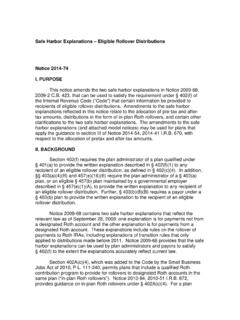
1 Part III Administrative, Procedural and Miscellaneous safe Harbor Explanation Eligible Rollover Distributions notice 2009 -68 I. PURPOSE This notice contains two safe Harbor explanations that may be provided to recipients of Eligible Rollover distributions from an employer plan in order to satisfy 402(f) of the Internal Revenue Code (Code). The first safe Harbor Explanation applies to a distribution not from a designated Roth account (as described in 402A). The second safe Harbor Explanation applies to a distribution from a designated Roth account. These safe Harbor explanations update the safe Harbor explanations that were published in notice 2002-3, 2002-1 289, to reflect changes in the law.
2 These safe Harbor explanations also reorganize and simplify the presentation of the information. II. BACKGROUND Section 402(f) requires the plan administrator of a plan qualified under 401(a) to provide a written Explanation to any recipient of an Eligible Rollover distribution, as defined in 402(c)(4). In addition, 403(a)(4)(B) and 457(e)(16)(B) require a plan administrator of a 403(a) plan, or an Eligible 457(b) plan maintained by a governmental employer described in 457(e)(1)(A) (governmental 457(b) plan), to provide a written Explanation to any recipient of an Eligible Rollover distribution. Further, 403(b)(8)(B) requires a payor under a 403(b) plan to provide a written Explanation to the recipient of an Eligible Rollover distribution.
3 2An Eligible Rollover distribution is a payment that may be rolled over to an Eligible retirement plan, as defined in 402(c)(8)(B). The term Eligible retirement plan means an individual retirement plan or an Eligible employer plan. An individual retirement plan (IRA) is defined in 7701(a)(37) as an individual retirement account described in 408(a) or an individual retirement annuity described in 408(b). For purposes of this notice , the term Eligible employer plan means: a plan qualified under 401(a), including a money purchase pension plan, a profit-sharing or stock bonus plan (whether or not the plan includes a qualified cash or deferred arrangement under 401(k)), and a defined benefit plan; a 403(a) plan; a 403(b) plan; or a governmental 457(b) plan.
4 The written Explanation must describe the direct Rollover rules, the mandatory income tax withholding rules for distributions not directly rolled over, the tax treatment of distributions not rolled over, and when distributions may be subject to different restrictions and tax consequences after being rolled over. Section 402(f) provides that this Explanation must be given within a reasonable period of time before the plan makes an Eligible Rollover distribution. Under (f)-1, A-5, of the Income Tax Regulations, the requirements of 402(f) are satisfied if this Explanation ( 402(f) notice ) is provided through the use of an electronic medium that complies with the requirements of (a)-21.
5 This Explanation should be provided only to participants who are Eligible to receive distributions that are Eligible Rollover distributions. Section (f)-1, A-1(b), provides that a plan administrator is deemed to have complied with the requirement that a 402(f) notice contain certain specified information if the plan administrator provides the applicable model 402(f) notice published by the IRS. The safe Harbor explanations in this notice constitute applicable model 402(f) notices for this purpose. 3 This notice provides updated safe Harbor explanations that reflect changes made to the Code that affect the information required to be provided in a 402(f) notice , including sections 617 and 657 of the Economic Growth and Tax Relief Reconciliation Act of 2001 (EGTRRA), , and sections 824, 827, 828, 829, and 845 of the Pension Protection Act of 2006 (PPA 06), 109-280.
6 Section 617(a) of EGTRRA added 402A of the Code, which allows a plan to permit an employee who makes elective contributions under a qualified cash or deferred arrangement to designate some or all of those contributions as designated Roth Section 402A(c)(3) provides that a Rollover contribution of any payment or distribution to an individual from a designated Roth account may be made only if the contribution is to another designated Roth account of the individual or to a Roth IRA of the individual. Section 657 of EGTRRA amended 401(a)(31)(B) of the Code to require that a mandatory distribution of more than $1,000 from a plan qualified under 401(a) be paid in a direct Rollover to an IRA of a designated trustee or issuer if the distributee does not make an affirmative election to have the amount paid in a direct Rollover to an Eligible retirement plan or to receive the distribution directly.
7 Section 403(a) plans, 403(b) plans, and governmental 457(b) plans are also required to comply with 401(a)(31)(B). Section 824 of PPA 06 amended the definition of qualified Rollover contribution in 408A of the Code (relating to rollovers to a Roth IRA) to include Rollover contributions from any Eligible retirement plan as defined in 402(c)(8)(B). Prior to this amendment, a Roth IRA 1 A designated Roth contribution is an elective contribution under a cash or deferred arrangement that is (i) designated by the employee at the time of the cash or deferred election as a designated Roth contribution that is being made in lieu of all or a portion of the pre-tax elective contribution the employee is Eligible to make under the plan, (ii)
8 Treated by the employer as includible in the employee s gross income at the time the employee would have received the amount in cash if the employee had not made the cash or deferred election, and (iii) maintained by the plan in a separate account. 4could only accept Rollover contributions from another Roth IRA, a non-Roth IRA, or a designated Roth account described in 402A. Section 408A(d)(3)(A) provides that a taxpayer who makes a Rollover to a Roth IRA from an Eligible employer plan that is not from a designated Roth account must include in gross income the amount of the Rollover contribution (other than after-tax contributions).
9 Such a Rollover to a Roth IRA is permitted only if the recipient s modified adjusted gross income for the year of the distribution does not exceed $100,000 and, if married, the recipient files a joint return. Pursuant to section 512 of the Tax Increase Prevention and Reconciliation Act of 2005 (TIPRA), 109-222, the $100,000 income and joint filing requirements do not apply to distributions made after 2009 . Section 408A(d)(3)(A), as modified by TIPRA, provides that, in the absence of a contrary election, the amount otherwise required to be included in gross income for any taxable year beginning in 2010 is included in gross income ratably over the 2-year period beginning in 2011.
10 For distributions after 2010, the amount required to be included in income as a result of the distribution being rolled over to a Roth IRA is included in gross income in the year of the distribution. Under 72(t)(2)(G) of the Code (as added by section 827 of PPA 06 and modified by section 107 of the Heroes Earnings Assistance and Relief Tax Act of 2008, 110-245), the 10% additional income tax on early distributions described in 72(t) does not apply to a qualified reservist distribution. A qualified reservist distribution generally means a distribution from an IRA, or from amounts attributable to employer contributions made as elective deferrals described in 402(g)(3)(A) or (C) or 501(c)(18)(D)(iii), made to an individual who was called to active duty for a period in excess of 179 days.