Transcription of STUDY GUIDE LINK 7 - Sapling Learning
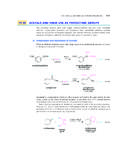
1 STEREOCHEMISTRY OF CHEMICAL REACTIONS305 The trans diastereomer can exist as a pair of enantiomers , and the two enantiomers of the cis di-astereomer are rapidly equilibrated by the chair interconversion and cannot be separated ( ). Hence, three potentially separable stereoisomers could be formed: the cis isomer and thetwo enantiomers of the trans isomer. Because the cis and trans isomers are diastereomers, they areformed in different amounts. (You can t predict at this point which one predominates, but we ll re-turn to that issue in Sec. ) The two enantiomers of the trans diastereomer must be formed inidentical amounts. Thus, whatever the amount of the trans isomer we obtain from the reaction, itis obtained as the racemate a 50:50 mixture of the two OF CHEMICAL REACTIONSAt this point, it may seem that stereochemistry adds a complicated new dimension to the studyand practice of organic chemistry.
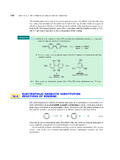
2 To some extent, this is true. No chemical structure is com-plete without stereochemical detail, and no chemical reaction can be planned without consid-ering problems of stereochemistry that might arise. This section examines the possible stere-ochemical outcomes of two general types of reaction: addition reactions and substitutionreactions. Then, some addition reactions covered in Chapter 5 will be revisited with particularattention to their Stereochemistry of Addition ReactionsRecall that an addition reactionis a reaction in which a general species XLY adds to eachend of a bond. The cases we ve studied so far involve addition to double bonds:An addition reaction can occur in either of two stereochemically different ways, called syn-additionand will be illustrated with cyclohexene and a general stereochemistry of addition to a double bond is discussed with reference to the planethat contains the double bond and its four attached groups.
3 The sides of this plane are side of the plane nearest the observer is the top face,and the other side is the bot-tom face.( )CACXXLLLYYMMMMCCL+ stereoisomeric products are possible when cis-2-butene undergoes bromine addition?Which are formed in different amounts? Which are formed in the same amounts? What stereoisomeric products are possible when trans-2-butene undergoes hydrobora-tion oxidation? Which are formed in different amounts? Which are formed in the sameamounts? all the possible products that might form when racemic 3-methylcyclohexene reactswith Br2. What is the relationship of each pair?
4 Which compounds should in principle beformed in the same amounts, and which in different amounts? GUIDE LINK of 12/8/08 12:13 PM Page 305306 CHAPTER 7 CYCLIC COMPOUNDS. STEREOCHEMISTRY OF REACTIONSIn a syn-addition,two groups add to a double bond from the same face:Syn-addition:In an anti-addition,two groups add to a double bond from opposite faces:Anti-addition:It is also conceivable that an addition might occur as a mixture of syn and anti modes. Insuch a reaction, the products would be a mixture of all of the products in both Eqs. of both syn-and anti-additions, as well as mixed additions, will be examined laterin this Eqs.
5 B suggest, the syn and anti modes of addition can be distinguished by ana-lyzing the stereochemistry of the products. In Eq. , for example, the cis relationship of thegroups X and Y in the product would tell us that a syn-addition has occurred. Thus, the stere-ochemistry of an addition can be determined only when the stereochemically different modesof addition give rise to stereochemically different products. Thus, when two groups X and Yadd to ethylene (H2 CACH2), the same product (XLCH2 LCH2LY) results whether the re-action is a syn-or an anti-addition. Because this product can t exist as stereoisomers, we can ttell whether the addition is syn or anti.
6 A more general way of stating the same point is to saythat syn-and anti-additions give different products only when bothcarbons of the double bondbecome carbon stereocenters in the product. If you stop and think about it, this should makesense, because the question of syn-and anti-addition is a question of the relative stereochem-istry at bothcarbons, and the relative stereochemistry cannot be determined if both carbonsaren t Stereochemistry of Substitution ReactionsIn a substitution reaction,one group is replaced by another. In the following substitution re-action, for example, the Br is replaced by OH:( )H3CL+OH_311311 BrH3CL+OH113311Br_( )XXYY``y++X adds from top face;Y adds from bottom faceX adds from bottom face.
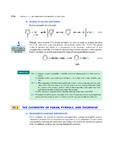
7 Y adds from top faceXYL( )XXYY``y++X and Y add fromthe top faceX and Y add fromthe bottom faceXYL( )observerbottom faceplane of the double bondtop 12/8/08 12:13 PM Page STEREOCHEMISTRY OF CHEMICAL REACTIONS307 The oxidation step of hydroboration oxidation is also a substitution reaction in which theboron is replaced by an OH substitution reaction can occur in two stereochemically different ways, called retentionof configurationand inversion of configuration. When a group X9replaces another group Xwith retention of configuration,then X and X9have the same relative stereochemical posi-tions. Thus, in the following example, if X is cis to Y, then X9is also cis to with retention of configuration:Substitution with retention also implies that if X and X9have the same relative priorities in theR,Ssystem, then the carbon that undergoes substitution will have the same configuration in thereactant and the product.
8 Thus, if this carbon has (for example) the Rconfiguration in the start-ing material, it has the same, or R, configuration in the substitution occurs with inversion of configuration,then X and X9have differentrelative stereochemical positions. Thus, if X is cis to Y in the starting material, X9is trans toY in the product:Substitution with inversion of configuration:Substitution with inversion also implies that if X and X9have the same relative priorities in theR,Ssystem, then the carbon that undergoes substitution must have opposite configurations inthe reactant and the product. Thus, if this carbon has (for example) the Rconfiguration in thestarting material, it has the opposite, or S, configuration in the with addition, it is also possible that a reaction might occur so that both retention andinversion can occur at comparable rates in a substitution reaction.
9 In such a case, stereoiso-meric products corresponding to both pathways will be formed. Examples of substitution re-actions with inversion, retention, and mixed stereochemistry are all well Eqs. b suggest, analysis of the stereochemistry of substitution requires that thecarbon that undergoes substitution must be a stereocenter in both the reactants and the prod-ucts. For example, in the following situation, the stereochemistry of substitution cannot the carbon that undergoes substitution is not a stereocenter, the same product is ob-tained from both the retention and inversion modes of substitution.( )X`X!`X!`substitution by X!
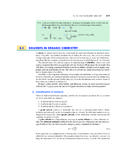
10 With retentionsubstitution by X! with inversionsame compoundnot astereocenter( )`XY`X!Yreplace X with X!( )XY`replace X with X!X!Y`( )_OH3 HOOHL++(CH3CH2)3B3 CH3CH2 OHL+_B(OH) 12/8/08 12:13 PM Page 307308 CHAPTER 7 CYCLIC COMPOUNDS. STEREOCHEMISTRY OF REACTIONSA reaction in which particular stereoisomers of the product are formed in significant excessover others is said to be a stereoselective , an addition that occurs only withanti stereochemistry, as shown in Eq. , is a stereoselective reaction because only one pairof enantiomers is formed to the exclusion of a diastereomeric pair. A substitution that occursonly with inversion, as shown in Eq.