
Chapter 9 Metal-Semiconductor Contacts
9.2 Thermionic Emission Theory / / 2 0 2 / / 3 2 ( )/ 3/2 2 ( )/,where 100 A/cm 4 2 1 3 / 2 / 2 2 q kT o qV kT n q kT qV kT S M thx th n thx n q V kT n q V kT c B B B B J e J e T e e h qm k J qnv v kT m v kT m e h m kT n N e
Download Chapter 9 Metal-Semiconductor Contacts

Information
Domain:
Source:
Link to this page:
Documents from same domain
Diodes and Transistors
inst.eecs.berkeley.eduDiodes and Transistors 1. ... basic semiconductor physics. We won’t discuss the details because the point of this ... switch. Below the specified ...
HSPICE Tutorial - University of California, Berkeley
inst.eecs.berkeley.eduHSPICE Tutorial Contents 1 Introduction 1 ... ee105 spice tutorial example 1 - simple rc circuit in the Results Browser and double-clicking vs and vo to plot them in the graph. You may have been able to guess from the netlist, but you’ll see that vsis a …
Introduction to LabVIEW - University of California, …
inst.eecs.berkeley.eduIntroduction to LabVIEW 1. Introduction Welcome to the LabVIEW component of EE100! This lab is just a simple introduction to the graphical circuit simulation ...
Introduction to LabVIEW For Use in Embedded …
inst.eecs.berkeley.eduUC Berkeley EE249 Hugo.Andrade@ni.com Introduction to LabVIEW For Use in Embedded System Development
EE105 –Fall 2015 Microelectronic Devices and Circuits
inst.eecs.berkeley.eduSummary of MOS Single-Transistor Amplifiers MOS Common Source Common Source with Deg. Common Drain Common Gate Ri ∞ ∞ ∞ Small Ro Large Very Large Small Large
Introduction to Digital Systems - University of …
inst.eecs.berkeley.eduDepartment of EECS EE100/42-43 Spring 2007 Rev. 1 Introduction to Digital Systems 0. Acknowledgments Many thanks to Prof. Bernhard Boser and National Instruments for funding this project in the
EE126: Probability and Random Processes - Lecture 1 ...
inst.eecs.berkeley.eduprobability 4 The probabilities summed over all of the base outcomes always equals 1 Example: Toss a fair coin twice 1 Base outcomes are HH,HT,TH,TT 2 This covers all the possibilities. M.E. 3 Each of these outcomes is equally likely 4 Assign each outcome a probability of 0:25. The list (set) of base outcomes is called the Sample Space.
EECS 126 Probability and Random Processes: Course Syllabus ...
inst.eecs.berkeley.eduDescription: Probability is a mathematical discipline that allows one to reason about uncertainty: it helps us to predict uncertain events, to make better decisions under uncertainty, and to design and build systems. Throughout the course, we will teach you the fundamental ideas of probability and random processes along with the labs.

3-Phase Brushless DC Motor Pre-Driver
inst.eecs.berkeley.eduDescription The A4931 is a complete 3-phase brushless DC motor pre-driver . The device is capable of driving a wide range of N-channel power MOSFETs and can support motor supply voltages up to
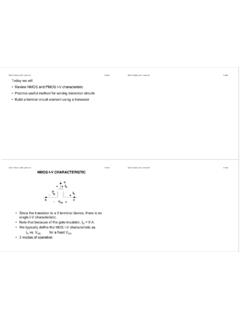
DS -V I G - EECS Instructional Support Group Home Page
inst.eecs.berkeley.eduG D S I D I G-V DS + + V G S _ NMOS I-V CHARACTERISTIC • Since the transistor is a 3-terminal device, there is no single I-V characteristic. • Note that because of the gate insulator, I G = 0 A. • We typically define the MOS I-V characteristic as I D vs. V DS for a fixed V GS. • 3 modes of operation
Related documents
Physical Chemistry of Surfaces - sciencenet.cn
image.sciencenet.cnThermionic Work Function 208 C. Electrode Potentials 209 D. Irreversible Electrode Phenomena 212 10. Problems 215 General References 217 Textual References 218 VI. Long-Range Forces 225 1. Introduction 225 2. Forces between Atoms and Molecules 226 3. Long-Range Forces 232 A. The Microscopic Approach 232 B. The Retarded Dispersion Interaction 234

5: Thermionic Emission
www.physics.csbsju.eduThermionic Emission 103 where V(x) is the potential difference (“voltage”) at xand mis the mass of an electron. Because the accelerating electrons constitute a steady current (i.e., J
Electron Diffraction - Boston University
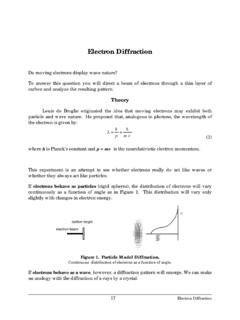
physics.bu.eduthe cathode. Electrons are ejected by thermionic emission from this heated piece of metal (see Figure 4). Once emitted, the electrons are accelerated by two pairs of anode rings. You apply an adjustable acceleration potential Va (2000-4000 V dc) with the kilovolt power supply between the cathode (-) and anode (+). This accelerates electrons to ...
주사전자현미경의 기본원리와 응용(Part Ⅱ
www.cheric.orgSEM의 전자총에는 열방사형(thermionic electron gun)과 전계방사형(field emission electron gun)으 Figure 2. Hair Pin 형태의 열방사형 전자총의 모식도[9]. 로 나뉘어진다. 열방사형(thermal emission)의 경우 음극은 주로 텅스텐으로 약 100 µm 직경의 선 필라멘트로서

Metal/Semiconductor Ohmic Contacts - Stanford University
web.stanford.edu(1) Thermionic emission (TE), occurring in the case of a depletion region so wide that the only way for electrons to jump the potential barrier is by emission over its maximum (Fig. 3a). The barrier height is reduced from its original value as a result of image force barrier lowering.

Class Notes of BET102 Basic Electronics Engineering Common ...
sctevtservices.nic.in2. Field Emission - (Due to application of strong electric field) 3. Secondary Emission – (due to bombardment of high-speed electrons) 4. Photo Electric Emission – (by the application of light) 1. Thermionic Emission The process of electron emission from a metal surface by supplying thermal energy to it is known as Thermionic emission.

X-ray tube design The Production and Properties
www.utoledo.eduthermionic emission (V f ~ 10V, I f ~ 4A, resulting in T>2000oC) • X rays are produced by high-speed electrons bombarding the target • Typically < 1% of energy is converted to x rays; the rest is heat Figure 2-1 (a). Schematic diagram of x-ray tube and circuit V f X-ray tube current • Electron cloud near the filament creates space charge ...