Transcription of ANOTHER LOOK AT THE COVALENT BOND: …
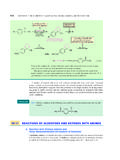
1 32 CHAPTER 1 CHEMICAL BONDING AND CHEMICAL STRUCTUREAs shown in the diagram, the 3sand 3pelectrons are the valence electrons of sulfur; the 3sand 3porbitals are the valence LOOK AT THE COVALENT BOND: MOLECULAR ORBITALSA. Molecular Orbital TheoryOne way to think about chemical bonding is to assume that a bond consists of two electronslocalized between two specific atoms. This is the simplest view of a Lewis electron-pair useful as this picture is, it is sometimes too restrictive. When atoms combine into a mole-cule, the electrons contributed to the chemical bonds by each atom are no longer localized onindividual atoms but belong to the entire molecule. Consequently, atomic orbitals are nolonger appropriate descriptions for the state of electrons in molecules. Instead, molecular or-bitals, nicknamed MOs,which are orbitals for the entire molecule,are used. Determining the electronic configuration of a molecule is a lot like determining the elec-tronic configuration of an atom, except that molecular orbitals are used instead of atomic or-bitals.
2 The following four steps summarize conceptually how we start with two isolated hy-drogen atoms and end up with the electronic configuration of the dihydrogen molecule, with the isolated atoms of the molecule and bring them together to the positionsthat they have in the molecule. Their valence atomic orbitals will H2, this means bringing the two hydrogen atoms together until the nuclei are separated bythe length of the HLH bond (Fig. ). At this distance, the 1sorbitals of the atoms the overlapping valence atomic orbitals to interact to form molecular orbitals (MOs). This step implies that MOs of H2are derived by combining the 1satomic orbitals of the twohydrogen atoms in a certain way. Conceptually, this is reasonable: molecules result from acombination of atoms, so molecular orbitals result from a combination of atomic l l s h o r t l y l e a r n t h e p r o c e s s f o r c o m b i n i n g a t o m i c o r b i t a l s t o f o r m m o l e c u l a r o r b i t a l s.
3 Give the electronic configurations of each of the following atoms and ions. Identify thevalence electrons and valence orbitals in each.(a)oxygen atom (b) chloride ion, Cl_(c)potassium ion, K|(d) sodium atom PROBLEMLL LL LL3p3s2p2s1ssulfur, S: (1s)2(2s)2(2p)6(3s)2(3px)2(3py)1(3pz)1LL LL 12/8/08 11:48 AM Page ANOTHER LOOK AT THE COVALENT BOND: MOLECULAR ORBITALS33 Step the MOs in order of increasing 1 and 2 will yield two MOs for H2that differ in energy. We ll also learn how to deter-mine relative energies of these the electronic configuration of the molecule by redistributing the electronsfrom the constituent atoms into the MOs in order of increasing MO energy; the Pauliprinciple and Hund s rules are r e d i s t r i bu t e t h e t wo e l e c t r o n s ( o n e f r o m e a c h s t a r t i n g h y d r o g e n a t o m ) i n t o t h e M O s o f H2to give the electronic configuration of the to carry out steps 2 and 3 is the key to understanding the formation of molecular or-bitals.
4 Quantum theory gives us a few simple rules that allow us to derive the essential featuresof molecular orbitals without any calculations. We ll state these rules as they apply to H2andother cases involving the overlap of two atomic orbitals . (These rules will require only slightmodification for more complex cases.)bring atoms togetherto the bonding distance1s orbitalsnucleimolecular orbitalsare formedoverlapping orbitals interactorbitals overlapaddbonding molecularorbital for H21s orbitals1s orbitals (a)(b)addchange one peak to a troughantibonding molecularorbital for H2planar node(c)peak changed to troughFigure of H2molecular orbitals . (a) Two hydrogen atoms are brought to the HLH bonding dis-tance so that the 1sorbitals overlap. Interaction of these atomic orbitals forms the molecular orbitals . (b) To formthe bonding MO of H2,addthe1sorbital wavefunctions of the interacting hydrogen atoms. (c) To form the anti-bonding MO of H2,subtractthe1sorbital wavefunctions by changing one peak to a trough and then adding.
5 Thisprocess results in a node in the antibonding 12/8/08 11:48 AM Page 3334 CHAPTER 1 CHEMICAL BONDING AND CHEMICAL STRUCTURER ules for forming molecular combination of two atomic orbitals gives two molecular H2, this rule means that the overlap of two 1sorbitals from the constituent hydro-gen atoms gives two molecular orbitals . Later, we ll have situations in which we com-bine more than two atomic orbitals . When we combine jatomic orbitals , we always ob-tain jmolecular molecular orbital is derived by the addition of the two atomic orbitals in the regionof a p p l y t h i s t o H2, remember that the 1sorbital is a wave peak. When we add twowave peaks, they reinforce. When we add two 1sorbitals in the overlap region, they re-inforce to form a continuous orbital that includes the region between the two nuclei ( ). This molecular orbital is called a bonding molecular orbital, or bonding reason for the name is that, when electrons occupy this MO, they are attracted to bothnuclei simultaneously.
6 In other words, the electrons occupy not only the region aroundthe nuclei but also the region between the nuclei, thus providing electron cement thatholds the nuclei together, just as mortar between two bricks holds the bricks other molecular orbital is derived by subtraction of the two atomic orbitals in theregion of s u b t r a c t t h e t wo 1sorbitals, we change one of the 1sorbitals from a peak to atrough. (This is equivalent to changing the mathematical sign of the 1swavefunction.)Then we add the two resulting orbitals . This process is illustrated in Fig. Addinga wave peak to a wave trough results in cancellationof the two waves in the region ofoverlap and formation of a node a region in which the wave is zero. In this case, thenode is a plane. The resulting orbital is called an antibonding molecular orbitalor an-tibonding MO. Electrons that occupy this MO decrease bonding because the region be-tween the nuclei contains no electron two molecular orbitals have different energies.
7 Orbital energy increases with thenumber of nodes. The bonding MO has a lower energy than the isolated 1s orbitals andthe antibonding MO has a higher energy than the isolated 1s orbital energies are summarized in an orbital interaction diagram, shown inFig. This diagram is a plot of orbital energy versus the position of the two interact-ing nuclei. The isolated atomic orbitals and their energies are shown on the left and rightsides of the diagram, and the molecular orbitals and their energies are shown in the cen-ter, where the separation of the atoms corresponds to the bond length. The number ofnodes tells us the relative energies of the MOs:the more nodes an MO has, the higher isits energy. The bonding MO has no nodes and therefore has the lower energy. The anti-bonding MO has one node and has the higher energy. Notice that the energies of the twoMOs spread about the energy of the isolated 1sorbitals the energy of the bondingMO is lowered by a certain amount and the energy of the antibonding MO is raised bythe same that we ve described how to form the MOs and rank their energies, we re ready topopulate these MOs with electrons.
8 We apply the aufbau principle. We have two electrons one from each hydrogen atom to redistribute. Both can be placed in the bonding MO withopposite spins. Electron occupancy of the bonding MO is also shown in Fig. we talk about the energy of an orbital, what we are really talking about is the energyof an electron that occupies the orbital. It follows, then, that the electrons in the bonding MOhave lower energy than two electrons in their parent 1sorbitals. In other words, chemical bond-ing is an energetically favorable process. Each electron in the bonding MO of H2contributesabout half to the stability of the HLH bond. It takes about 435 kJ (104 kcal) to dissociate amole of H2into hydrogen atoms, or about 218 kJ (52 kcal) per bonding electron. This a lot 12/8/08 11:48 AM Page ANOTHER LOOK AT THE COVALENT BOND: MOLECULAR ORBITALS35energy on a chemical scale more than enough to raise the temperature of a kilogram of waterfrom freezing to to the picture just developed, the chemical bond in a hydrogen molecule resultsfrom the occupancy of a bonding molecular orbital by two electrons.
9 You may wonder why weconcern ourselves with the antibonding molecular orbital if it is not occupied. The reason isthat it canbe occupied! If a third electron were introduced into the hydrogen molecule, thenthe antibonding molecular orbital would be occupied. The resulting three-electron species isthe hydrogen molecule anion, H2_(see Prob. , p. 36). H2_exists because each electron inthe bonding molecular orbital of the hydrogen molecule contributes equally to the stability ofthe molecule. The third electron in H2_, the one in the antibonding molecular orbital, has a highenergy that offsets the stabilization afforded by oneof the bonding electrons. However, thestabilization due to the second bonding electron remains. Thus, H2_is a stable species, but onlyabout half as stable as the hydrogen molecule. In terms of our brick-and-mortar analogy, ifelectrons in a bonding MO bind the two nuclei together as mortar binds two bricks, then elec-trons in an antibonding MO act as anti-mortar : not only do they notbind the two nuclei to-gether, but they oppose the binding effect of the bonding electrons.
10 The importance of the an-tibonding MO is particularly evident when we attempt to construct diatomic helium, He2, asshown in Study Problem ENERGY electron occupancyANTIBONDINGMOLECULAR ORBITALBONDINGMOLECULAR ORBITAL energy of isolated1s orbitals1s orbital1s orbitalnodenuclear position0+ Figure orbital interaction diagram for the formation of the H2molecular orbitals from interacting 1s or-bitals of two hydrogen atoms. The dashed lines show schematically how the two 1sorbitals interact as the inter-nuclear distance changes from very large (6`) to the HLH bond bonding MO has lower energy thanthe 1sorbitals and the antibonding MO has higher energy. Both electrons occupy the bonding 12/8/08 11:48 AM Page 3536 CHAPTER 1 CHEMICAL BONDING AND CHEMICAL STRUCTURES tudy Problem molecular orbital theory to explain why He2does not exist. The molecular orbitals of He2areformed in the same way as those of orbital interaction diagram for the MOs of He2is conceptually the same as for H2(Fig.)